World Book
Bosnia and Herzegovina
World Book Index
72

With a score of 72, the country is ranked 54th out of 158 countries in the World Book ranking. (more information)
Introduction
Bosnia and Herzegovina, a country rich in history and cultural diversity, has undergone significant transformations over the past century. Once part of the Austro-Hungarian Empire from 1878 to 1918, it later joined the Kingdom of Serbs, Croats, and Slovenes. Following World War II, Bosnia and Herzegovina became a constituent republic of the Socialist Federal Republic of Yugoslavia (SFRY). The quest for independence culminated in 1992, leading to a devastating three-year interethnic conflict that reshaped the nation. Today, Bosnia and Herzegovina stands as a candidate for European Union membership, a testament to its ongoing journey towards integration and stability in the region.
Neighboring countries
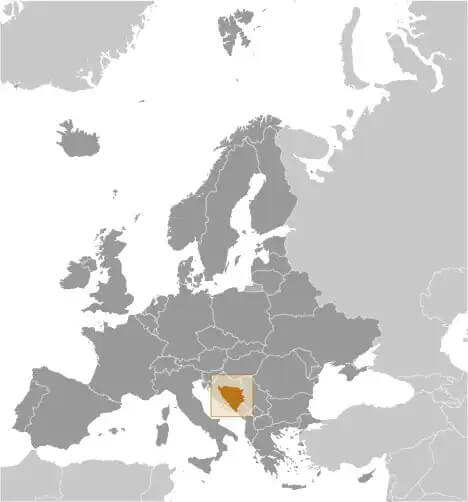
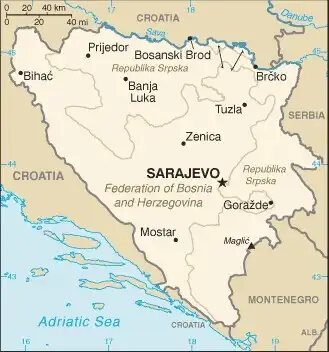
Croatia - Montenegro - Serbia
Geography
Area
Total: 51,197 sq km
Land: 51,187 sq km
Water: 10 sq km
Bosnia and Herzegovina is characterized by its diverse topography, which includes mountainous regions, valleys, and rivers. The country is predominantly hilly and mountainous, with the Dinaric Alps running through its central and western parts. This geographical diversity contributes to a variety of climates, ranging from hot summers and cold winters in the lowlands to cooler temperatures in the elevated areas. The country also boasts a mild, rainy climate along its coastal regions, enhancing its natural beauty and ecological diversity. The rich natural resources, including coal, iron ore, and hydropower, play a crucial role in the country's economic potential and development.
People and Society
Population
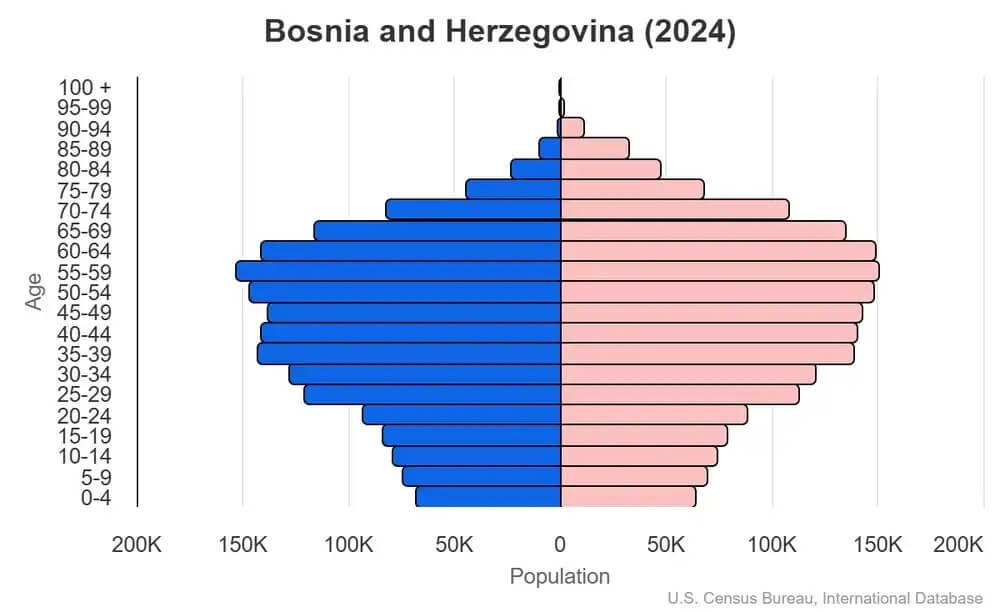
Total: 3,798,671 (2024 estimated)
Bosnia and Herzegovina is a mosaic of ethnicities and cultures, with the population primarily composed of Bosniaks (50.1%), Serbs (30.8%), and Croats (15.4%). This ethnic diversity is a defining feature of the nation, influencing its social dynamics and political landscape. The official languages reflect this diversity, with Bosnian (52.9%), Serbian (30.8%), and Croatian (14.6%) being spoken across the country. The religious composition is similarly varied, with Muslims constituting 50.7%, Orthodox Christians 30.7%, and Roman Catholics 15.2%. However, the country faces challenges such as a declining population growth rate of -0.25% (2024 estimated), which raises concerns about demographic sustainability and economic vitality in the years to come.
Government
Government type
Parliamentary republic
Capital
Name: Sarajevo
The governance structure of Bosnia and Herzegovina is characterized by a complex parliamentary republic system, which reflects the country's intricate ethnic composition. The executive branch is led by a tripartite presidency, consisting of representatives from the three main ethnic groups: the Chairperson of the Presidency, Zeljko KOMSIC (Croat seat), Denis BECIROVIC (Bosniak seat), and Zeljka CVIJANOVIC (Serb seat). The head of government is the Chairperson of the Council of Ministers, Borjana KRISTO, who has been in office since January 2023. This political framework aims to ensure representation and power-sharing among the diverse ethnic groups, although it also presents challenges in terms of governance and decision-making efficiency.
Diplomatic representation in the US
Chief of mission: Ambassador Sven ALKALAJ (since 30 June 2023)
Diplomatic representation from the US
Chief of mission: Ambassador (vacant); Chargé d’Affaires Daniel KOSKI (since February 2025)
Economy
Economic overview
Bosnia and Herzegovina's economy is characterized as import-dominated and remains heavily reliant on consumption. The lack of private sector investments and diversification poses significant structural challenges that hinder economic growth. The country is actively addressing these issues, with notable Chinese investments in energy infrastructure aimed at modernizing the sector. However, high unemployment rates persist, exacerbated by the impact of the COVID-19 pandemic on the tourism industry. The economic outlook remains cautious as the nation strives to enhance its economic resilience and attract foreign investment.
Real GDP (purchasing power parity)
$64.641 billion (2024 estimated)
$63.077 billion (2023 estimated)
$61.843 billion (2022 estimated)
Real GDP per capita
$20,400 (2024 estimated)
$19,800 (2023 estimated)
$19,300 (2022 estimated)
Exports
$12.141 billion (2024 estimated)
$12.126 billion (2023 estimated)
$11.838 billion (2022 estimated)
Exports - partners
Germany 15%, Croatia 14%, Serbia 12%, Austria 10%, Slovenia 9% (2023)
Exports - commodities
Footwear, electricity, garments, plastic products, insulated wire (2023)
Imports
$16.202 billion (2024 estimated)
$15.37 billion (2023 estimated)
$15.166 billion (2022 estimated)
Imports - partners
Italy 13%, Germany 11%, Serbia 11%, China 9%, Croatia 8% (2023)
Imports - commodities
Refined petroleum, cars, garments, plastic products, packaged medicine (2023)
Human Development Index
The country's Human Development Index (HDI) is 0.804, ranking it 74th out of 193 countries tested. (more information)
World Happiness Report
The World Happiness Report ranked the country 32nd out of 158 countries tested with a score of 6.491. (more information)