World Book
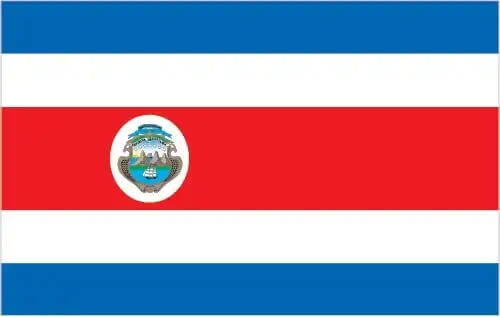
Costa Rica
World Book Index
76

With a score of 76, the country is ranked 30th out of 158 countries in the World Book ranking. (more information)
Introduction
Costa Rica, a beacon of stability and peace in Central America, proclaimed its independence from the United Provinces of Central America in 1838. Since then, it has cultivated a robust democratic tradition, with only two brief periods of violence disrupting its political landscape. The nation is renowned for its commitment to environmental sustainability and social welfare, maintaining a significant agricultural sector while simultaneously expanding into technology and tourism. This dual focus not only enhances its economic resilience but also positions Costa Rica as a leader in sustainable development in the region.
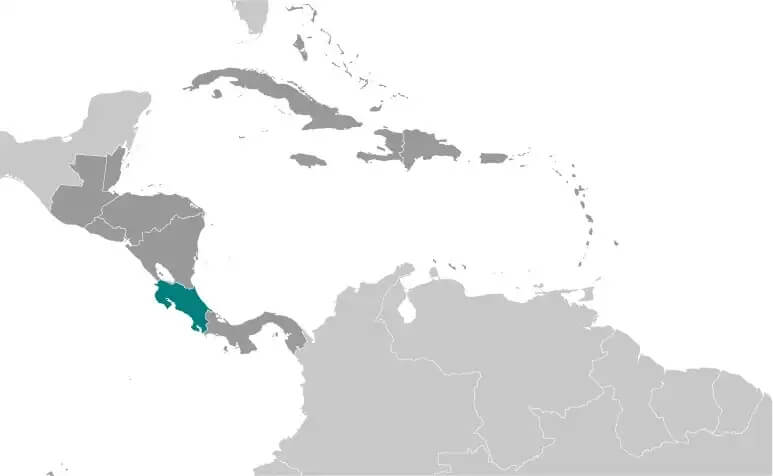
Neighboring countries
Nicaragua - Panama
Geography
Area
Total: 51,100 sq km
Land: 51,060 sq km
Water: 40 sq km
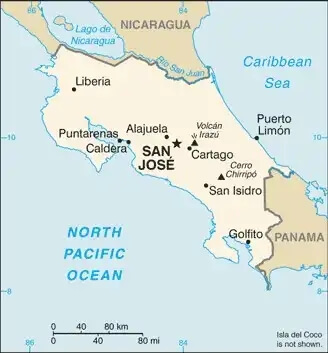
Costa Rica is strategically located in Central America, bordered by Nicaragua to the north and Panama to the south. The country's diverse geography encompasses a variety of ecosystems, from lush rainforests to arid plains, and features both Pacific and Caribbean coastlines. The climate is predominantly tropical and subtropical, characterized by a distinct dry season from December to April and a rainy season from May to November. The cooler highlands offer a contrasting climate, contributing to the rich biodiversity that Costa Rica is famous for. The nation is also endowed with significant natural resources, particularly in hydropower, which plays a crucial role in its energy infrastructure.
People and Society
Population
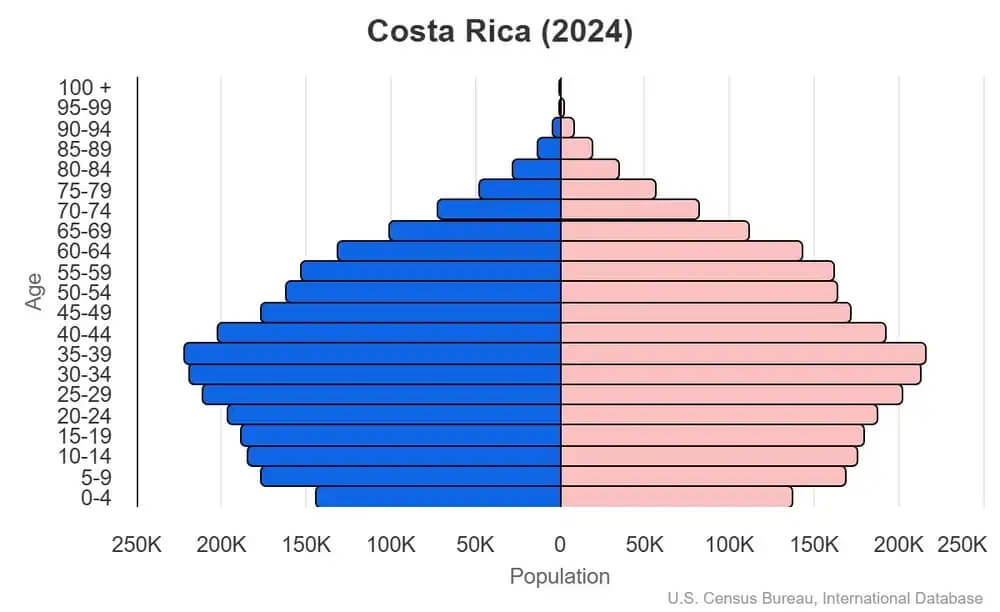
Total: 5,265,575 (2024 estimated)
Ethnic groups
White or Mestizo 83.6%, Mulatto 6.7%, Indigenous 2.4%, Black or African descent 1.1%, other 1.1%, none 2.9%, unspecified 2.2% (2011 estimated)
Languages
Spanish (official), English
Religions
Roman Catholic 47.5%, Evangelical and Pentecostal 19.8%, Jehovah's Witness 1.4%, other Protestant 1.2%, other 3.1%, none 27% (2021 estimated)
Population growth rate
0.74% (2024 estimated)
Costa Rica's population reflects a rich tapestry of ethnic diversity, with the majority identifying as White or Mestizo. The nation is predominantly Spanish-speaking, although English is also widely understood, particularly in tourist areas. The religious landscape is primarily Roman Catholic, yet there is a significant presence of Evangelical and Pentecostal communities, indicating a dynamic spiritual environment. The population growth rate of 0.74% suggests a stable demographic trend, which, combined with a relatively high standard of living, contributes to the overall social cohesion and quality of life in the country.
Government
Government type
Presidential republic
Capital
Name: San José
Executive branch
Chief of state: President Rodrigo CHAVES Robles (since 8 May 2022)
Head of government: President Rodrigo CHAVES Robles (since 8 May 2022)
Diplomatic representation in the US
Chief of mission: Ambassador Catalina CRESPO SANCHO (since 19 April 2023)
Diplomatic representation from the US
Chief of mission: Ambassador (vacant); Chargé d’Affaires Jennifer SAVAGE (since August 2025)
Costa Rica operates as a presidential republic, with a strong emphasis on democratic governance and civil liberties. The capital, San José, serves as the political and cultural heart of the nation. The executive branch is led by President Rodrigo CHAVES Robles, who has been in office since May 2022. The country maintains active diplomatic relations, particularly with the United States, where it is represented by Ambassador Catalina CRESPO SANCHO. This diplomatic engagement underscores Costa Rica's commitment to international cooperation and regional stability.
Economy
Economic overview
Costa Rica boasts a trade-based upper middle-income economy, recognized as a leader in the green economy movement, having successfully reversed deforestation trends. The country is investing in blue economy infrastructure, aiming to harness marine resources sustainably. While poverty levels had been declining, the impacts of COVID-19 have posed significant challenges, leading to a liquidity crisis exacerbated by lingering inequality and growing government debts. The nation is now focused on recovery and sustainable growth strategies to navigate these economic hurdles.
Real GDP (purchasing power parity)
$138.371 billion (2024 estimated)
$132.64 billion (2023 estimated)
$126.189 billion (2022 estimated)
Real GDP per capita
$27,000 (2024 estimated)
$26,000 (2023 estimated)
$24,800 (2022 estimated)
Exports
$36.77 billion (2024 estimated)
$33.683 billion (2023 estimated)
$29.392 billion (2022 estimated)
Exports - partners
USA 40%, Netherlands 6%, China 5%, Guatemala 4%, Belgium 3% (2023)
Exports - commodities
medical instruments, integrated circuits, orthopedic appliances, bananas, tropical fruits (2023)
Imports
$30.459 billion (2024 estimated)
$28.413 billion (2023 estimated)
$27.095 billion (2022 estimated)
Imports - partners
USA 38%, China 15%, Mexico 6%, Brazil 3%, Guatemala 3% (2023)
Imports - commodities
refined petroleum, plastic products, cars, medical instruments, broadcasting equipment (2023)
Human Development Index
The country's Human Development Index (HDI) is 0.833, ranking it 62th out of 193 countries tested. (more information)
World Happiness Report
The World Happiness Report ranked the country 11th out of 158 countries tested with a score of 7.057. (more information)