World Book
Gambia
World Book Index
48

With a score of 48, the country is ranked 133rd out of 158 countries in the World Book ranking. (more information)
Introduction
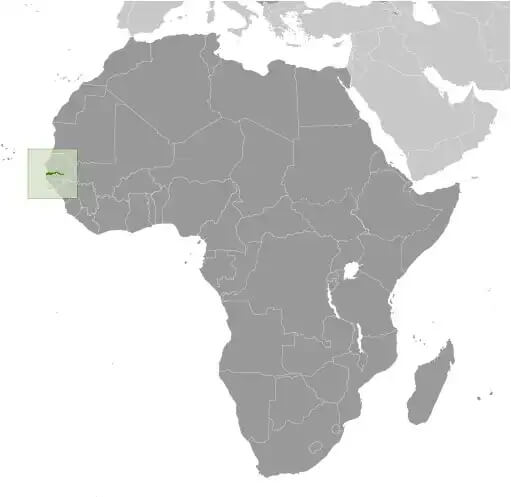
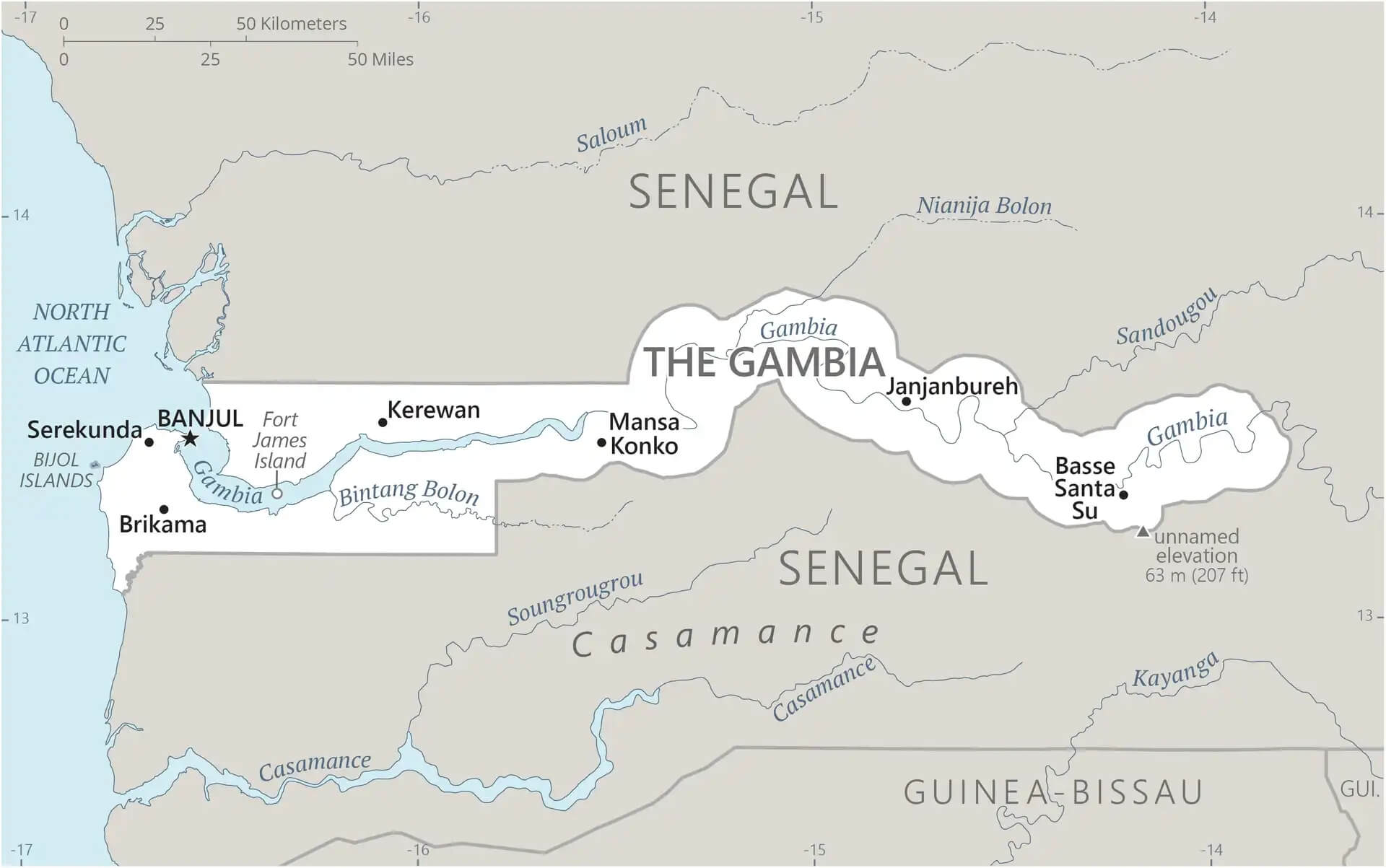
The Gambia, a small yet vibrant nation on the western coast of Africa, gained its independence from the United Kingdom in 1965. This historic moment marked the beginning of a journey towards self-determination and national identity. The Gambia's geographical position, bordered by Senegal on three sides and the Atlantic Ocean to the west, has shaped its cultural and political landscape. In a significant development, The Gambia joined Senegal to form a short-lived Confederation of Senegambia between 1982 and 1989, reflecting its intertwined history with its neighbor. Since the landmark presidential election in 2016, which was hailed as the first free and fair election in decades, The Gambia has experienced a renewed commitment to democratic governance and has fostered improved relations with the United States, signaling a hopeful trajectory for its future.
Neighboring country
Senegal
Geography
Area
Total: 11,300 sq km
Land: 10,120 sq km
Water: 1,180 sq km
The Gambia is characterized by its unique geographical features, primarily consisting of a narrow strip of land that follows the Gambia River. This river, which flows through the heart of the country, is vital for transportation, agriculture, and fishing. The country's total area of 11,300 sq km includes 10,120 sq km of land and 1,180 sq km of water bodies, making it one of the smallest countries in Africa. The climate is tropical, with a distinct hot and rainy season from June to November, followed by a cooler and dry season from November to May. This climatic pattern significantly influences agricultural practices, which are central to the Gambian economy. The Gambia is endowed with natural resources, including fish, clay, silica sand, titanium (rutile and ilmenite), tin, and zircon, which play a crucial role in its economic activities and development prospects.
People and Society
Population
Total: 2,523,327 (2024 estimated)
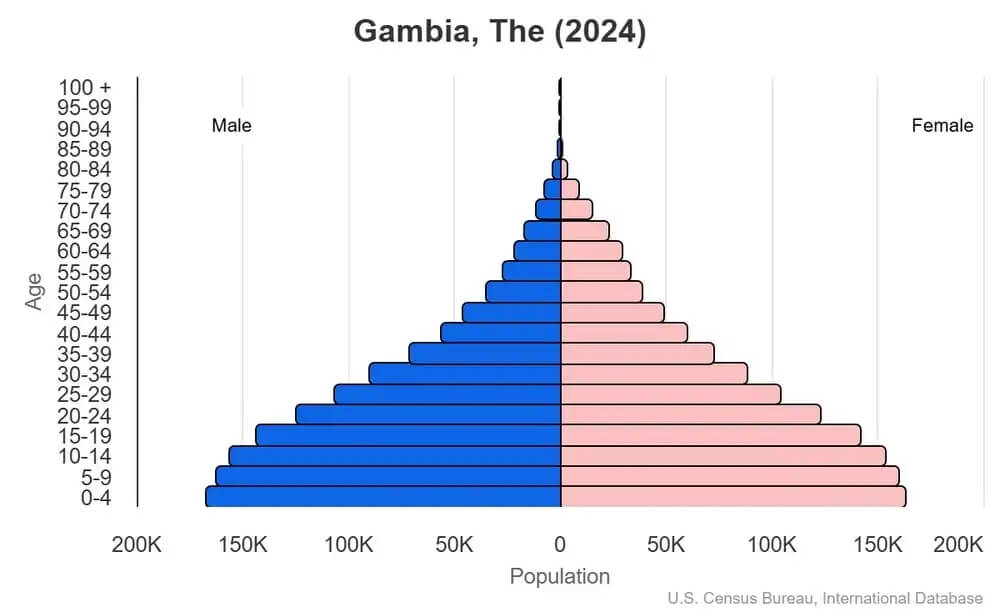
The Gambia's population, estimated at 2,523,327 in 2024, is a rich tapestry of ethnic diversity and cultural heritage. The major ethnic groups include the Mandinka/Jahanka (33.3%), Fulani/Tukulur/Lorobo (18.2%), Wolof (12.9%), Jola/Karoninka (11%), Serahuleh (7.2%), Serer (3.5%), and others (4%), with a notable non-Gambian population of 9.9% as of the 2019-20 estimate. This diversity is reflected in the country's languages, with English serving as the official language alongside indigenous vernaculars such as Mandinka, Wolof, and Fula. The predominant religion is Islam, practiced by 96.4% of the population, while Christians make up 3.5%, and other beliefs or non-religious individuals account for 0.1%. The population growth rate of 2.16% (2024 estimated) indicates a youthful demographic, which presents both opportunities and challenges for the country's development, particularly in education, employment, and healthcare.
Government
Government type
Presidential republic
Capital
Name: Banjul
The Gambia operates as a presidential republic, where the President serves as both the head of state and government. The capital city, Banjul, is the political and administrative center of the country. Since January 19, 2022, President Adama BARROW has been at the helm, leading the nation through a period of democratic consolidation and reform. The Vice President, Mohammed JALLOW, assumed office on February 23, 2024, contributing to the executive leadership. The Gambia maintains diplomatic relations with the United States, represented by Ambassador Momodou Lamin BAH, who has been in office since December 12, 2022. The diplomatic representation from the U.S. is currently led by Chargé d’Affaires Robert ANDERSON since August 22, 2025, highlighting the ongoing engagement between the two nations.
Economy
Economic overview
The Gambia's economy is classified as a low-income West African economy, heavily reliant on agriculture, which dominates its economic landscape. Despite its agricultural potential, the country faces significant challenges, including a high poverty rate and heightened inflation, which impact the livelihoods of its citizens. The economy's dependence on foreign assistance and remittances underscores its vulnerability to external shocks. Structural reforms are being implemented as part of the IMF Extended Credit Facility program, aimed at stabilizing the economy and promoting sustainable growth. The Real GDP (purchasing power parity) is estimated at $8.365 billion for 2024, reflecting a gradual recovery from previous years, with figures of $7.911 billion in 2023 and $7.549 billion in 2022. The Real GDP per capita stands at $3,000 for 2024, indicating the economic challenges faced by the population. Exports are projected to reach $838.409 million in 2024, with key partners including Kazakhstan (92%), Guinea-Bissau (2%), and others. The primary export commodities include packaged medicine, cars, harvesting machinery, refined petroleum, and trailers. Conversely, imports are expected to total $1.549 billion in 2024, with Kazakhstan (26%), China (18%), and Senegal (8%) being the main sources. The import commodities primarily consist of crude petroleum, refined petroleum, cotton fabric, iron alloys, and rice. This economic landscape highlights the need for diversification and resilience-building strategies to enhance The Gambia's economic stability and growth prospects.
Human Development Index
The country's Human Development Index (HDI) is 0.524, ranking it 170th out of 193 countries tested. (more information)
World Happiness Report
The World Happiness Report ranked the country 118th out of 158 countries tested with a score of 4.485. (more information)