World Book
Kosovo
Introduction
Kosovo, a land steeped in history and cultural significance, has undergone a tumultuous journey through the ages. Once a vital part of the Ottoman Empire from 1389 until 1912, it later became integrated into Serbia and subsequently Yugoslavia in 1945. The late 20th century was marked by conflict, particularly during the brutal counterinsurgency campaign against Kosovo Albanians in 1999, which prompted a NATO military intervention. This pivotal moment led to Kosovo's declaration of independence in 2008, a significant step towards self-determination. In recent years, Kosovo has sought to solidify its place on the European stage, formally applying for EU membership in 2022, reflecting its aspirations for greater integration and development within Europe.
Neighboring countries
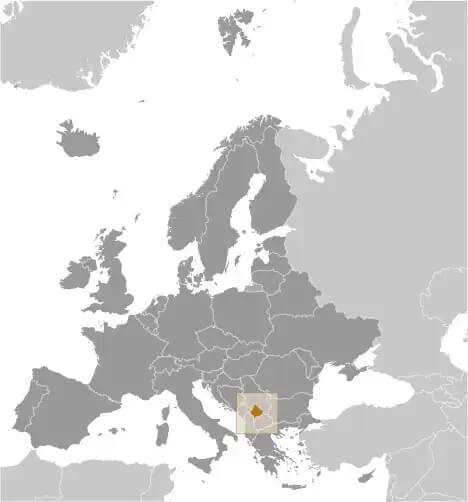
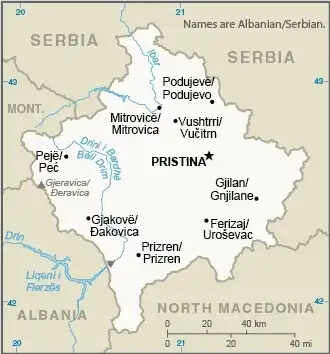
Albania - Montenegro - North Macedonia - Serbia
Geography
Area
Total: 10,887 sq km
Land: 10,887 sq km
Water: 0 sq km
Climate
Kosovo's climate is predominantly influenced by continental air masses, resulting in relatively cold winters characterized by heavy snowfall and hot, dry summers and autumns. The interplay of Mediterranean and alpine influences contributes to regional climatic variations, with the maximum rainfall typically occurring between October and December, shaping the agricultural patterns and natural ecosystems of the region.
Natural resources
The country is endowed with a variety of natural resources, including nickel, lead, zinc, magnesium, lignite, kaolin, chrome, and bauxite. These resources present opportunities for economic development and industrial growth, although their extraction and management remain critical challenges for sustainable development.
People and Society
Population
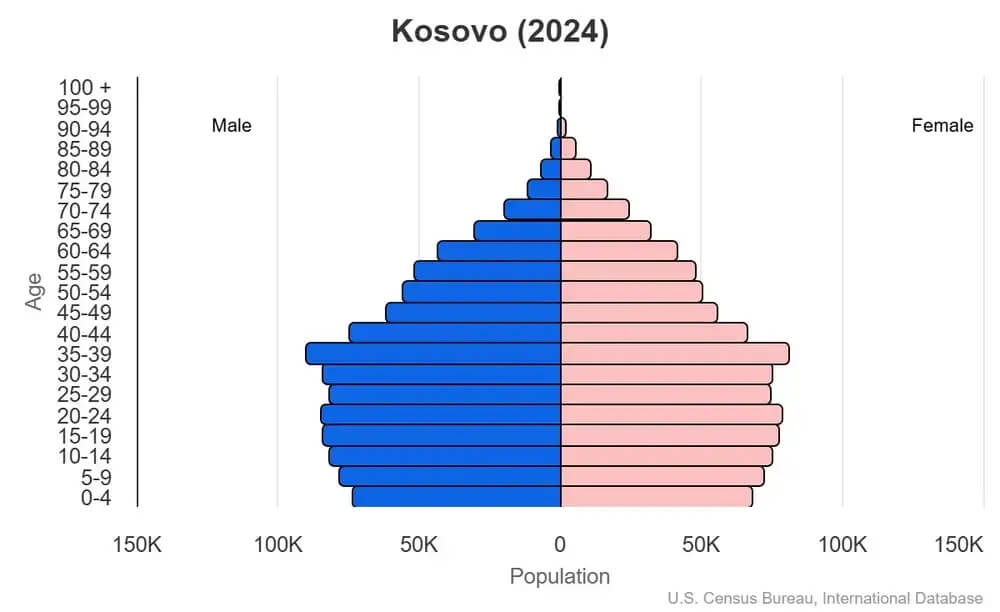
Total: 1,977,093 (2024 estimated)
Ethnic groups
The demographic landscape of Kosovo is predominantly Albanian, comprising 92.9% of the population. Other ethnic groups include Bosniaks (1.6%), Serbs (1.5%), Turks (1.1%), Ashkali (0.9%), Egyptians (0.7%), Gorani (0.6%), Romani (0.5%), and other/unspecified groups (0.2%) as of the 2011 estimate. This ethnic diversity reflects the complex historical and cultural tapestry of the region, which has implications for social cohesion and political representation.
Languages
Albanian is the official language, spoken by 94.5% of the population, while other languages include Bosnian (1.7%), Serbian (1.6%), Turkish (1.1%), and various other languages (0.9%), including Romani. The linguistic diversity highlights the multicultural nature of Kosovo, although it also poses challenges for national unity and communication.
Religions
The religious composition of Kosovo is predominantly Muslim (95.6%), with Roman Catholics (2.2%), Orthodox Christians (1.5%), and other religions (0.1%), alongside a small percentage of individuals identifying as having no religion (0.1%) or unspecified (0.6%). This religious diversity is a significant aspect of Kosovo's identity, influencing cultural practices and community relations.
Population growth rate
The population growth rate stands at 0.68% (2024 estimated), indicating a gradual increase in the population, which has implications for economic development, social services, and infrastructure planning.
Government
Government type
Kosovo operates as a parliamentary republic, a system that emphasizes democratic governance and the rule of law.
Capital
Name: Pristina (Prishtine, Prishtina)
Executive branch
The chief of state is President Vjosa OSMANI-Sadriu, who has been in office since 4 April 2021. The head of government is Acting Prime Minister Albin KURTI, who has been serving since 15 April 2025. This leadership structure reflects the political dynamics and challenges faced by Kosovo in its pursuit of stability and development.
Diplomatic representation in the US
The chief of mission is Ambassador Ilir DUGOLLI, who has been in position since 13 January 2022.
Diplomatic representation from the US
The chief of mission is currently vacant; however, Chargé d'Affaires Anu PRATTIPATI has been serving since January 2025, indicating ongoing diplomatic engagement between Kosovo and the United States.
Economy
Economic overview
Kosovo's economy can be characterized as small but growing, situated within the European context. Although it is not a member of the European Union, Kosovo has adopted the euro as its currency, which facilitates trade and economic stability. However, the country faces significant challenges, including very high unemployment rates, particularly among the youth, which poses a threat to social stability and economic growth. The economy's vulnerability is further exacerbated by a reliance on diaspora tourism services, which were severely impacted by COVID-19 disruptions. Additionally, the health of the public loan portfolio remains unclear, raising concerns about fiscal sustainability and economic resilience.
Real GDP (purchasing power parity)
$25.019 billion (2024 estimated)
$23.962 billion (2023 estimated)
$23.025 billion (2022 estimated)
Real GDP per capita
$16,400 (2024 estimated)
$14,200 (2023 estimated)
$13,000 (2022 estimated)
Exports
$4.156 billion (2023 estimated)
$3.579 billion (2022 estimated)
$3.138 billion (2021 estimated)
Exports - partners
United States 16%, Albania 15%, North Macedonia 12%, Germany 8%, Italy 8% (2021)
Exports - commodities
Key exports include mattress materials, iron alloys, metal piping, scrap iron, and building plastics (2021), which reflect the industrial capabilities of the country.
Imports
$7.362 billion (2023 estimated)
$6.661 billion (2022 estimated)
$6.128 billion (2021 estimated)
Imports - partners
Major import partners include Germany (13%), Turkey (13%), China (10%), Serbia (7%), and Italy (6%) (2021), indicating a diverse trade network.
Imports - commodities
The primary imports consist of refined petroleum, cars, iron rods, electricity, cigars, and packaged medicines (2021), which are essential for meeting domestic needs and supporting economic activity.