World Book
San Marino
Introduction
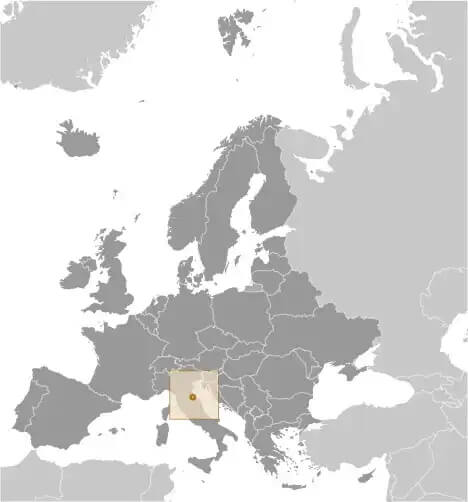
San Marino, a landlocked microstate surrounded by Italy, is not only the third-smallest country in Europe but also proudly claims the title of the world's oldest republic. Founded in A.D. 301 by a Christian stonemason named Marinus, this historic enclave has maintained its independence and unique identity through centuries of change. The political and social dynamics of San Marino are closely intertwined with those of Italy, reflecting a shared history and cultural heritage. As a result, San Marino offers a fascinating blend of tradition and modernity, making it a significant point of interest in European geopolitics.
Neighboring country
Italy
Geography
Area
Total: 61 sq km
Land: 61 sq km
Water: 0 sq km
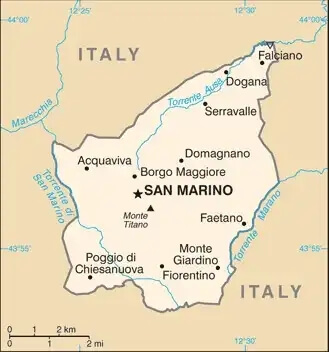
San Marino's geographical landscape is characterized by its mountainous terrain, which is part of the Apennine mountain range. The country enjoys a Mediterranean climate, featuring mild to cool winters and warm, sunny summers that contribute to its picturesque scenery. The absence of significant water bodies within its borders emphasizes its compact land area, which is entirely landlocked. The natural resources of San Marino are limited, with building stone being the primary resource extracted, reflecting the country’s historical reliance on its own materials for construction and development.
People and Society
Population
Total: 35,095 (2024 estimated)
Ethnic groups
Sammarinese, Italian
Languages
Italian
Religions
Roman Catholic
Population growth rate
0.57% (2024 estimated)
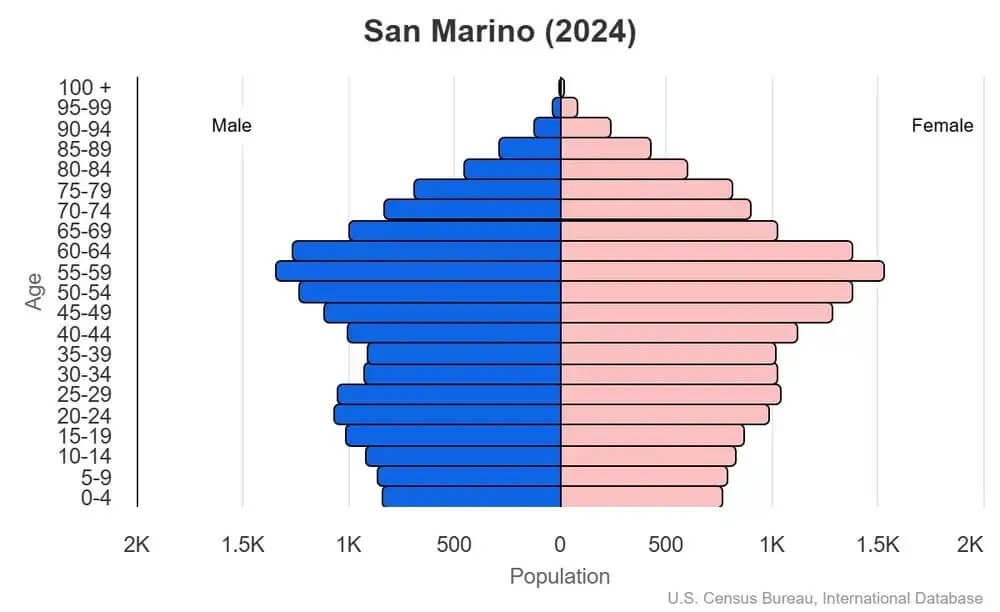
San Marino's population, estimated at 35,095 in 2024, is predominantly composed of Sammarinese and Italian ethnic groups, reflecting its close ties with Italy. The official language is Italian, which is spoken universally among the populace. The society is largely Roman Catholic, which plays a significant role in cultural and social practices. With a population growth rate of 0.57%, San Marino experiences a modest increase in its demographic profile, indicative of stable living conditions and a relatively high standard of living. The interplay between tradition and modernity is evident in the daily lives of its citizens, who navigate a unique cultural landscape shaped by their historical roots and contemporary influences.
Government
Government type
Parliamentary republic
Capital
Name: San Marino (city)
Executive branch
Chief of state: Co-chiefs of state Captains Regent Denise Bronzetti and Italo Righi (for the period 1 April 2025 - 30 September 2025)
Head of government: Secretary of State for Foreign and Political Affairs Luca Beccari (since 8 January 2020)
Diplomatic representation in the US
Chief of mission: Ambassador Damiano Beleffi (since 21 July 2017); note - also Permanent Representative to the UN
San Marino operates as a parliamentary republic, where the government is characterized by a dual executive system led by two Captains Regent, currently Denise Bronzetti and Italo Righi, who serve for a six-month term. The Secretary of State for Foreign and Political Affairs, Luca Beccari, heads the government, ensuring that San Marino maintains its diplomatic relations and navigates its foreign policy effectively. This unique governance structure reflects the country’s commitment to shared leadership and democratic principles, while also allowing for a stable political environment that fosters continuity and tradition.
Economy
Economic overview
San Marino boasts a high-income, non-EU European economy, strategically positioned as a landlocked enclave within Italy. This geographical reality shapes its economic interactions, with Italy serving as the dominant partner for both imports and exports. The country benefits from an open border to the EU and utilizes the euro, which facilitates trade and economic stability. San Marino's economy is bolstered by a robust financial sector, attracting high levels of foreign investment due to its low taxation policies. However, the nation faces challenges, including an increasingly high and risky debt profile that necessitates careful economic management.
Real GDP (purchasing power parity)
$2.393 billion (2022 estimated)
$2.218 billion (2021 estimated)
$1.947 billion (2020 estimated)
Real GDP per capita
$70,900 (2022 estimated)
$64,700 (2021 estimated)
$56,000 (2020 estimated)
Exports
$3.616 billion (2022 estimated)
$3.23 billion (2021 estimated)
$2.439 billion (2020 estimated)
Exports - partners
Germany 12%, Austria 10%, USA 9%, Romania 8%, Brazil 7% (2023)
Exports - commodities
Washing and bottling machines, other foods, packaged medicine, woodworking machines, aircraft (2023)
Imports
$3.169 billion (2022 estimated)
$2.94 billion (2021 estimated)
$2.232 billion (2020 estimated)
Imports - partners
Germany 24%, Italy 13%, Netherlands 9%, Spain 9%, Poland 8% (2023)
Imports - commodities
Garments, cars, electricity, animal food, footwear (2023)
Human Development Index
The country's Human Development Index (HDI) is 0.915, ranking it 29th out of 193 countries tested. (more information)