World Book
Andorra
Introduction
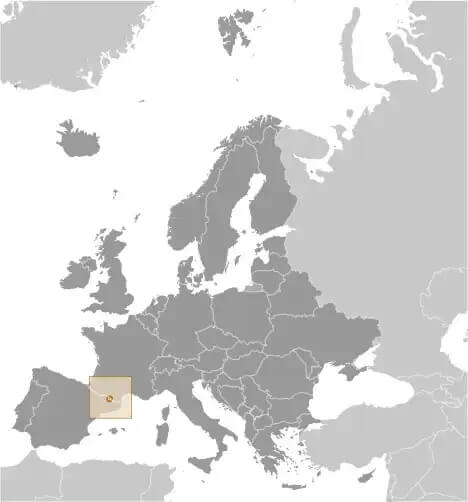
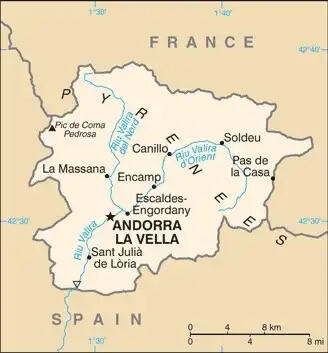
The landlocked Principality of Andorra, nestled in the eastern Pyrenees mountains between France and Spain, is one of the smallest states in Europe. Despite its size, Andorra boasts a rich cultural heritage and a unique political system. Although not a member of the European Union, Andorra enjoys a special relationship with the bloc, governed by various customs and cooperation agreements. The country uses the euro as its national currency, reflecting its integration into the European economic framework. This small yet vibrant nation is known for its stunning landscapes, ski resorts, and as a hub for tourism and commerce.
Neighboring countries
France - Spain
Geography
Area
Total: 468 sq km
Land: 468 sq km
Water: 0 sq km
Climate
Andorra experiences a temperate climate characterized by snowy, cold winters and warm, dry summers. This climate not only supports a diverse range of flora and fauna but also makes the country an attractive destination for winter sports enthusiasts and summer hikers alike.
Natural resources
The country is endowed with several natural resources, including hydropower, mineral water, timber, iron ore, and lead. These resources play a crucial role in supporting Andorra's economy, particularly in the energy and tourism sectors.
People and Society
Population
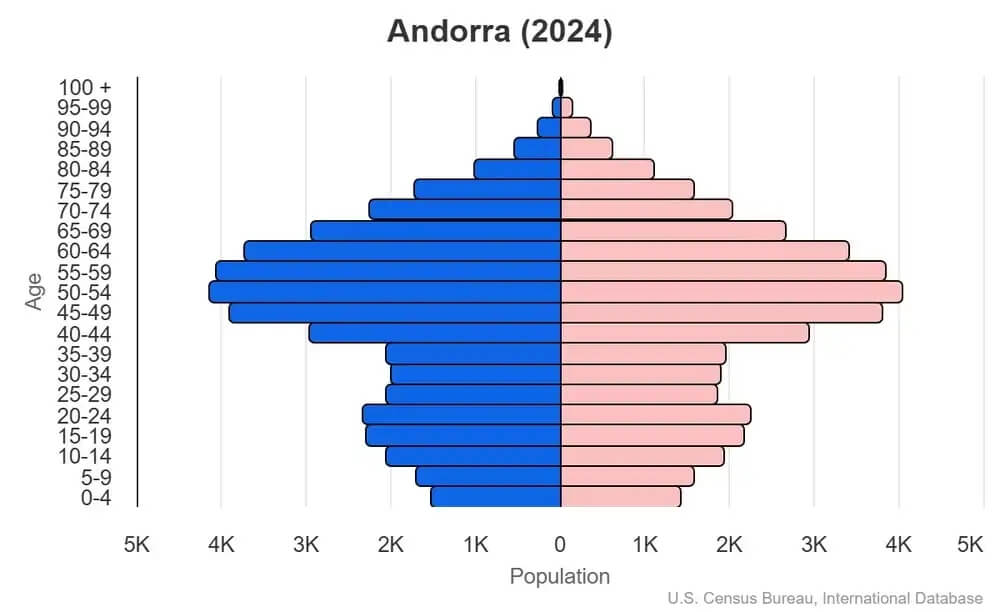
Total: 85,370 (2024 estimated)
Ethnic groups
The population of Andorra is diverse, comprising Spanish (34.3%), Andorran (32.1%), Portuguese (10%), French (5.6%), and other ethnicities (18%) as of 2024. This mix of cultures contributes to the rich social fabric of the nation, fostering a unique blend of traditions and customs.
Languages
Catalan is the official language, spoken by 44.1% of the population, while Castilian (40.3%), Portuguese (13.5%), French (10%), English (3%), and other languages (6.8%) are also prevalent, reflecting the multicultural nature of Andorran society (2022 estimated).
Religions
The predominant religion in Andorra is Christianity, with 89.5% of the population identifying as Roman Catholic. Other religions account for 8.8%, while 1.7% of the population is unaffiliated (2020 estimated). This religious landscape influences various aspects of daily life and cultural practices in the country.
Population growth rate
The population growth rate is currently at -0.12% (2024 estimated), indicating a slight decline in the population, which may have implications for the labor market and social services in the future.
Government
Government type
Andorra operates as a parliamentary democracy, a system that has been in place since March 1993. The country retains its unique co-principality structure, where the heads of state are the President of France and the Bishop of Seu d'Urgell, Spain. This dual leadership model reflects Andorra's historical ties and its commitment to maintaining a balance between secular and religious authority.
Capital
Name: Andorra la Vella
Executive branch
The chief of state is Co-prince Emmanuel MACRON (since 14 May 2017), represented by Patrick STROZDA (since 14 May 2017), and Co-prince Archbishop Joan-Enric VIVES i Sicilia (since 12 May 2003), represented by Eduard Ibanez PULIDO (since 27 November 2023). The head of government is Prime Minister Xavier Espot ZAMORA (since 16 May 2019), who oversees the executive functions of the government.
Diplomatic representation in the US
The chief of mission is Ambassador Joan FORNER ROVIRA (since 13 January 2025), who also serves as the Permanent Representative to the UN, highlighting Andorra's commitment to international diplomacy and cooperation.
Economy
Economic overview
Andorra's economy is characterized by a high GDP and low unemployment rates, positioning it as a prosperous nation despite not being a member of the European Union. The country operates as a duty-free area between Spain and France, making it a significant tourist hub, although the COVID-19 pandemic has posed challenges to this sector. The financial sector is modern and not classified as a tax haven, reflecting a commitment to transparency and international standards. Andorra is actively seeking to attract big tech investments and has recently become a member of the Single Euro Payments Area (SEPA) and the International Monetary Fund (IMF), further integrating into the global economy.
Real GDP (purchasing power parity)
$5.402 billion (2024 estimated)
$5.226 billion (2023 estimated)
$5.094 billion (2022 estimated)
Real GDP per capita
$65,900 (2024 estimated)
$64,600 (2023 estimated)
$63,900 (2022 estimated)
Exports
$3.169 billion (2023 estimated)
$2.736 billion (2022 estimated)
$2.446 billion (2021 estimated)
Exports - partners
Spain 39%, USA 21%, France 11%, UK 5%, UAE 3% (2023)
Exports - commodities
The main exports include paintings, integrated circuits, cars, orthopedic appliances, and garments (2023).
Imports
$2.716 billion (2023 estimated)
$2.44 billion (2022 estimated)
$2.143 billion (2021 estimated)
Imports - partners
The primary import partners are Spain (65%), France (11%), Germany (4%), China (3%), and Italy (3%) (2023).
Imports - commodities
Andorra's imports consist mainly of cars, refined petroleum, garments, perfumes, and electricity (2023).
Human Development Index
The country's Human Development Index (HDI) is 0.913, ranking it 32nd out of 193 countries tested. (more information)