World Book
Angola
World Book Index
49

With a score of 49, the country is ranked 130th out of 158 countries in the World Book ranking. (more information)
Introduction
Angola, a country rich in history and culture, was once the site of multiple kingdoms, with the Kongo and Ndongo being the most prominent. The arrival of Portuguese colonizers in the 16th century marked the beginning of a long colonial period that lasted until Angola gained independence in 1975. Following independence, the nation endured a devastating civil war that lasted for 27 years, concluding in 2002. Today, Angola is a nation in transition, striving to rebuild and develop its infrastructure and economy while grappling with the legacies of its tumultuous past.
Neighboring countries
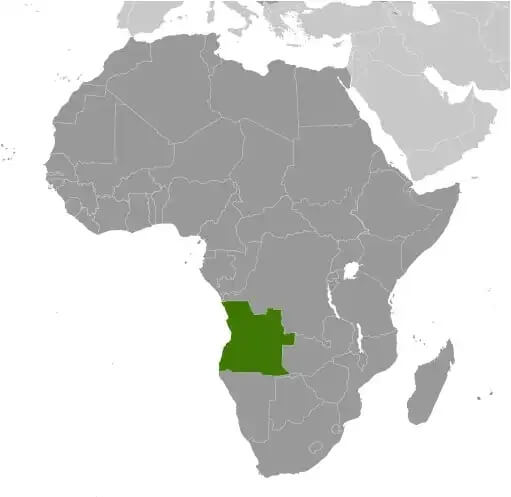
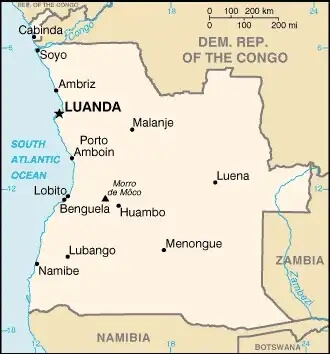
Democratic Republic of the Congo - Namibia - Zambia
Geography
Area
Total: 1,246,700 sq km
Land: 1,246,700 sq km
Water: 0 sq km
Climate
The climate of Angola varies significantly across its regions. The southern and coastal areas experience a semi-arid climate, while the northern regions enjoy a more temperate climate characterized by a cool, dry season from May to October and a hot, rainy season from November to April.
Natural resources
Angola is endowed with a wealth of natural resources, including petroleum, diamonds, iron ore, phosphates, copper, feldspar, gold, bauxite, and uranium. These resources play a crucial role in the country's economy and development prospects.
People and Society
Population
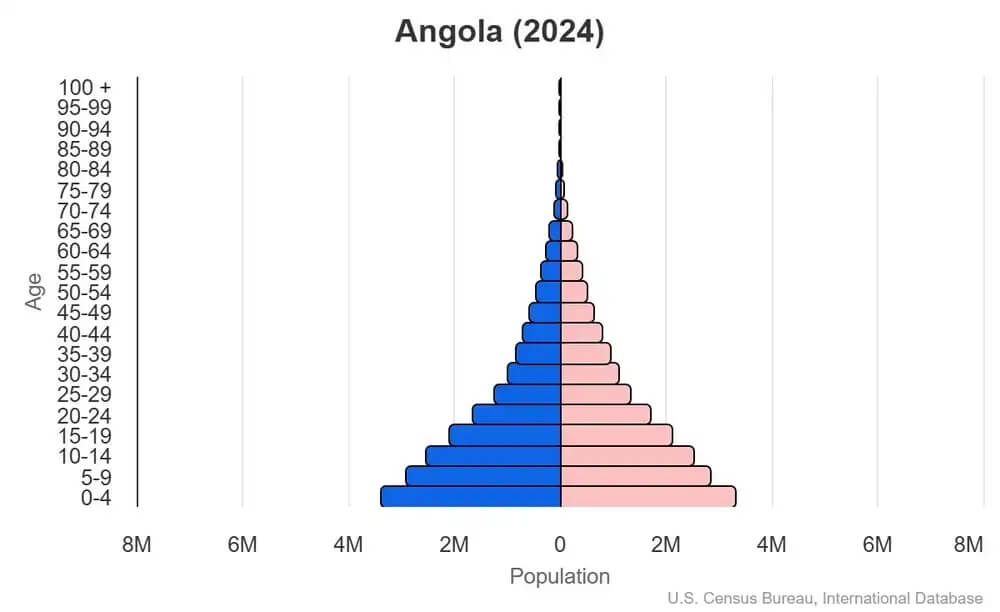
Total: 37,202,061 (2024 estimated)
Ethnic groups
The population of Angola is diverse, comprising various ethnic groups, with Ovimbundu making up 37%, Kimbundu 25%, Bakongo 13%, Mestico (mixed European and native African) 2%, European 1%, and other groups accounting for 22%. This rich tapestry of cultures contributes to the nation's vibrant social fabric.
Languages
Portuguese is the official language, spoken by 71.2% of the population. Other languages include Umbundu (23%), Kikongo (8.2%), Kimbundu (7.8%), Chokwe (6.5%), Nhaneca (3.4%), Nganguela (3.1%), Fiote (2.4%), Kwanhama (2.3%), Muhumbi (2.1%), Luvale (1%), and other languages (3.6%) as of 2014. This linguistic diversity reflects the country's complex history and cultural influences.
Religions
The religious landscape of Angola is predominantly Roman Catholic (41.1%) and Protestant (38.1%), with other religions accounting for 8.6% and those identifying as having no religion at 12.3% (2014 estimated). This diversity in beliefs plays a significant role in shaping the societal values and traditions of the Angolan people.
Population growth rate
The population growth rate is estimated at 3.33% for 2024, indicating a youthful and rapidly growing population that presents both opportunities and challenges for the country's development.
Government
Government type
Angola operates as a presidential republic, where the President serves as both the head of state and government.
Capital
Name: Luanda
Executive branch
The chief of state is President Joao Manuel Goncalves LOURENCO, who has been in office since 26 September 2017. He also serves as the head of government.
Diplomatic representation in the US
The chief of mission is Ambassador Agostinho de Carvalho dos Santos VAN-DÚNEM, who has been serving since 30 June 2023.
Diplomatic representation from the US
The chief of mission is currently vacant; however, Chargé d’Affaires Ambassador Noah ZARING has been in position since March 2025.
Economy
Economic overview
Angola's economy is classified as a middle-income, oil-dependent African economy. Despite its rich natural resources, the country faces widespread poverty, rising inflation, and currency depreciation. The government is actively seeking to diversify the economy, particularly through agricultural production, to reduce its reliance on oil. However, significant corruption in public institutions remains a challenge. Major infrastructure investments from China and the United States are underway, and Angola exited OPEC in 2023, marking a significant shift in its economic strategy.
Real GDP (purchasing power parity)
$278.239 billion (2024 estimated)
$266.452 billion (2023 estimated)
$263.61 billion (2022 estimated)
Real GDP per capita
$7,300 (2024 estimated)
$7,300 (2023 estimated)
$7,400 (2022 estimated)
Exports
$36.924 billion (2024 estimated)
$36.961 billion (2023 estimated)
$50.12 billion (2022 estimated)
Exports - partners
China 40%, India 9%, UAE 6%, Spain 6%, Netherlands 5% (2023)
Exports - commodities
The primary commodities exported by Angola include crude petroleum, diamonds, natural gas, ships, and refined petroleum (2023).
Imports
$22.683 billion (2024 estimated)
$23.688 billion (2023 estimated)
$28.564 billion (2022 estimated)
Imports - partners
The main partners for imports are China (19%), Portugal (10%), UAE (7%), India (6%), and the USA (5%) (2023).
Imports - commodities
Angola's imports primarily consist of refined petroleum, wheat, ships, cars, and trucks (2023).
Human Development Index
The country's Human Development Index (HDI) is 0.616, ranking it 148th out of 193 countries tested. (more information)
World Happiness Report
The World Happiness Report ranked the country 140th out of 158 countries tested with a score of 3.795. (more information)