World Book
Antigua and Barbuda
Introduction
Antigua and Barbuda, a stunning twin-island nation located in the heart of the Caribbean, boasts a rich history that dates back to the Siboney people, who first inhabited the islands around 2400 B.C. The islands were later populated by the Arawaks when Christopher Columbus arrived during his second voyage in 1493. After centuries of colonial rule, Antigua and Barbuda achieved independence in 1981, becoming a sovereign state within the British Commonwealth of Nations. This unique blend of indigenous heritage and colonial history shapes the cultural landscape of the nation today.
Neighboring countries
Saint Kitts and Nevis
Geography
Area
Total: 443 sq km
Land: 443 sq km
Water: 0 sq km
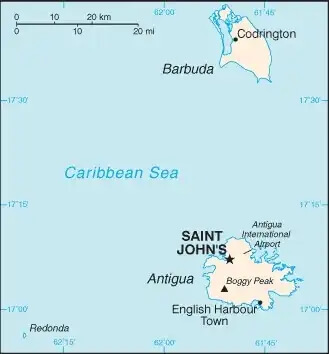
Antigua and Barbuda is characterized by its tropical maritime climate, which results in minimal seasonal temperature variation, making it an ideal destination for tourists year-round. The islands' geography is predominantly flat, with a few hilly areas, and they are surrounded by the crystal-clear waters of the Caribbean Sea. The pleasant climate and beautiful landscapes foster a thriving tourism industry, which is a cornerstone of the local economy. However, the islands face challenges such as limited freshwater resources and vulnerability to hurricanes, which can impact both the environment and economic activities.
People and Society
Population
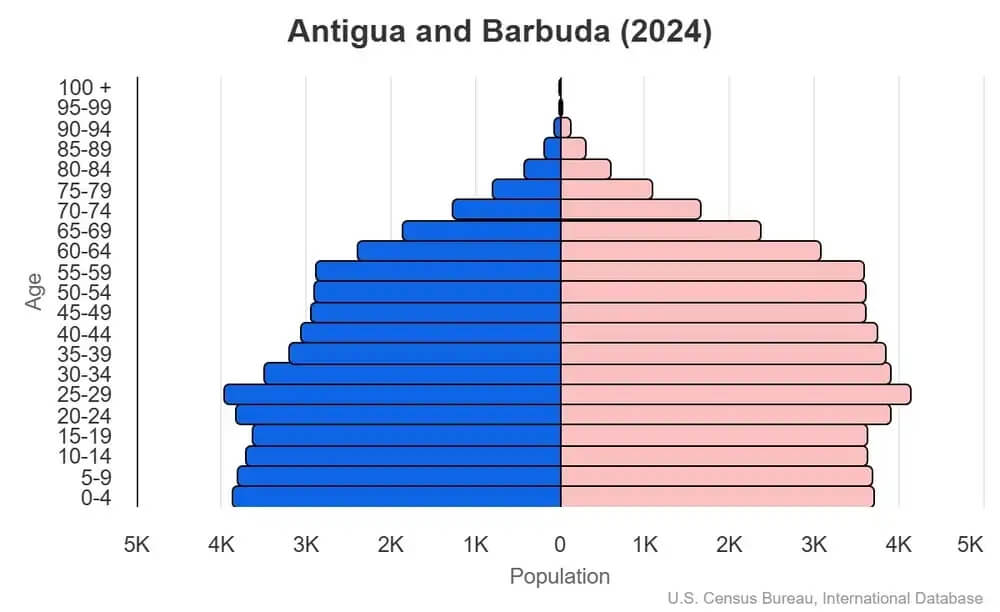
Total: 102,634 (2024 estimated)
Antigua and Barbuda's population is predominantly of African descent, comprising 87.3% of the demographic makeup, with mixed heritage accounting for 4.7%. The islands also have a small Hispanic population (2.7%), alongside White individuals (1.6%) and other ethnic groups (2.7%). The official language is English, complemented by Antiguan Creole, which reflects the islands' cultural diversity. The religious landscape is predominantly Protestant, with 68.3% of the population adhering to various denominations, including Anglican, Seventh Day Adventist, and Pentecostal faiths. The population growth rate stands at 1.11% (2024 estimated), indicating a steady increase in the number of residents, which presents both opportunities and challenges for the nation in terms of resource management and social services.
Government
Government type
Parliamentary democracy under a constitutional monarchy; a Commonwealth realm
Capital
Name: Saint John's
The government of Antigua and Barbuda operates as a parliamentary democracy, functioning under a constitutional monarchy. The head of state is King Charles III, who has been in this position since September 8, 2022, and is represented locally by Governor General Rodney Williams, who has held the role since August 14, 2014. The head of government is Prime Minister Gaston Browne, who has been in office since June 13, 2014. This political structure allows for a blend of traditional monarchy and modern democratic governance, reflecting the country's historical ties to Britain while promoting local representation and decision-making.
Diplomatic representation in the US
Chief of mission: Ambassador Sir Ronald Sanders (since September 17, 2015)
Economy
Economic overview
Antigua and Barbuda's economy is primarily driven by a dual focus on tourism and construction, with the tourism sector being a significant contributor to GDP. The nation is also exploring the emerging “blue economy,” which emphasizes sustainable use of ocean resources. However, the economy faces limitations due to a restricted water supply and its susceptibility to hurricanes, which can disrupt economic activities. Despite these challenges, the country is making strides in improving its road infrastructure and is considered friendly to foreign direct investment. Additionally, there is a growing interest in financial innovation, particularly in cryptocurrency and blockchain technologies, which could diversify the economic landscape.
Real GDP (purchasing power parity)
$2.772 billion (2024 estimated)
$2.657 billion (2023 estimated)
$2.594 billion (2022 estimated)
Real GDP per capita
$29,600 (2024 estimated)
$28,500 (2023 estimated)
$27,900 (2022 estimated)
Exports
$1.314 billion (2024 estimated)
$1.185 billion (2023 estimated)
$1.111 billion (2022 estimated)
Exports - partners
Suriname 29%, Poland 21%, USA 8%, Dominican Republic 7%, Australia 5% (2023)
Exports - commodities
Refined petroleum, ships, soybean meal, shellfish, paintings (2023)
Imports
$1.282 billion (2024 estimated)
$1.273 billion (2023 estimated)
$1.227 billion (2022 estimated)
Imports - partners
USA 43%, Poland 6%, China 5%, UK 4%, Germany 4% (2023)
Imports - commodities
Ships, refined petroleum, cars, plastic products, furniture (2023)
Human Development Index
The country's Human Development Index (HDI) is 0.851, ranking it 53rd out of 193 countries tested. (more information)