World Book
Brunei
Introduction
The Sultanate of Brunei, a small yet significant nation on the island of Borneo, has a rich history that reflects its strategic position in Southeast Asia. Once a powerful maritime empire during the 15th to 17th centuries, Brunei's influence extended over coastal regions of northwest Borneo and parts of the southern Philippines. This historical prominence laid the foundation for its cultural and political identity. In 1888, Brunei became a British protectorate, a status that lasted until it regained independence in 1984. The nation has been under the rule of the same royal family for over six centuries, showcasing a remarkable continuity in leadership and governance.
Neighboring country
Malaysia
Geography
Area
Total: 5,765 sq km
Land: 5,265 sq km
Water: 500 sq km
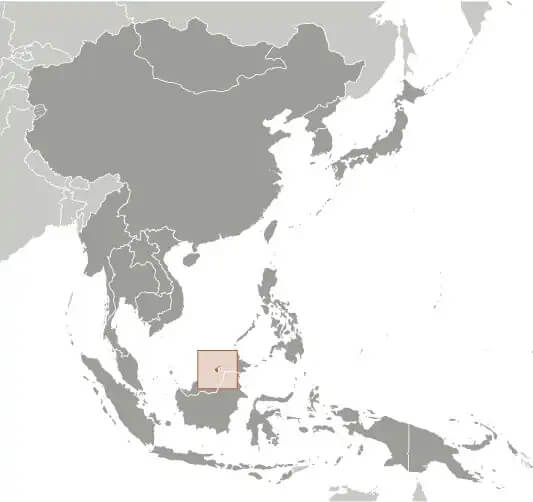
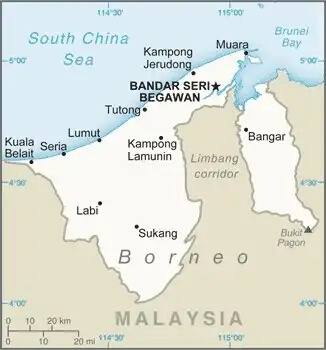
Brunei is located on the northern coast of Borneo, bordered by the South China Sea to the north and surrounded by Malaysia on the island. The country's geography is characterized by a mix of coastal plains, hilly regions, and dense rainforests, which contribute to its rich biodiversity. The tropical climate, marked by high humidity and significant rainfall, supports a variety of ecosystems and natural resources. The nation is endowed with substantial reserves of petroleum and natural gas, which play a crucial role in its economy, alongside timber resources.
People and Society
Population
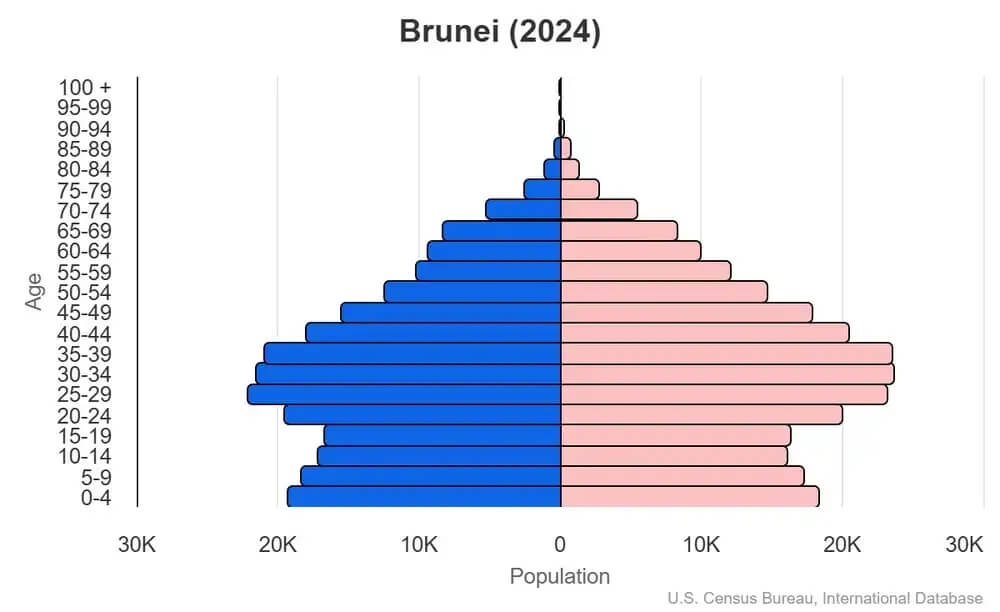
Total: 491,900 (2024 estimated)
Brunei's population is a tapestry of ethnic diversity, with the majority being Malay (67.4%), followed by a significant Chinese community (9.6%) and other ethnic groups (23%) as of 2021. This demographic composition reflects the country's historical trade connections and cultural exchanges. The official language is Malay (Bahasa Melayu), but English and various Chinese dialects are also widely spoken, highlighting the multicultural fabric of society. Religion plays a pivotal role in the lives of Bruneians, with Islam being the official faith, practiced by 82.1% of the population, followed by Christians (6.7%), Buddhists (6.3%), and other religions (4.9%) as of 2021. The population growth rate stands at 1.4% (2024 estimated), indicating a steady increase in the number of residents.
Government
Government type
Absolute monarchy or sultanate
Capital
Name: Bandar Seri Begawan
Brunei operates under an absolute monarchy, with the Sultan serving as both the head of state and the head of government. Sultan and Prime Minister Sir HASSANAL Bolkiah has been in power since 5 October 1967, embodying the central authority of the nation. The Sultanate's governance structure reflects a blend of traditional monarchy and modern administrative practices, ensuring stability and continuity in leadership. Diplomatic representation in the United States is currently led by a Chargé d'Affaires, IZZATI Baharuddin, since 6 May 2025, while the U.S. ambassador to Brunei is Caryn R. McCLELLAND, who has held the position since December 2021.
Economy
Economic overview
Brunei's economy is almost exclusively reliant on oil and gas, making it one of the wealthiest nations in the world. As a high-income country, it boasts an expansive and robust welfare system that supports its citizens. The majority of the workforce is employed by the government, reflecting the state's significant role in the economy. In recent years, Brunei has been promoting a nationalized halal brand and is considering the establishment of a bond market and stock exchange to diversify its economic activities. This strategic move aims to enhance economic resilience and reduce dependency on hydrocarbon revenues.
Real GDP (purchasing power parity)
$36.64 billion (2024 estimated)
$35.163 billion (2023 estimated)
$34.771 billion (2022 estimated)
Real GDP per capita
$79,200 (2024 estimated)
$76,600 (2023 estimated)
$76,400 (2022 estimated)
Exports
$11.483 billion (2024 estimated)
$11.573 billion (2023 estimated)
$14.405 billion (2022 estimated)
Exports - partners
Australia 21%, Japan 17%, China 17%, Singapore 16%, Malaysia 6% (2023)
Exports - commodities
Refined petroleum, natural gas, crude petroleum, hydrocarbons, fertilizers (2023)
Imports
$9.11 billion (2024 estimated)
$9.077 billion (2023 estimated)
$10.099 billion (2022 estimated)
Imports - partners
Malaysia 23%, UAE 10%, China 10%, UK 10%, Australia 6% (2023)
Imports - commodities
Crude petroleum, gold, refined petroleum, coal, cars (2023)
Human Development Index
The country's Human Development Index (HDI) is 0.837, ranking it 60th out of 193 countries tested. (more information)