World Book
Czechia
World Book Index
81

With a score of 81, the country is ranked 16th out of 158 countries in the World Book ranking. (more information)
Introduction
Czechia, a nation with a rich historical tapestry, emerged from the ashes of the Austro-Hungarian Empire following World War I when the Czechs and Slovaks united to form Czechoslovakia. This union, however, was short-lived, as the peaceful "velvet divorce" in 1993 led to the establishment of two independent states. Czechia has since evolved into a modern European nation, joining NATO in 1999 and the European Union in 2004, marking its commitment to collective security and economic integration. In 2016, the country adopted the short-form name Czechia, reflecting its national identity on the global stage.
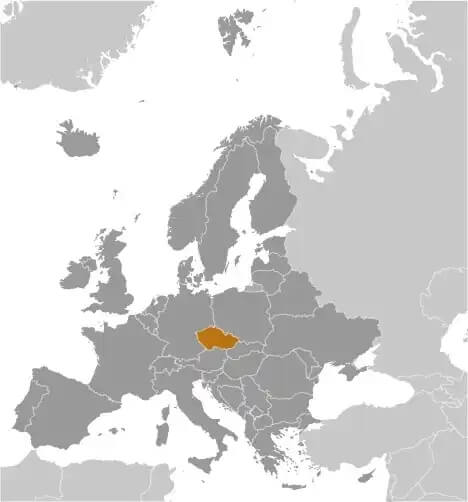
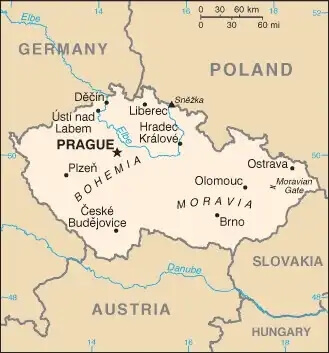
Neighboring countries
Austria - Germany - Poland - Slovakia
Geography
Area
Total: 78,867 sq km
Land: 77,247 sq km
Water: 1,620 sq km
Czechia is situated in Central Europe, characterized by its diverse landscape that includes mountains, forests, and rivers. The temperate climate, with cool summers and cold, cloudy, humid winters, contributes to the country's rich biodiversity. The nation is endowed with significant natural resources, including hard coal, soft coal, kaolin, clay, graphite, timber, and arable land, which play a crucial role in its economy and environmental sustainability.
People and Society
Population
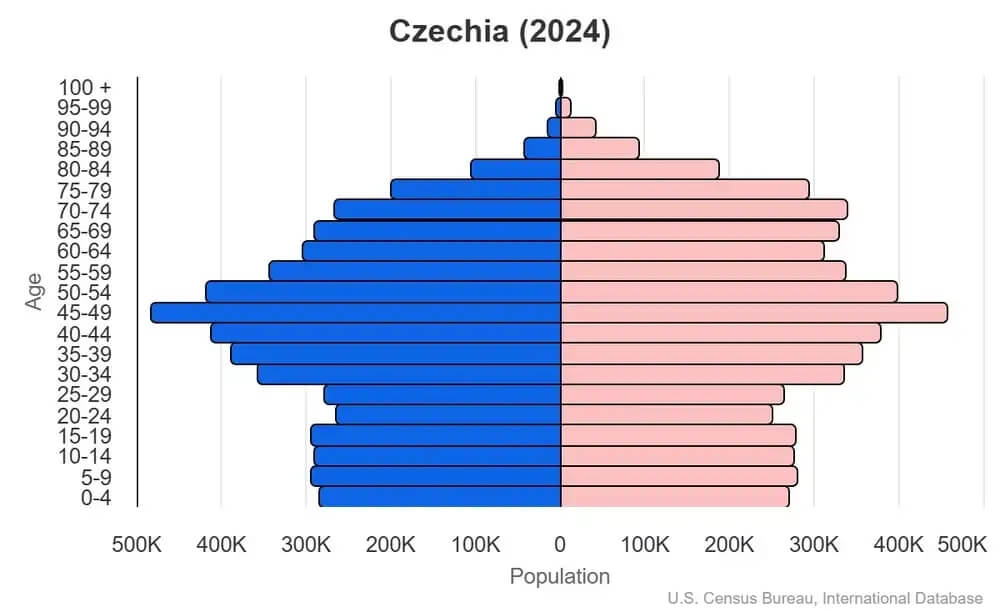
Total: 10,837,890 (2024 estimated)
Ethnic groups
Czech 57.3%, Moravian 3.4%, other 7.7%, unspecified 31.6% (2021 estimated)
Languages
Czech (official) 88.4%, Slovak 1.5%, other 2.6%, unspecified 7.2% (2021 estimated)
Religions
Roman Catholic 7%, other believers belonging to a church or religious society 6% (includes Evangelical United Brethren Church and Czechoslovak Hussite Church), believers unaffiliated with a religious society 9.1%, none 47.8%, unspecified 30.1% (2021 estimated)
Population growth rate
0.04% (2024 estimated)
Czechia's population is predominantly Czech, with a notable Moravian minority, reflecting the country's historical and cultural diversity. The official language is Czech, which is spoken by the vast majority, while Slovak and other languages are also present, indicating a degree of linguistic diversity. The religious landscape is varied, with a significant portion of the population identifying as unaffiliated, highlighting a trend towards secularism. The slow population growth rate suggests demographic stability, which may have implications for future economic and social policies.
Government
Government type
Parliamentary republic
Capital
Name: Prague
Executive branch
Chief of state: President Petr PAVEL (since 9 March 2023)
Head of government: Prime Minister Petr FIALA (since 17 December 2021)
Diplomatic representation in the US
Chief of mission: Ambassador Miloslav STAŠEK (since 16 September 2022)
Diplomatic representation from the US
Chief of mission: Ambassador (vacant); Chargé d'Affaires David WISNER (since June 2025)
Czechia operates as a parliamentary republic, where the President serves as the head of state and the Prime Minister as the head of government. The political landscape is characterized by a multi-party system, allowing for a diverse representation of views in the parliament. The capital city, Prague, not only serves as the political hub but also as a cultural and economic center, reflecting the nation's rich heritage and modern aspirations.
Economy
Economic overview
Czechia boasts a high-income, diversified EU economy, primarily driven by a robust manufacturing sector, particularly in the automotive industry. The economy has experienced moderate growth, fueled by household consumption and investments, despite facing challenges from net exports. The labor market remains tight, with low unemployment rates, indicating a healthy demand for labor. Notably, in April 2025, Czechia achieved energy independence from Russian oil, marking a significant milestone in its economic strategy.
Real GDP (purchasing power parity)
$521.928 billion (2024 estimated)
$516.145 billion (2023 estimated)
$516.431 billion (2022 estimated)
Real GDP per capita
$48,000 (2024 estimated)
$47,500 (2023 estimated)
$48,400 (2022 estimated)
Exports
$239.259 billion (2024 estimated)
$236.103 billion (2023 estimated)
$219.419 billion (2022 estimated)
Exports - partners
Germany 29%, Slovakia 7%, Poland 6%, France 5%, UK 5% (2023)
Exports - commodities
Cars, vehicle parts/accessories, broadcasting equipment, computers, plastic products (2023)
Imports
$216.741 billion (2024 estimated)
$219.09 billion (2023 estimated)
$216.042 billion (2022 estimated)
Imports - partners
Germany 22%, China 17%, Poland 8%, Slovakia 5%, Italy 4% (2023)
Imports - commodities
Broadcasting equipment, vehicle parts/accessories, cars, plastic products, computers (2023)
Human Development Index
The country's Human Development Index (HDI) is 0.915, ranking it 29th out of 193 countries tested. (more information)
World Happiness Report
The World Happiness Report ranked the country 10th out of 158 countries tested with a score of 7.06. (more information)