World Book
El Salvador
World Book Index
68

With a score of 68, the country is ranked 73rd out of 158 countries in the World Book ranking. (more information)
Introduction
El Salvador, the smallest country in Central America, has a rich history marked by its struggle for independence and subsequent civil strife. Achieving independence from Spain in 1821 and later from the Central American Federation in 1839, the nation has faced numerous challenges. A significant turning point occurred in 1992 when a 12-year civil war concluded with a peace treaty that initiated vital military and political reforms. Today, El Salvador is on a path of recovery and development, striving to overcome its historical challenges while embracing opportunities for growth and stability.
Neighboring countries
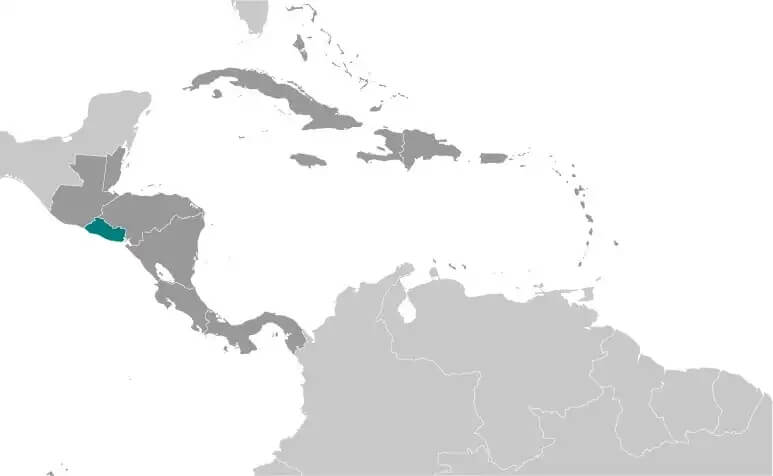
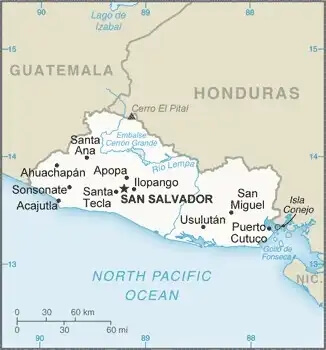
Guatemala - Honduras
Geography
Area
Total: 21,041 sq km
Land: 20,721 sq km
Water: 320 sq km
El Salvador is characterized by its diverse geography, which includes coastal plains, volcanic mountains, and fertile highlands. The country's total area of 21,041 sq km comprises predominantly land, with only 320 sq km of water bodies. The climate is tropical, featuring a rainy season from May to October and a dry season from November to April. The coastal regions experience a tropical climate, while the uplands enjoy a more temperate climate. The nation is endowed with natural resources such as hydropower, geothermal energy, and arable land, which are crucial for its economic development.
People and Society
Population
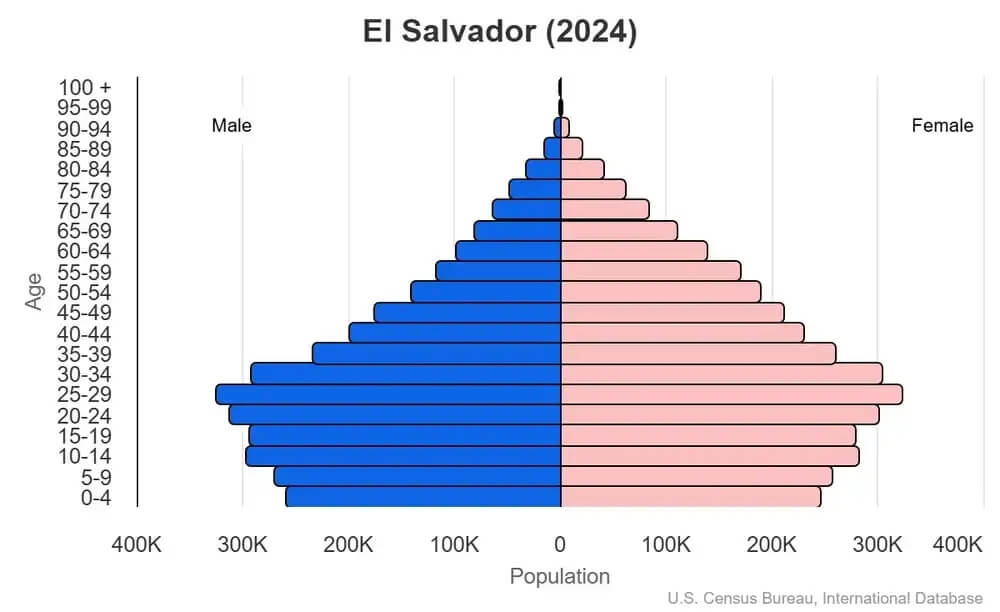
Total: 6,628,702 (2024 estimated)
El Salvador's population is a vibrant tapestry of ethnicities, with Mestizos making up 86.3%, followed by Whites at 12.7%, and Indigenous peoples at 0.2%, including groups such as the Lenca, Kakawira, and Nahua-Pipil. The country is predominantly Spanish-speaking, with Spanish as the official language, while Nawat is spoken among some indigenous communities. In terms of religious affiliation, the population is largely Roman Catholic (43.9%) and Protestant (39.6%), reflecting a blend of cultural influences. The population growth rate is estimated at 0.34% for 2024, indicating a gradual increase in the number of inhabitants. This demographic profile highlights the cultural richness and social dynamics of El Salvador, which continue to evolve in the context of globalization and modernization.
Government
Government type
Presidential republic
Capital
Name: San Salvador
El Salvador operates as a presidential republic, with a political system that emphasizes the role of the president as both the head of state and government. Currently, President Nayib Armando BUKELE Ortez has been in office since June 1, 2019, leading the country through a transformative period. The capital city, San Salvador, serves as the political and administrative hub. The country maintains diplomatic relations with the United States, represented by Ambassador Carmen Milena MAYORGA VALERA since December 23, 2020, while the U.S. is represented by a Chargé d’Affaires, Naomi C. FELLOWS, since August 2025.
Economy
Economic overview
El Salvador is classified as an upper-middle-income country with a dollarized economy, heavily reliant on remittances from its citizens living in the United States. Recent economic growth has been attributed to significant infrastructure investments, increased consumption, and efforts to reduce crime. The government has secured a $1.3 billion loan from the International Monetary Fund (IMF) to address fiscal imbalances, reflecting ongoing economic challenges. Notably, Bitcoin has been adopted as legal tender, marking a significant shift in the country's financial landscape. Despite these advancements, El Salvador continues to grapple with persistent poverty and a large informal sector, which pose challenges to sustainable economic development.
Real GDP (purchasing power parity)
$73.961 billion (2024 estimated)
$72.085 billion (2023 estimated)
$69.621 billion (2022 estimated)
Real GDP per capita
$11,700 (2024 estimated)
$11,400 (2023 estimated)
$11,100 (2022 estimated)
Exports
$11.586 billion (2024 estimated)
$10.629 billion (2023 estimated)
$10.164 billion (2022 estimated)
Exports - partners
USA 36%, Guatemala 17%, Honduras 15%, Nicaragua 8%, Costa Rica 5% (2023)
Exports - commodities
Garments, plastic products, electrical capacitors, raw sugar, toilet paper (2023)
Imports
$18.354 billion (2024 estimated)
$17.034 billion (2023 estimated)
$18.181 billion (2022 estimated)
Imports - partners
USA 28%, China 15%, Guatemala 11%, Mexico 8%, Honduras 5% (2023)
Imports - commodities
Refined petroleum, natural gas, garments, packaged medicine, plastics (2023)
Human Development Index
The country's Human Development Index (HDI) is 0.678, ranking it 132nd out of 193 countries tested. (more information)
World Happiness Report
The World Happiness Report ranked the country 17th out of 158 countries tested with a score of 6.894. (more information)