World Book
Honduras
World Book Index
62

With a score of 62, the country is ranked 98th out of 158 countries in the World Book ranking. (more information)
Introduction
Honduras, a nation with a rich historical tapestry, emerged from the shadows of Spanish colonial rule to establish its independence in 1821. This journey towards self-governance has been marked by significant political upheaval, including a prolonged period of military dominance that lasted over two decades. The restoration of democracy in 1982 paved the way for civilian governance, a crucial turning point in the nation’s political landscape. In recent years, Honduras has faced formidable challenges, including the economic repercussions of the COVID-19 pandemic and the devastation wrought by severe storms in 2020 and 2021. However, the resilience of the Honduran economy is evident as it gradually rebounds, showcasing the tenacity of its people and institutions.
Neighboring countries
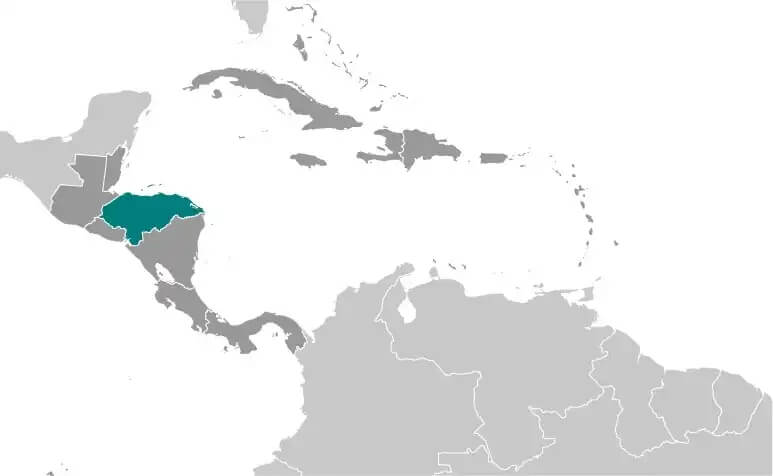
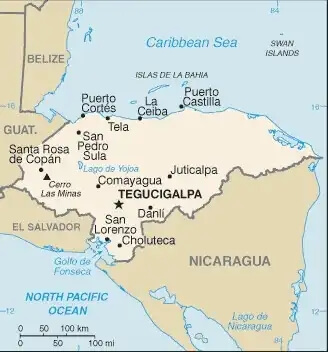
El Salvador - Guatemala - Nicaragua
Geography
Area
Total: 112,090 sq km
Land: 111,890 sq km
Water: 200 sq km
Honduras is characterized by its diverse geography, which includes a mix of coastal plains, mountainous regions, and lush forests. The country’s total area of 112,090 square kilometers encompasses a variety of ecosystems, from the subtropical lowlands to the temperate highlands. The climate varies significantly across these regions, with subtropical conditions prevailing in the lowlands and a more temperate climate found in the mountainous areas. This geographical diversity not only contributes to the country's natural beauty but also plays a crucial role in its economic activities, particularly in agriculture and tourism. Honduras is endowed with a wealth of natural resources, including timber, gold, silver, copper, lead, zinc, iron ore, antimony, coal, fish, and hydropower, which are vital for its economic development and sustainability.
People and Society
Population
Total: 9,529,188 (2024 estimated)
Ethnic groups
Mestizo (mixed Indigenous and European) 90%, Indigenous 7%, African descent 2%, White 1%
Languages
Spanish (official), Amerindian dialects
Religions
Evangelical 55%, Roman Catholic 33.4%, none 10.1%, unspecified 1.5% (2023 estimated)
Population growth rate
1.29% (2024 estimated)
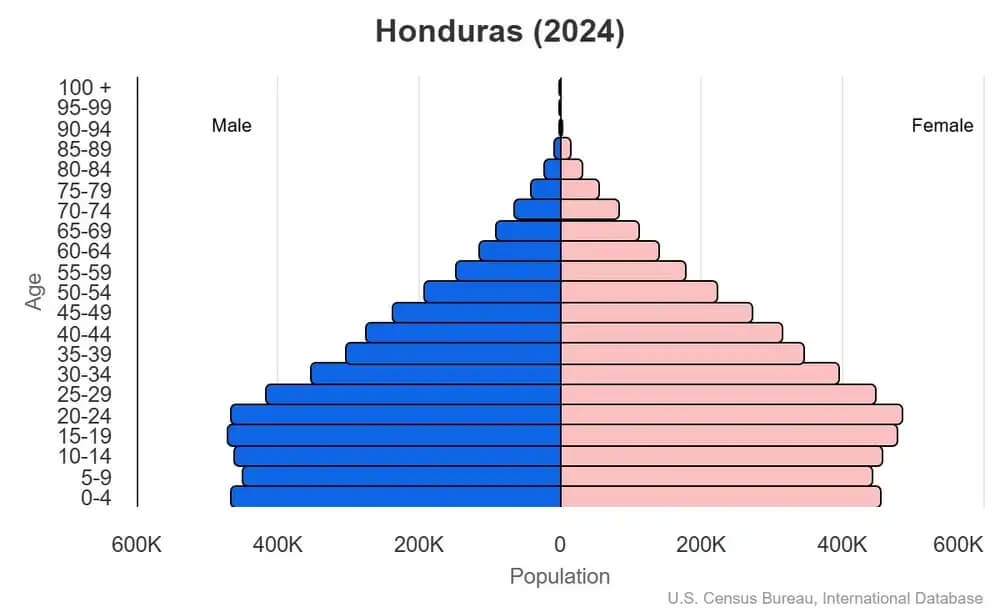
Honduras is home to a population of approximately 9.5 million people, reflecting a rich cultural mosaic primarily composed of Mestizo (90%), with Indigenous groups (7%), individuals of African descent (2%), and White populations (1%). The official language is Spanish, although various Amerindian dialects are also spoken, highlighting the country’s cultural heritage. The religious landscape is predominantly Evangelical (55%), followed by Roman Catholic (33.4%), with a notable portion of the population identifying as non-religious (10.1%). The population growth rate of 1.29% indicates a steady increase, which poses both opportunities and challenges for the nation in terms of resource allocation, education, and employment.
Government
Government type
Presidential republic
Capital
Name: Tegucigalpa
Executive branch
Chief of state: President Iris Xiomara CASTRO de Zelaya (since 27 January 2022)
Head of government: President Iris Xiomara CASTRO de Zelaya (since 27 January 2022)
Diplomatic representation in the US
Chief of mission: Ambassador (vacant); Chargé d'Affaires Leonardo VALENZUELA NEDA (since 10 June 2025)
Diplomatic representation from the US
Chief of mission: Ambassador (vacant); Chargé d’Affaires Colleen Anne HOEY (since 23 June 2025)
Honduras operates as a presidential republic, with the capital city being Tegucigalpa. The executive branch is led by President Iris Xiomara CASTRO de Zelaya, who has been in office since January 27, 2022. The political landscape is shaped by the challenges of governance, including issues of corruption and public trust. The diplomatic representation of Honduras in the United States is currently managed by a Chargé d'Affaires, as the ambassadorial position remains vacant. This reflects the ongoing adjustments within the country's foreign relations framework, particularly in the context of its interactions with the United States.
Economy
Economic overview
Honduras boasts the second-fastest-growing economy in Central America, although it has faced significant setbacks due to the COVID-19 pandemic and the impact of two devastating hurricanes. The economy is characterized by high levels of poverty and inequality, alongside a persistent issue of violent crime that, while declining, continues to disrupt daily life and economic activities. Systemic corruption remains a challenge, undermining public confidence and economic stability. Despite these hurdles, Honduras is a notable exporter of coffee and bananas, which are key components of its agricultural sector. Additionally, the country benefits from substantial remittances sent by Hondurans living abroad, which play a crucial role in supporting local economies and households.
Real GDP (purchasing power parity)
$71.297 billion (2024 estimated)
$68.85 billion (2023 estimated)
$66.473 billion (2022 estimated)
Real GDP per capita
$6,600 (2024 estimated)
$6,500 (2023 estimated)
$6,400 (2022 estimated)
Exports
$9.352 billion (2024 estimated)
$9.805 billion (2023 estimated)
$9.51 billion (2022 estimated)
Exports - partners
USA 49%, Nicaragua 8%, El Salvador 7%, Guatemala 5%, Mexico 5% (2023)
Exports - commodities
Garments, coffee, insulated wire, palm oil, shellfish (2023)
Imports
$18.235 billion (2024 estimated)
$17.926 billion (2023 estimated)
$18.101 billion (2022 estimated)
Imports - partners
USA 36%, China 14%, Guatemala 8%, Mexico 6%, El Salvador 6% (2023)
Imports - commodities
Refined petroleum, cotton yarn, garments, trucks, packaged medicine (2023)
Human Development Index
The country's Human Development Index (HDI) is 0.645, ranking it 139th out of 193 countries tested. (more information)
World Happiness Report
The World Happiness Report ranked the country 58th out of 158 countries tested with a score of 6.03. (more information)