World Book
Ireland
World Book Index
81

With a score of 81, the country is ranked 13th out of 158 countries in the World Book ranking. (more information)
Introduction
Ireland, an island nation steeped in rich history and culture, has seen the arrival of Celtic tribes between 600 and 150 B.C., marking the beginning of its complex societal evolution. The late 8th century brought Norsemen, who established trade routes and settlements, further influencing the island's development. The 12th century witnessed the Anglo-Norman invasions, which laid the groundwork for centuries of conflict and change. In the 20th century, Ireland emerged as an independent state, breaking away from the United Kingdom in 1921, and subsequently declaring itself a republic in 1949. Today, Ireland stands as a vibrant nation, known for its stunning landscapes, cultural heritage, and a resilient spirit that has shaped its modern identity.
Neighboring country
United Kingdom
Geography
Area
Total: 70,273 sq km
Land: 68,883 sq km
Water: 1,390 sq km
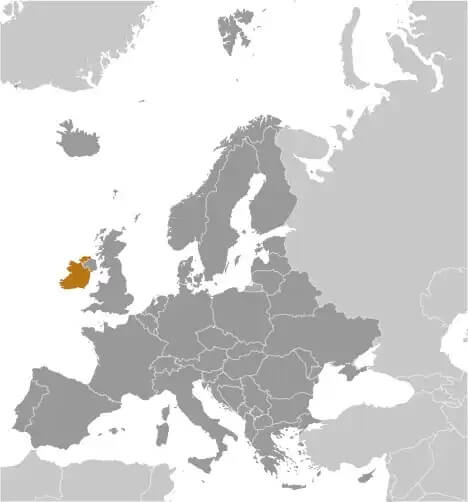
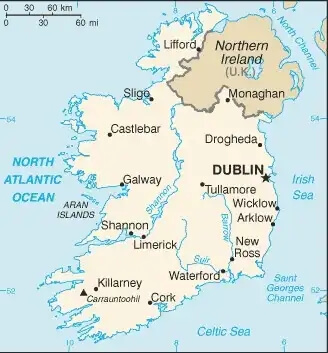
Ireland's geography is characterized by its lush landscapes and rugged coastlines, offering a diverse range of natural beauty. The island is situated in the North Atlantic Ocean, west of Great Britain, and is known for its temperate maritime climate, which is significantly influenced by the North Atlantic Current. This results in mild winters and cool summers, with a consistent level of humidity and overcast skies that are prevalent throughout the year. The country is endowed with a variety of natural resources, including natural gas, peat, copper, lead, zinc, silver, barite, gypsum, limestone, and dolomite, which contribute to its economic activities and development.
People and Society
Population
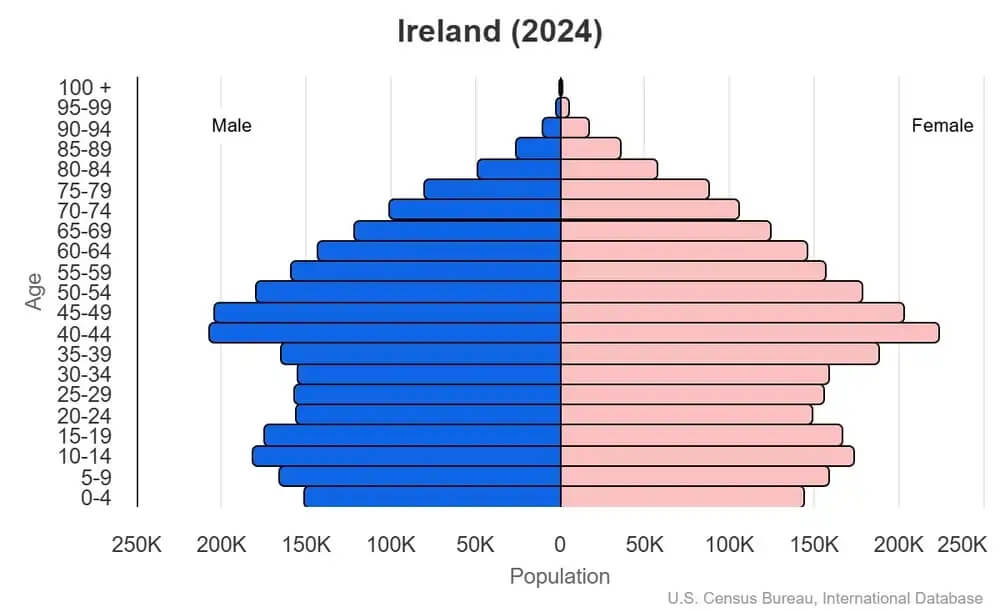
Total: 5,233,461 (2024 estimated)
Ethnic groups
Irish 76.6%, Irish travelers 0.6%, other White 9.9%, Asian 3.3%, Black 1.5%, other (includes Arab, Roma, and persons of mixed backgrounds) 2%, unspecified 2.6% (2022 estimated)
Languages
English (official, the language generally used), Irish (Gaelic or Gaeilge) (official, spoken by approximately 37.7% of the population)
Religions
Roman Catholic 69.2% (includes lapsed), Protestant 3.7% (Church of Ireland/England/Anglican/Episcopalian 2.5%, other Protestant 1.2%), Orthodox 2%, other Christian 0.9%, Muslim 1.6%, other 1.4%, agnostic/atheist 0.1%, none 14.5%, unspecified 6.7% (2022 estimated)
Population growth rate
0.93% (2024 estimated)
Ireland's population reflects a rich tapestry of ethnic diversity, with the majority identifying as Irish (76.6%). The presence of Irish travelers and various other ethnic groups, including Asian and Black communities, highlights the multicultural aspect of modern Irish society. English serves as the primary language, while Irish, recognized as an official language, is spoken by a significant minority, emphasizing the country's cultural heritage. The religious landscape is predominantly Roman Catholic, yet there exists a notable presence of other faiths, including Protestant and Muslim communities. The population growth rate of 0.93% indicates a steady increase, suggesting a dynamic society that continues to evolve and adapt in the face of global changes.
Government
Government type
Parliamentary republic
Capital
Name: Dublin
Executive branch
Chief of state: President Michael D. HIGGINS (since 11 November 2011)
Head of government: Taoiseach (Prime Minister) Michael MARTIN (since 23 January 2025)
Diplomatic representation in the US
Chief of mission: Ambassador Geraldine BYRNE NASON (since 16 September 2022)
Diplomatic representation from the US
Chief of mission: Ambassador Edward S. WALSH (since 1 July 2025)
Ireland operates as a parliamentary republic, where the government is elected by the people and accountable to the parliament. The capital city, Dublin, serves as the political and administrative center of the country. The executive branch is led by the President, currently Michael D. Higgins, who has held the position since November 2011, and the Taoiseach, or Prime Minister, Michael Martin, who took office in January 2025. This political structure facilitates a democratic process, allowing for representation and participation from the citizenry in governance.
Economy
Economic overview
High-income, export-oriented EU economy; large multinational business sector contributes to growth and tax revenues but poses volatility risks; high living standards; strong labor market challenged by skill shortages and aging workforce
Real GDP (purchasing power parity)
$620.544 billion (2024 estimated)
$613.056 billion (2023 estimated)
$648.943 billion (2022 estimated)
Real GDP per capita
$115,300 (2024 estimated)
$115,500 (2023 estimated)
$124,500 (2022 estimated)
Exports
$761.876 billion (2023 estimated)
$763.233 billion (2022 estimated)
$722.655 billion (2021 estimated)
Exports - partners
USA 28%, Germany 11%, UK 8%, Belgium 8%, China 7% (2023)
Exports - commodities
Vaccines, packaged medicine, nitrogen compounds, integrated circuits, hormones (2023)
Imports
$580.399 billion (2023 estimated)
$536.882 billion (2022 estimated)
$500.334 billion (2021 estimated)
Imports - partners
UK 20%, USA 17%, France 10%, China 7%, Germany 7% (2023)
Imports - commodities
Aircraft, nitrogen compounds, vaccines, packaged medicine, integrated circuits (2023)
Human Development Index
The country's Human Development Index (HDI) is 0.949, ranking it 11th out of 193 countries tested. (more information)
World Happiness Report
The World Happiness Report ranked the country 21st out of 158 countries tested with a score of 6.749. (more information)