World Book
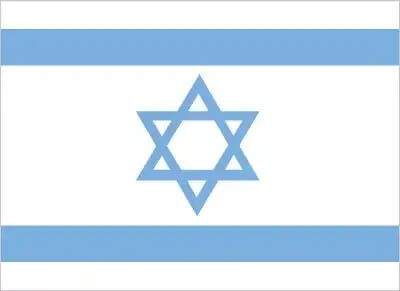
Israel
World Book Index
84

With a score of 84, the country is ranked 3rd out of 158 countries in the World Book ranking. (more information)
Introduction
The State of Israel, established in 1948, represents a significant historical and cultural entity in the Middle East. Following the end of British rule over Palestine, Israel emerged as a sovereign nation and quickly became a member of the United Nations in 1949. The country has experienced remarkable demographic changes, largely fueled by waves of immigration from Europe and the Middle East, contributing to a diverse and vibrant society. Over the past 25 years, Israel's economy has undergone a remarkable transformation, characterized by a robust high-tech sector that has positioned the nation as a global leader in innovation and technology.
Neighboring countries
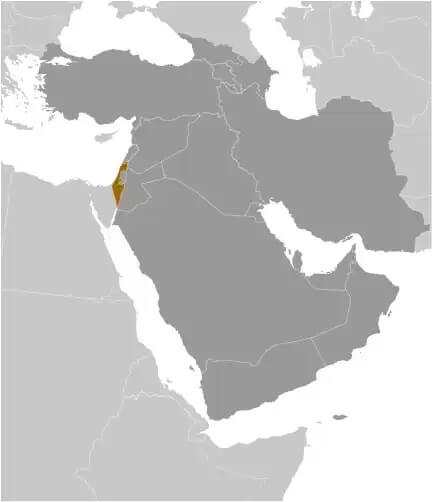
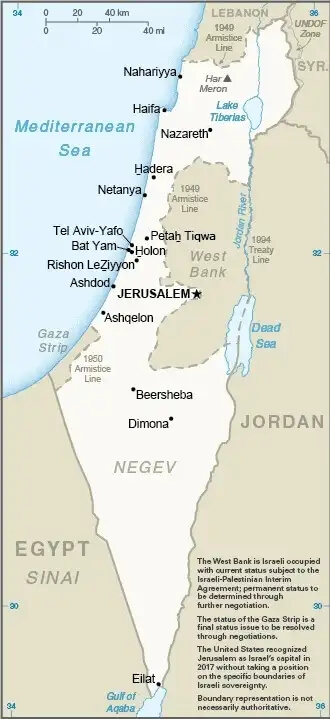
Gaza Strip - Egypt - Jordan - Lebanon - Syria - West Bank
Geography
Area
Total: 21,937 sq km
Land: 21,497 sq km
Water: 440 sq km
Climate
Israel's climate is predominantly temperate, with hot and dry conditions prevailing in the southern and eastern desert regions. This climatic diversity contributes to the country's varied ecosystems and agricultural practices.
Natural resources
The nation is endowed with several natural resources, including timber, potash, copper ore, natural gas, phosphate rock, magnesium bromide, clays, and sand. These resources play a crucial role in supporting Israel's economy and industrial activities.
People and Society
Population
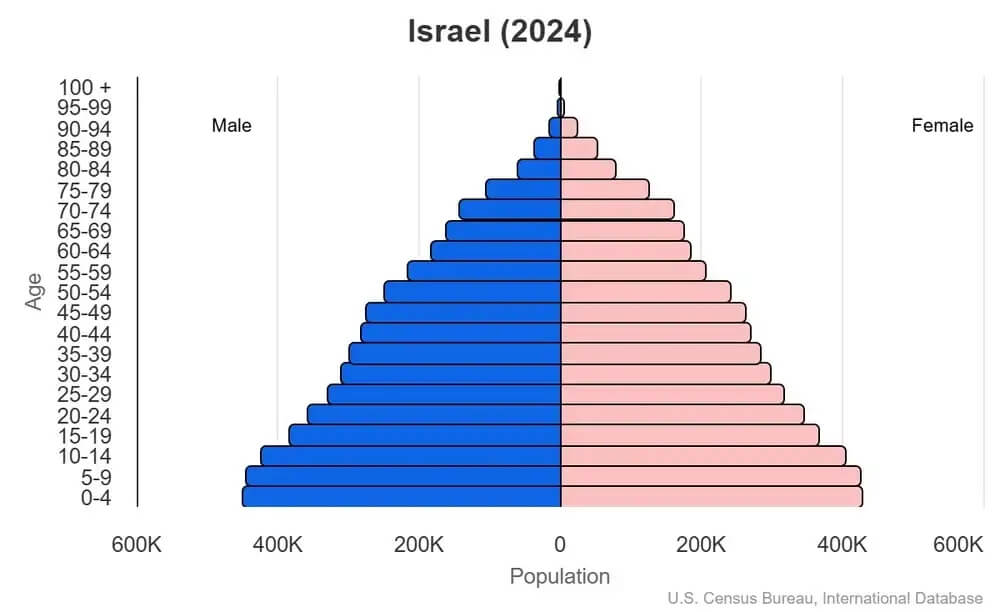
Total: 9,402,617 (2024 estimated)
Ethnic groups
The population is predominantly Jewish, comprising 73.5% of the total, with a significant portion being Israel-born (79.7%). The Jewish community is diverse, with 14.3% originating from Europe, America, and Oceania, 3.9% from Africa, and 2.1% from Asia. Arabs make up 21.1% of the population, while other ethnic groups account for 5.4% (2022 estimated). This ethnic composition reflects the complex historical and social dynamics within the country.
Languages
Hebrew is the official language, while Arabic holds a special status under Israeli law. English is widely spoken and serves as the most commonly used foreign language, facilitating communication in various sectors, including business and tourism.
Religions
The religious landscape is predominantly Jewish (73.5%), followed by Muslims (18.1%), Christians (1.9%), Druze (1.6%), and other faiths (4.9%) (2022 estimated). This religious diversity influences cultural practices and societal norms across the nation.
Population growth rate
1.58% (2024 estimated)
Government
Government type
Israel operates as a parliamentary democracy, characterized by a multi-party system that allows for a diverse representation of political views.
Capital
Name: Jerusalem
Executive branch
The chief of state is President Isaac HERZOG, who has been in office since 7 July 2021. The head of government is Prime Minister Benyamin NETANYAHU, who has held the position since 29 December 2022.
Diplomatic representation in the US
The chief of mission is Ambassador Yechiel (Michael) LEITER, who has served since 4 February 2025.
Diplomatic representation from the US
The chief of mission is Ambassador Mike HUCKABEE, who took office on 21 April 2025.
Economy
Economic overview
Israel boasts a high-income, technology- and industrial-based economy. However, recent conflicts, particularly the war in Gaza, have led to economic contraction and fiscal deficits. The labor force is stabilizing after the mobilization of military reservists, while the high-tech industry continues to demonstrate resilience. In contrast, sectors such as construction and tourism have been among the hardest hit by the ongoing challenges.
Real GDP (purchasing power parity)
$472.177 billion (2024 estimated)
$468.095 billion (2023 estimated)
$459.698 billion (2022 estimated)
Real GDP per capita
$47,300 (2024 estimated)
$47,500 (2023 estimated)
$48,100 (2022 estimated)
Exports
$153.248 billion (2024 estimated)
$154.638 billion (2023 estimated)
$164.407 billion (2022 estimated)
Exports - partners
USA 29%, China 10%, Ireland 6%, Germany 4%, Hong Kong 4% (2023)
Exports - commodities
Key exports include integrated circuits, diamonds, broadcasting equipment, medical instruments, and refined petroleum (2023).
Imports
$140.438 billion (2024 estimated)
$140.432 billion (2023 estimated)
$153.388 billion (2022 estimated)
Imports - partners
Major import partners include China (17%), USA (12%), Germany (7%), Turkey (6%), and Italy (4%) (2023).
Imports - commodities
Israel's imports consist primarily of cars, diamonds, crude petroleum, broadcasting equipment, and garments (2023).
Human Development Index
The country's Human Development Index (HDI) is 0.919, ranking it 27th out of 193 countries tested. (more information)
World Happiness Report
The World Happiness Report ranked the country 2nd out of 158 countries tested with a score of 7.667. (more information)