World Book
Kuwait
World Book Index
77

With a score of 77, the country is ranked 27th out of 158 countries in the World Book ranking. (more information)
Introduction
Kuwait, a small yet strategically significant nation in the Arabian Peninsula, gained independence from the United Kingdom in 1961. The country faced a tumultuous period when Iraq invaded and occupied it in 1990, leading to a US-led coalition intervention that successfully liberated Kuwait in 1991. Since then, the AL-SABAH family has maintained its rule, overseeing a political landscape characterized by a reestablished elected legislature that has grown increasingly assertive in recent years. This dynamic has shaped Kuwait's identity as a nation striving for both stability and progress in a complex regional context.
Neighboring countries
Iraq - Saudi Arabia
Geography
Area
Total: 17,818 sq km
Land: 17,818 sq km
Water: 0 sq km
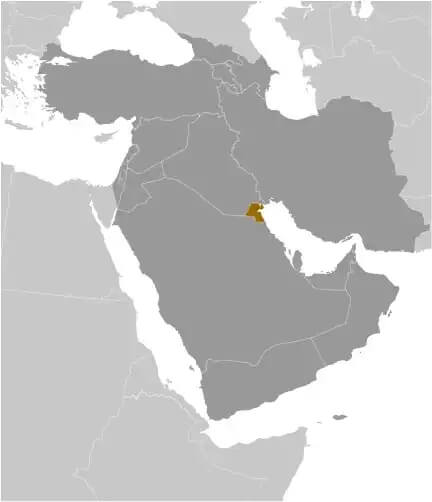
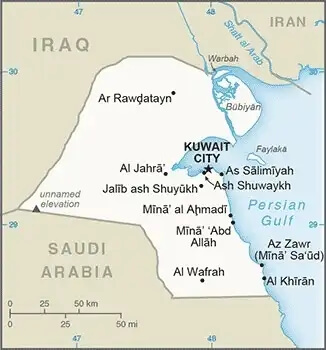
Kuwait is situated at the northeastern edge of the Arabian Peninsula, bordered by Iraq to the north and Saudi Arabia to the south. The country's geography is predominantly flat and arid, characterized by a dry desert climate that experiences intensely hot summers and short, cool winters. Despite its small size, Kuwait's strategic location along the Persian Gulf has historically made it a focal point for trade and commerce. The nation is endowed with significant natural resources, particularly petroleum, which has been the backbone of its economy. Additionally, Kuwait's coastal waters are home to a variety of marine life, including fish and shrimp, contributing to its economic diversity.
People and Society
Population
Total: 3,138,355 (2024 estimated)
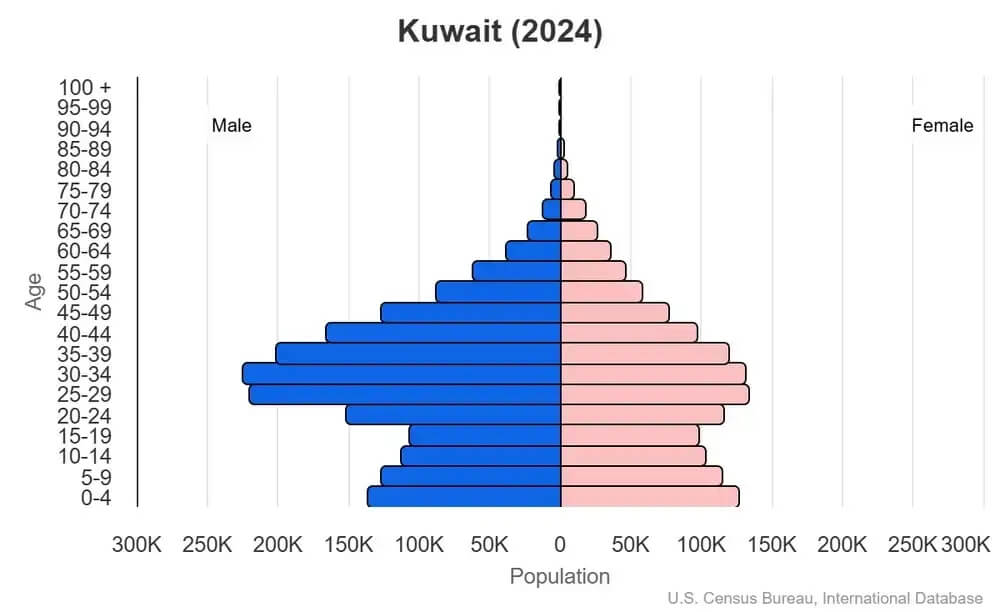
Kuwait's population is a vibrant tapestry of ethnicities and cultures, with Kuwaiti nationals comprising 30.4% of the total population, while other Arab groups account for 27.4%, and a significant Asian community makes up 40.3%. This diverse demographic landscape reflects Kuwait's historical role as a regional hub for trade and migration. The official language is Arabic, although English is widely spoken, facilitating communication in this multicultural society. The predominant religion is Islam, with 74.6% of the population identifying as Muslim, followed by 18.2% who are Christians. The population growth rate stands at 1.1% (2024 estimated), indicating a steady increase in the number of residents, which poses both opportunities and challenges for the nation's social and economic development.
Government
Government type
Constitutional monarchy (emirate)
Capital
Name: Kuwait City
Kuwait operates under a constitutional monarchy, where the Amir serves as the chief of state. The current Amir, MISHAL al-Ahmad al-Jabir al-Sabah, has been in power since December 16, 2023. The head of government is Prime Minister AHMAD ABDULLAH Al-Ahmad al Sabah, who took office on May 15, 2024. The political framework allows for a degree of parliamentary representation, with an elected legislature that plays a crucial role in governance. Kuwait's diplomatic representation in the United States is led by Ambassador AL-ZAIN Sabah Naser Saud Al-Sabah, who has been in position since April 19, 2023. The US diplomatic mission in Kuwait is currently represented by Chargé d’Affaires Steven R. BUTLER since July 2025, highlighting the ongoing bilateral relations between the two nations.
Economy
Economic overview
Kuwait boasts a small, high-income, oil-based economy that plays a pivotal role in the Middle East. The nation is a proponent of renewable energy initiatives and has established itself as a regional leader in finance and investment. Notably, Kuwait maintains the oldest sovereign wealth fund in the world, which underscores its commitment to economic stability and growth. The country is currently navigating a 25-year development program aimed at diversifying its economy, with emerging sectors such as space and tourism gaining traction. This strategic focus is essential for ensuring sustainable economic growth in the face of global energy transitions.
Real GDP (purchasing power parity)
$225.947 billion (2024 estimated)
$231.884 billion (2023 estimated)
$235.815 billion (2022 estimated)
Real GDP per capita
$45,400 (2024 estimated)
$47,800 (2023 estimated)
$51,400 (2022 estimated)
Exports
$89.71 billion (2024 estimated)
$95.476 billion (2023 estimated)
$110.923 billion (2022 estimated)
Exports - partners
China 25%, India 13%, Japan 13%, Taiwan 7%, UK 5% (2023)
Exports - commodities
Crude petroleum, refined petroleum, natural gas, hydrocarbons, plastics (2023)
Imports
$61.521 billion (2024 estimated)
$63.43 billion (2023 estimated)
$55.909 billion (2022 estimated)
Imports - partners
China 18%, UAE 10%, USA 9%, Saudi Arabia 6%, Japan 6% (2023)
Imports - commodities
Cars, natural gas, garments, broadcasting equipment, packaged medicine (2023)
Human Development Index
The country's Human Development Index (HDI) is 0.852, ranking it 52nd out of 193 countries tested. (more information)
World Happiness Report
The World Happiness Report ranked the country 16th out of 158 countries tested with a score of 6.9. (more information)