World Book
Luxembourg
World Book Index
82

With a score of 82, the country is ranked 8th out of 158 countries in the World Book ranking. (more information)
Introduction
Founded in 963, Luxembourg has a rich historical legacy that has shaped its identity as a nation. It became a grand duchy in 1815 and was recognized as a constituent part of the Kingdom of the Netherlands following the Congress of Vienna. The subsequent declaration of independence by Belgium in 1839 resulted in Luxembourg losing more than half of its territory. However, it regained full sovereignty in 1867. Today, Luxembourg stands as a prominent member of the European Union, being one of the six founding members of the European Economic Community (EEC), which later evolved into the EU. This small yet influential country plays a significant role in European politics and economics, reflecting its historical resilience and adaptability.
Neighboring countries
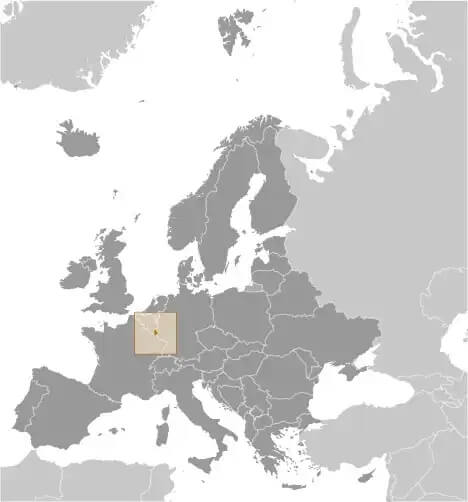
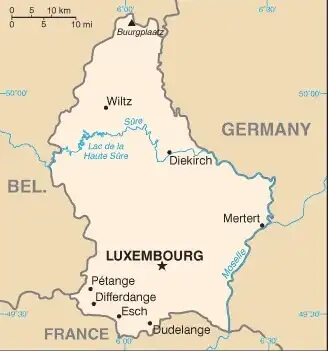
Belgium - France - Germany
Geography
Area
Total: 2,586 sq km
Land: 2,586 sq km
Water: 0 sq km
Climate
Luxembourg experiences a modified continental climate characterized by mild winters and cool summers, providing a diverse range of seasonal changes that influence both the environment and lifestyle of its inhabitants.
Natural resources
The country is endowed with arable land, although its historical iron ore deposits are no longer exploited. This limited resource base necessitates a focus on sustainable agricultural practices and efficient land use to support its economy.
People and Society
Population
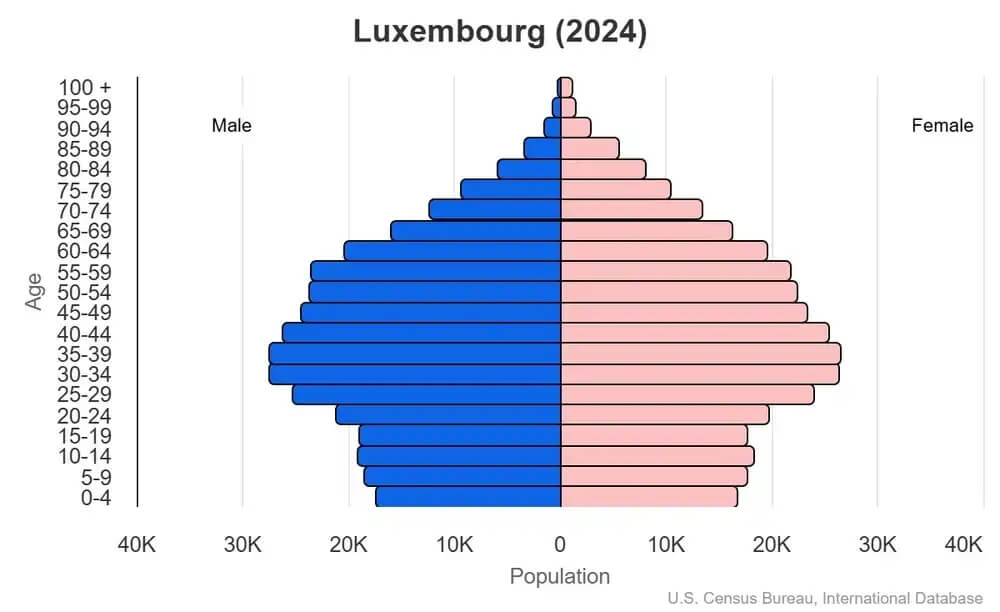
Total: 671,254 (2024 estimated)
Ethnic groups
The demographic composition of Luxembourg is quite diverse, with Luxembourgers making up 52.9% of the population, followed by significant communities of Portuguese (14.5%), French (7.6%), and Italians (3.7%). Other ethnicities include Belgians (3%), Germans (2%), Spaniards (1.3%), Romanians (1%), and various other groups (14%) as of 2022. This multicultural environment enriches the social fabric of the nation, fostering a blend of traditions and cultural practices.
Languages
Luxembourgish serves as the official administrative, judicial, and national language, spoken by 48.9% of the population. Additionally, Portuguese (15.4%) and French (14.9%) are also widely used, with French serving as an official administrative, judicial, and legislative language. Other languages such as Italian (3.6%), English (3.6%), and German (2.9%) contribute to the linguistic diversity, reflecting the country's historical ties and contemporary global interactions as of 2021.
Religions
The religious landscape is predominantly Christian, with 70.6% of the population identifying as Roman Catholic. A small Muslim community constitutes 2.3%, while other religions, including Buddhism, folk religions, Hinduism, and Judaism, account for 0.4%. Notably, 26.7% of the population is unaffiliated, indicating a trend towards secularism and diverse belief systems as of 2020.
Population growth rate
1.52% (2024 estimated)
Government
Government type
Luxembourg operates under a constitutional monarchy, where the Grand Duke serves as the head of state, embodying the nation's historical continuity and stability.
Capital
Name: Luxembourg
Executive branch
The chief of state is Grand Duke HENRI, who has held the position since 7 October 2000. The head of government is Prime Minister Luc FRIEDEN, who took office on 17 November 2023, leading the executive branch in shaping national policies and governance.
Diplomatic representation in the US
The chief of mission is Ambassador Nicole BINTNER-BAKSHIAN, who has been in position since 15 August 2021, representing Luxembourg's interests in the United States.
Diplomatic representation from the US
The chief of mission is currently vacant, with Chargé d'Affaires Anthony BAIRD serving since 21 July 2025, maintaining diplomatic relations between the two nations.
Economy
Economic overview
Luxembourg boasts a high-income economy within the EU and eurozone, characterized by a global and highly capitalized banking sector. It consistently ranks among the highest countries in terms of GDP per capita, reflecting its economic prosperity. The growth of the economy has been bolstered by strengthened domestic demand and lower interest rates, which have contributed positively to overall economic performance. However, challenges persist, including the sustainability of the pension system, dynamics within the labor market, and volatility in energy prices, which require ongoing attention and strategic planning.
Real GDP (purchasing power parity)
$86.871 billion (2024 estimated)
$85.984 billion (2023 estimated)
$86.584 billion (2022 estimated)
Real GDP per capita
$128,200 (2024 estimated)
$129,000 (2023 estimated)
$132,600 (2022 estimated)
Exports
$202.203 billion (2024 estimated)
$195.294 billion (2023 estimated)
$184.53 billion (2022 estimated)
Exports - partners
Germany 18%, France 15%, Belgium 8%, Netherlands 7%, Italy 6% (2023)
Exports - commodities
Key exports include iron blocks, gas turbines, plastic products, rubber tires, and various plastics as of 2023.
Imports
$160.032 billion (2024 estimated)
$156.818 billion (2023 estimated)
$149.751 billion (2022 estimated)
Imports - partners
The primary sources of imports are Belgium (26%), Germany (23%), France (10%), Netherlands (5%), and the USA (4%) as of 2023.
Imports - commodities
Luxembourg's imports consist mainly of cars, refined petroleum, electricity, plastic products, and gas turbines as of 2023.
Human Development Index
The country's Human Development Index (HDI) is 0.922, ranking it 25th out of 193 countries tested. (more information)
World Happiness Report
The World Happiness Report ranked the country 8th out of 158 countries tested with a score of 7.301. (more information)