World Book
Mauritania
World Book Index
49

With a score of 49, the country is ranked 131th out of 158 countries in the World Book ranking. (more information)
Introduction
Mauritania, a nation steeped in rich history, is home to the Amazigh and Bafour peoples, who were among the earliest inhabitants of this vast land. Gaining independence from French colonial rule in 1960 marked a significant turning point in its history. The journey since then has been tumultuous, characterized by periods of dictatorship, flawed electoral processes, and military interventions. However, in recent years, Mauritania has made strides towards establishing itself as an emerging democracy, navigating the complexities of governance and societal change.
Neighboring countries
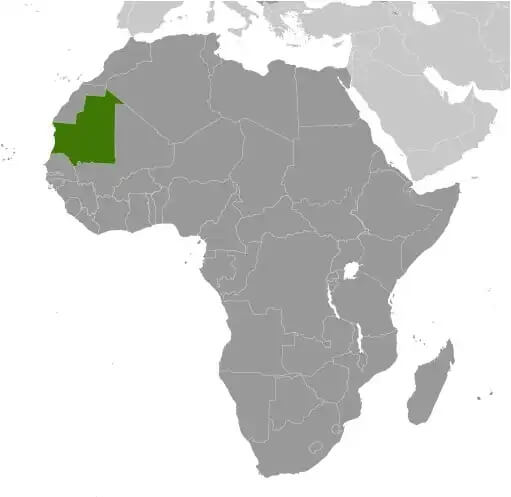
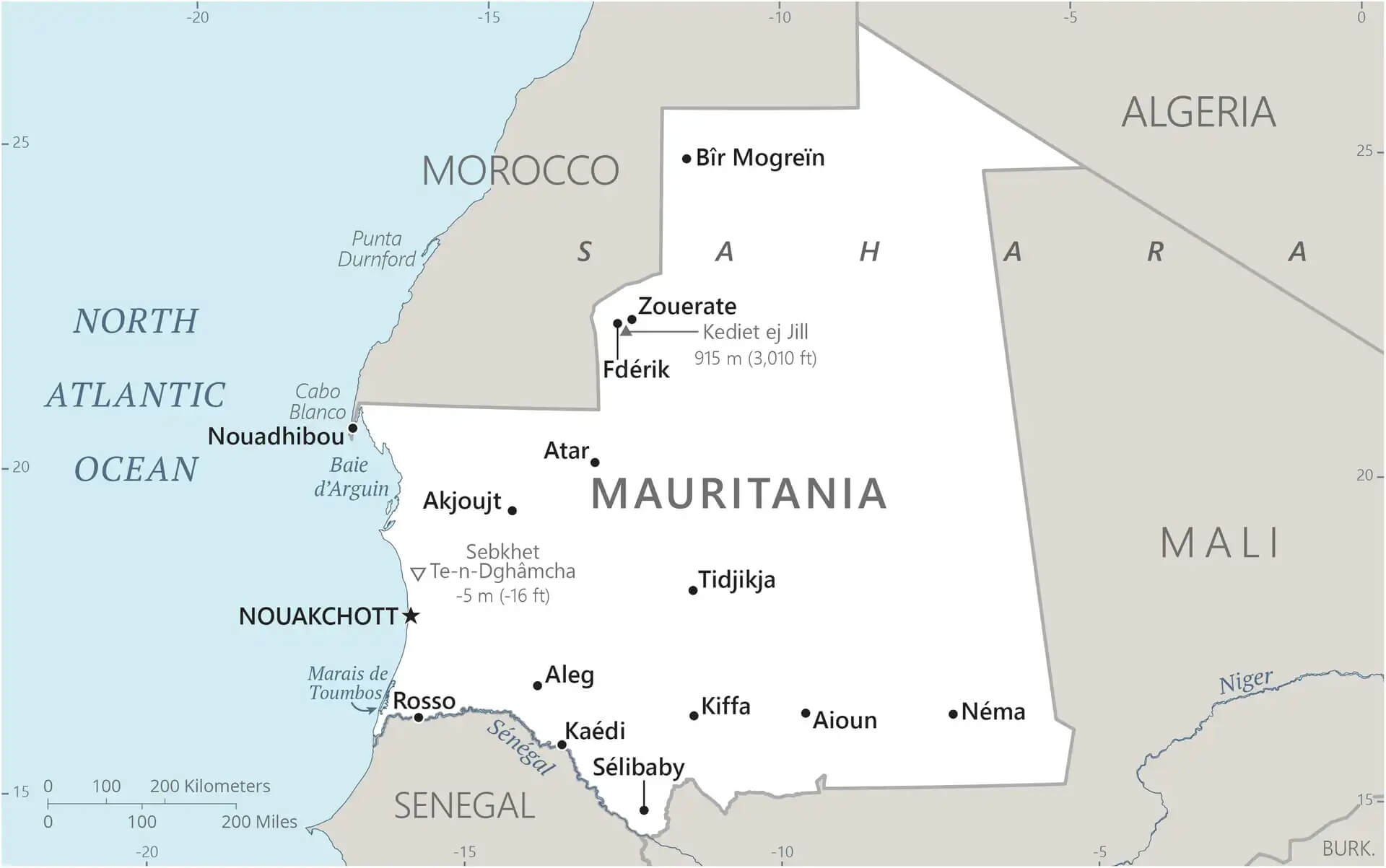
Algeria - Mali - Senegal
Geography
Area
Total: 1,030,700 sq km
Land: 1,030,700 sq km
Water: 0 sq km
Mauritania is characterized by its vast expanse of land, making it one of the largest countries in Africa. The entire territory is predominantly arid, with a climate that is classified as desert, resulting in consistently high temperatures and low humidity. The country is devoid of significant bodies of water, which further accentuates its dry landscape. Despite these challenges, Mauritania is endowed with a wealth of natural resources, including iron ore, gypsum, copper, phosphate, diamonds, gold, oil, and fish, which play a crucial role in its economic activities.
People and Society
Population
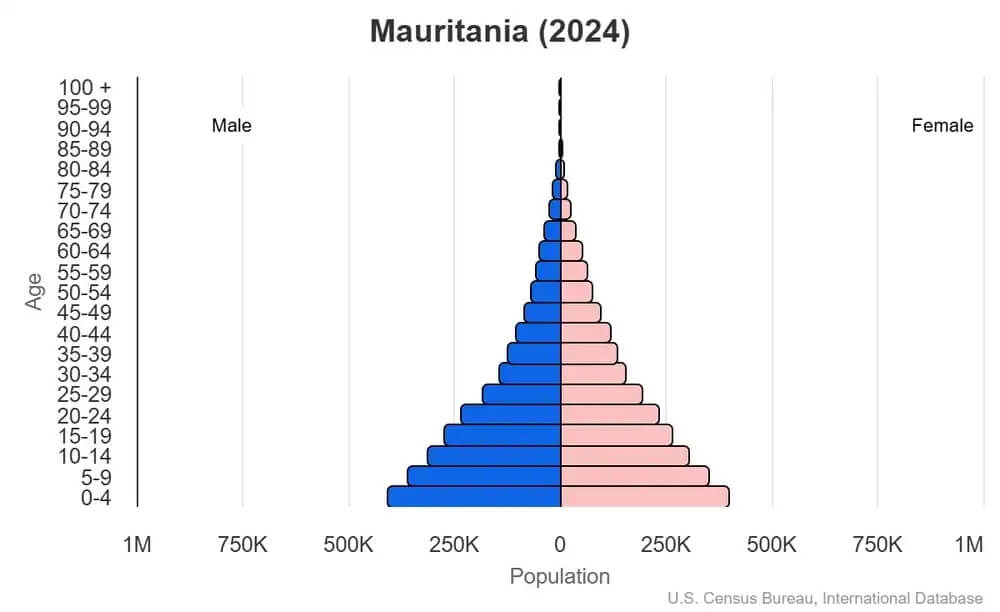
Total: 4,328,040 (2024 estimated)
Ethnic groups
Black Moors (Haratines - Arabic-speaking descendants of African origin who are or were enslaved by White Moors) 40%, White Moors (of Arab-Amazigh descent, known as Beydane) 30%, Sub-Saharan Mauritanians (non-Arabic speaking, largely resident in or originating from the Senegal River Valley, including Halpulaar, Fulani, Soninke, Wolof, and Bambara ethnic groups) 30%
Languages
Arabic (official and national), Pular, Soninke, Wolof (all national languages), French
Religions
Muslim (official) 100%
Population growth rate
1.92% (2024 estimated)
The demographic landscape of Mauritania is marked by a diverse tapestry of ethnic groups, with the Black Moors, White Moors, and Sub-Saharan Mauritanians each contributing to the cultural richness of the nation. Arabic serves as the official language, while several other languages reflect the country's ethnic diversity. The population is predominantly Muslim, which shapes the social fabric and cultural practices of the society. With a population growth rate of 1.92%, Mauritania is experiencing gradual demographic changes that may influence its socio-economic dynamics in the coming years.
Government
Government type
Presidential republic
Capital
Name: Nouakchott
Executive branch
Chief of state: President Mohamed Ould Cheikh el GHAZOUANI (since 1 August 2019)
Head of government: Prime Minister Moctar Ould DIAY (since 2 August 2024)
Diplomatic representation in the US
Chief of mission: Ambassador Cissé Mint Cheikh Ould BOIDE (since 15 September 2021)
Diplomatic representation from the US
Chief of mission: Ambassador (vacant); John T. ICE Chargé d’Affaires (since July 2024)
Mauritania operates as a presidential republic, where the President serves as both the head of state and government. The capital city, Nouakchott, serves as the political and administrative center of the country. The current leadership, under President Mohamed Ould Cheikh el GHAZOUANI, has been in place since August 2019, with Prime Minister Moctar Ould DIAY taking office in August 2024. The diplomatic landscape is marked by active representation in the United States, with an ambassadorial position currently held by Cissé Mint Cheikh Ould BOIDE.
Economy
Economic overview
Lower middle-income West African economy; primarily agrarian; rising urbanization; poor property rights; systemic corruption; endemic social and workforce tensions; wide-scale terrorism; foreign over-fishing; environmentally fragile
Real GDP (purchasing power parity)
$33.069 billion (2024 estimated)
$31.434 billion (2023 estimated)
$29.514 billion (2022 estimated)
Real GDP per capita
$6,400 (2024 estimated)
$6,300 (2023 estimated)
$6,100 (2022 estimated)
Exports
$3.955 billion (2023 estimated)
$4.132 billion (2022 estimated)
$3.18 billion (2021 estimated)
Exports - partners
China 25%, Switzerland 14%, Canada 12%, UAE 9%, Spain 7% (2023)
Exports - commodities
Gold, iron ore, fish, processed crustaceans, copper ore (2023)
Imports
$5.271 billion (2023 estimated)
$5.77 billion (2022 estimated)
$4.312 billion (2021 estimated)
Imports - partners
China 19%, UAE 14%, Morocco 6%, Spain 6%, France 5% (2023)
Imports - commodities
Refined petroleum, raw sugar, palm oil, wheat, soybean oil (2023)
Mauritania's economy is classified as a lower middle-income economy within West Africa, heavily reliant on agriculture and natural resources. The nation is witnessing a trend of rising urbanization, which is gradually transforming its economic landscape. However, challenges such as poor property rights, systemic corruption, and social tensions persist, complicating economic development. The country's GDP, estimated at $33.069 billion in 2024, reflects a modest growth trajectory, with a real GDP per capita of $6,400. Exports are primarily driven by commodities such as gold, iron ore, and fish, with China being the largest trading partner. Conversely, imports are dominated by refined petroleum and agricultural products, indicating a reliance on foreign goods to meet domestic needs. The economic environment remains fragile, exacerbated by issues like terrorism and environmental vulnerabilities.
Human Development Index
The country's Human Development Index (HDI) is 0.563, ranking it 163rd out of 193 countries tested. (more information)
World Happiness Report
The World Happiness Report ranked the country 129th out of 158 countries tested with a score of 4.269. (more information)