World Book
Monaco
Introduction
Monaco, a small yet captivating principality on the French Riviera, boasts a rich historical tapestry that dates back to its establishment by the Genoese in 1215. The GRIMALDI family, who have ruled since their initial takeover in 1297, faced challenges in solidifying their power until 1419. The late 19th century marked a pivotal era for Monaco, as the introduction of a railroad connection to France and the establishment of a casino catalyzed significant economic growth, transforming the region into a renowned destination for luxury and tourism.
Neighboring country
France
Geography
Area
Total: 2 sq km
Land: 2 sq km
Water: 0 sq km
Climate
Monaco enjoys a Mediterranean climate characterized by mild, wet winters and hot, dry summers, making it an attractive location for both residents and tourists alike.
Natural resources
Monaco has no significant natural resources, which has led to a reliance on its strategic location and developed sectors for economic sustenance.
People and Society
Population
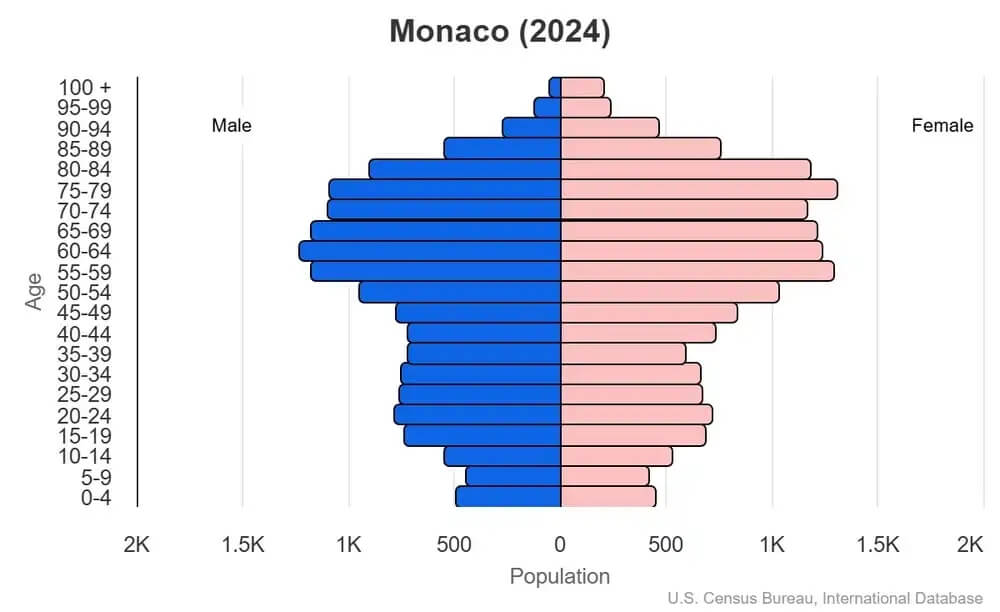
Total: 31,813 (2024 estimated)
Ethnic groups
The population is diverse, comprising Monegasque 32.1%, French 19.9%, Italian 15.3%, British 5%, Belgian 2.3%, Swiss 2%, German 1.9%, Russian 1.8%, American 1.1%, Dutch 1.1%, Moroccan 1%, and other 16.6% (2016 estimated). This ethnic mosaic contributes to the vibrant cultural landscape of Monaco.
Languages
The official language is French, but English, Italian, and Monegasque are also widely spoken, reflecting the multicultural nature of the society.
Religions
Roman Catholicism is the predominant religion, practiced by 90% of the population, with other religions representing the remaining 10%. This religious landscape plays a significant role in the cultural and social fabric of the principality.
Population growth rate
The population growth rate stands at 0.71% (2024 estimated), indicating a steady increase in the number of residents, which can be attributed to both natural growth and immigration.
Government
Government type
Monaco operates as a constitutional monarchy, where the Prince holds significant authority alongside a parliamentary system.
Capital
Name: Monaco
Executive branch
The chief of state is Prince ALBERT II (since 6 April 2005), while the head of government is Minister of State Christophe MIRMAND (since 21 July 2025), who oversees the administration of the principality.
Diplomatic representation in the US
The chief of mission is Ambassador Maguy MACCARIO DOYLE (since 3 December 2013), representing Monaco's interests in the United States.
Economy
Economic overview
Monaco's economy is classified as a high-income European economy, notable for its status as a non-EU euro user and a recognized tax haven. The tourism and banking sectors are the largest contributors to its economic framework. However, the economy faced challenges due to the COVID-19 pandemic, impacting various sectors. The principality is also home to a major oceanographic museum and is known for having some of the most expensive real estate in the world, alongside several major state-owned enterprises.
Real GDP (purchasing power parity)
$8.924 billion (2024 estimated)
$8.749 billion (2023 estimated)
$8.329 billion (2022 estimated)
Real GDP per capita
$270,100 (2024 estimated)
$256,600 (2023 estimated)
$226,100 (2022 estimated)
Exports - partners
Italy, Switzerland, Germany, Belgium, Spain
(2021)
Exports - commodities
Monaco's exports include jewelry, perfumes, watches, packaged medicines, and cars (2021), showcasing its luxury market orientation.
Imports - partners
Italy, Switzerland, United Kingdom, Germany, China (2021)
Imports - commodities
The principality imports jewelry, cars and vehicle parts, recreational boats, plastic products, and artwork (2021), reflecting its consumption patterns and luxury lifestyle.