World Book
Mongolia
World Book Index
64

With a score of 64, the country is ranked 89th out of 158 countries in the World Book ranking. (more information)
Introduction
Mongolia, a landlocked nation in East Asia, has a rich historical tapestry woven through centuries of nomadic culture and conquest. The Mongols, under the leadership of Genghis Khan, established one of the largest empires in history during the 13th century, which spanned vast territories across Eurasia. Following this period of expansion, the Mongols returned to their steppe homelands, where they faced the influence of neighboring powers, particularly China, which asserted control in the late 17th century. The Mongolian Revolution of 1921 marked a significant turning point, as it ended Chinese dominance and initiated a period of Soviet influence. The country transitioned to a democratic system in 1990, embracing a new era of political and economic reform that continues to shape its identity today.
Neighboring countries
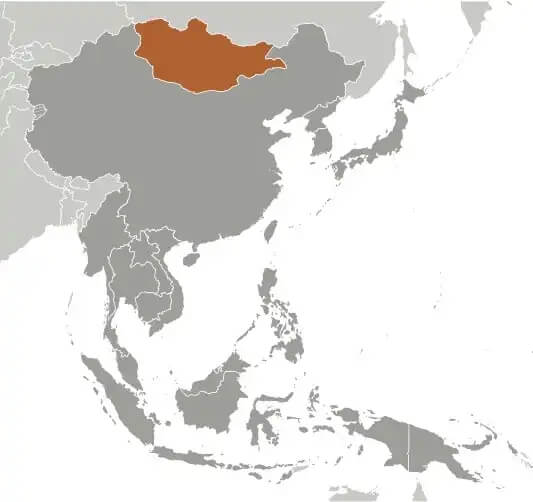
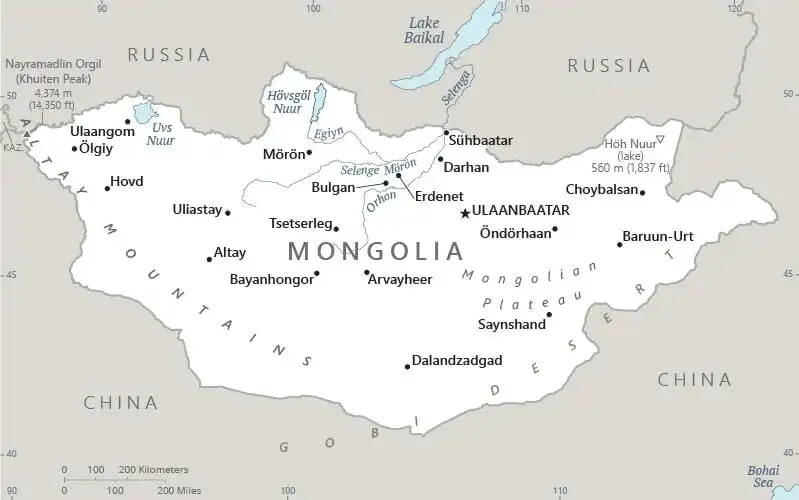
China - Russia
Geography
Area
Total: 1,564,116 sq km
Land: 1,553,556 sq km
Water: 10,560 sq km
Mongolia is characterized by its vast and diverse landscapes, which include expansive steppes, rugged mountains, and arid deserts. The country's topography is predominantly elevated, with an average altitude of about 1,580 meters above sea level, making it one of the highest countries in the world. The Gobi Desert, located in the southern part of the country, is known for its extreme temperature variations and unique ecosystems. Mongolia's climate is classified as continental, with significant daily and seasonal temperature fluctuations, contributing to its distinct environmental conditions. The nation is endowed with a wealth of natural resources, including oil, coal, copper, molybdenum, tungsten, phosphates, tin, nickel, zinc, fluorspar, gold, silver, and iron, which play a crucial role in its economic development.
People and Society
Population
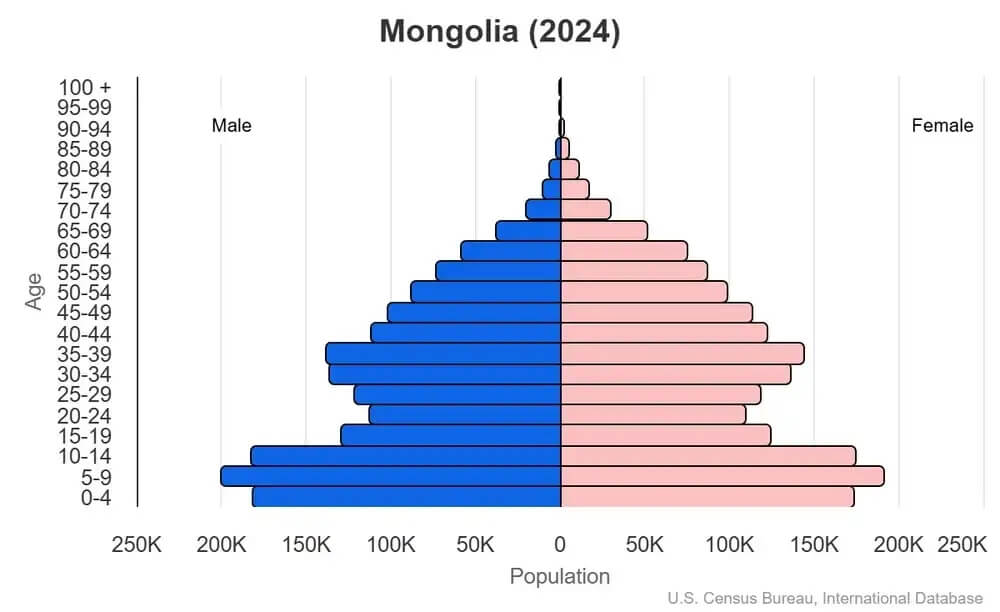
Total: 3,281,676 (2024 estimated)
Mongolia's population is a tapestry of ethnic diversity, with the Khalkh ethnic group comprising 83.8% of the total population, followed by Kazak (3.8%), Durvud (2.6%), and several other smaller groups. The demographic landscape reflects a blend of traditional nomadic lifestyles and urbanization, particularly in the capital city, Ulaanbaatar. The official language is Mongolian, predominantly in the Khalkha dialect, which is spoken by 90% of the population. The country is also home to various Turkic languages and Russian, reflecting its historical ties and cultural exchanges. In terms of religion, Buddhism is the most widely practiced faith, followed by Islam and Shamanism, with a significant portion of the population identifying as non-religious. The population growth rate stands at 0.78% (2024 estimated), indicating a gradual increase in the number of inhabitants, which poses both opportunities and challenges for the nation in terms of resource management and social services.
Government
Government type
Semi-presidential republic
Capital
Name: Ulaanbaatar
Mongolia operates under a semi-presidential republic framework, where the President serves as the head of state and the Prime Minister acts as the head of government. The current President, Ukhnaagiin Khurelsukh, has been in office since June 25, 2021, while the Prime Minister, Gombojavyn Zandanshatar, assumed office on June 13, 2025. This political structure allows for a balance of power between the executive and legislative branches, fostering democratic governance. Mongolia maintains diplomatic relations with various countries, including the United States, where the chief of mission is Ambassador Richard L. Buangan, who has served since November 2022. The country continues to navigate its foreign relations, balancing its historical ties with Russia and China while seeking to strengthen partnerships with Western nations.
Economy
Economic overview
Mongolia is classified as a lower middle-income economy within East Asia, characterized by significant improvements in human capital over the past three decades. The country is rich in agricultural and natural resources, which have been pivotal in driving its export and consumption-led growth. However, the economy faces challenges, including high inflation attributed to supply bottlenecks and rising food and energy prices, alongside currency depreciation that impacts purchasing power.
Real GDP (purchasing power parity)
$59.221 billion (2024 estimated)
$56.474 billion (2023 estimated)
$52.572 billion (2022 estimated)
Real GDP per capita
$16,800 (2024 estimated)
$16,200 (2023 estimated)
$15,300 (2022 estimated)
Exports
$15.501 billion (2023 estimated)
$10.989 billion (2022 estimated)
$8.95 billion (2021 estimated)
Exports - partners
China 92%, Switzerland 6%, Italy 1%, Thailand 0%, Japan 0% (2023)
Exports - commodities
Coal, copper ore, gold, iron ore, crude petroleum (2023)
Imports
$13.545 billion (2023 estimated)
$12.112 billion (2022 estimated)
$9.256 billion (2021 estimated)
Imports - partners
China 57%, Japan 13%, Germany 3%, Singapore 3%, USA 3% (2023)
Imports - commodities
Cars, trucks, trailers, tractors, construction vehicles (2023)
Human Development Index
The country's Human Development Index (HDI) is 0.747, ranking it 104th out of 193 countries tested. (more information)
World Happiness Report
The World Happiness Report ranked the country 90th out of 158 countries tested with a score of 5.364. (more information)