World Book
China
World Book Index
68

With a score of 68, the country is ranked 75th out of 158 countries in the World Book ranking. (more information)
Introduction
China, a nation with a rich and complex history, boasts a civilization that dates back to at least 1200 B.C. Over the centuries, it has experienced a dynamic ebb and flow of unity and disunity, shaped by a succession of imperial dynasties that have left an indelible mark on its culture and society. The 20th century brought significant upheaval, culminating in the establishment of the People's Republic of China in 1949 under the leadership of the Chinese Communist Party, led by MAO Zedong. This marked the beginning of an autocratic socialist system that has profoundly influenced the country's political landscape and economic trajectory, positioning China as a major global player in the contemporary world.
Neighboring countries
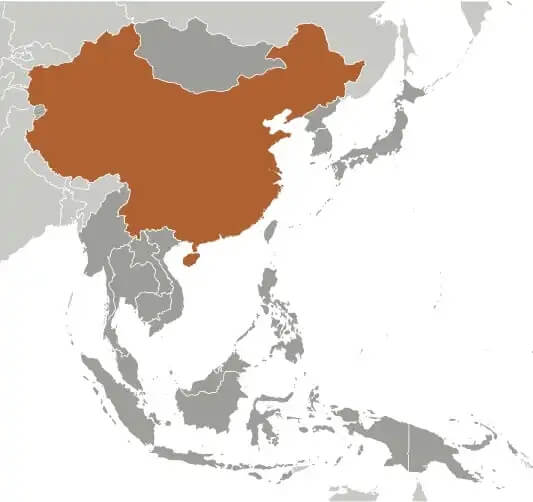
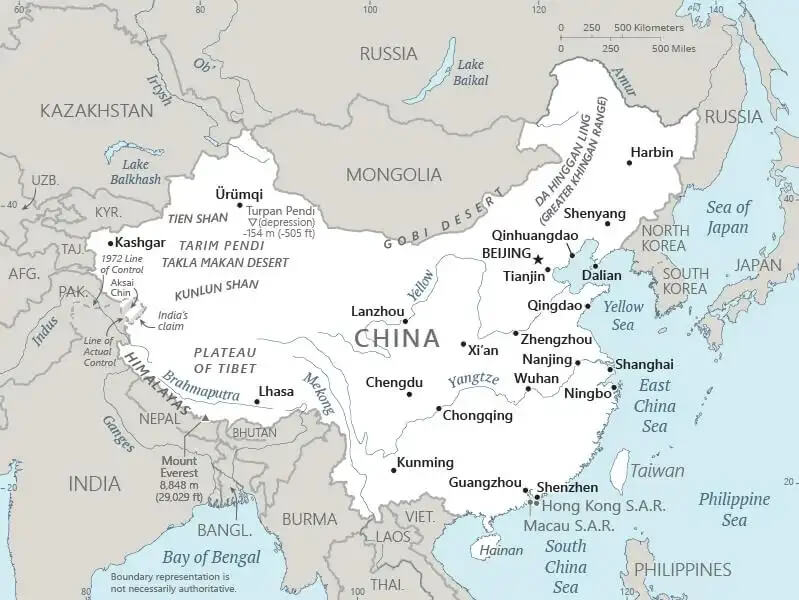
Afghanistan - Bhutan - Burma - India - Kazakhstan - Kyrgyzstan - Laos - Mongolia - Nepal - North Korea - Pakistan - Russia - Tajikistan - Vietnam
Geography
Area
Total: 9,596,960 sq km
Land: 9,326,410 sq km
Water: 270,550 sq km
China's geography is characterized by its vast expanse and remarkable diversity. Covering a total area of 9,596,960 square kilometers, it is the fourth largest country in the world. The land area alone spans 9,326,410 square kilometers, while water bodies account for 270,550 square kilometers. The country's climate ranges from tropical in the south to subarctic in the north, contributing to a wide variety of ecosystems and landscapes. This geographical diversity is complemented by an abundance of natural resources, including significant reserves of coal, iron ore, and petroleum, as well as a vast hydropower potential, which is the largest in the world. Such resources play a crucial role in supporting China's economic activities and development.
People and Society
Population
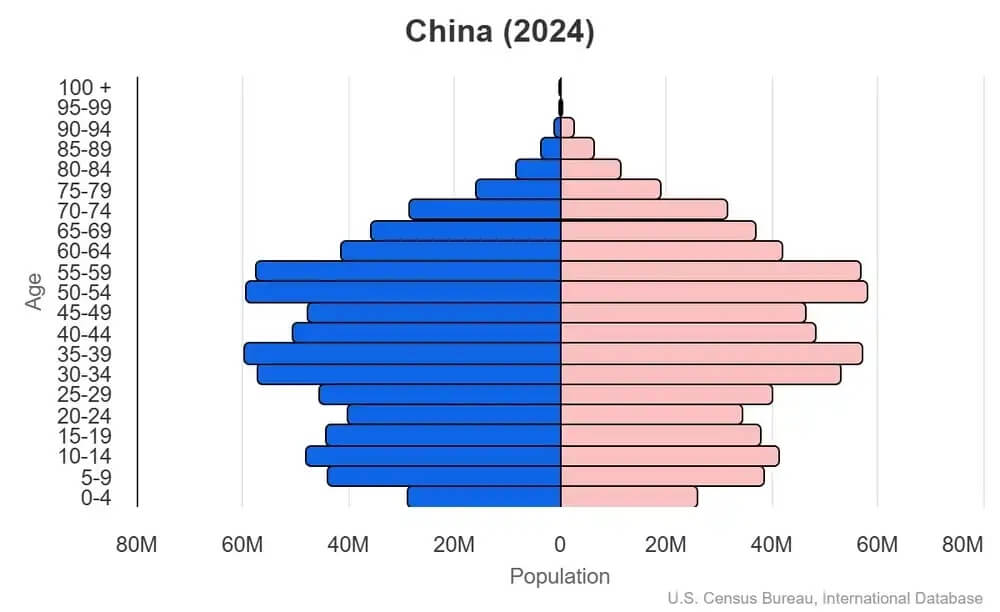
Total: 1,416,043,270 (2024 estimated)
Ethnic groups
Han Chinese 91.1%, ethnic minorities 8.9% (includes Zhang, Hui, Manchu, Uighur, Miao, Yi, Tujia, Tibetan, Mongol, Dong, Buyei, Yao, Bai, Korean, Hani, Li, Kazakh, Dai, and other nationalities) (2021 estimated)
Languages
Standard Chinese or Mandarin (official; Putonghua, based on the Beijing dialect), Yue (Cantonese), Wu (Shanghainese), Minbei (Fuzhou), Minnan (Hokkien-Taiwanese), Xiang, Gan, Hakka dialects, minority languages; note - Zhuang is official in Guangxi Zhuang, Yue is official in Guangdong, Mongolian is official in Nei Mongol, Uyghur is official in Xinjiang Uygur, Kyrgyz is official in Xinjiang Uygur, and Tibetan is official in Xizang (Tibet)
Religions
Folk religion 21.9%, Buddhist 18.2%, Christian 5.1%, Muslim 1.8%, Hindu < 0.1%, Jewish < 0.1%, other 0.7% (includes Daoist (Taoist)), unaffiliated 52.1% (2021 estimated)
Population growth rate
0.23% (2024 estimated)
China's population, estimated at 1,416,043,270 in 2024, is a tapestry of ethnic diversity, with Han Chinese constituting 91.1% of the population and various ethnic minorities making up the remaining 8.9%. This demographic composition reflects a rich cultural heritage, with numerous languages spoken across the country, including Mandarin, Cantonese, and various regional dialects. The religious landscape is equally diverse, with folk religions, Buddhism, and Christianity among the prominent faiths, while a significant portion of the population identifies as unaffiliated. The population growth rate, currently at 0.23%, indicates a gradual demographic transition, influenced by urbanization and changing social dynamics.
Government
Government type
Communist party-led state
Capital
Name: Beijing
Executive branch
Chief of state: President XI Jinping (since 14 March 2013)
Head of government: Premier LI Qiang (since 11 March 2023)
Diplomatic representation in the US
Chief of mission: Ambassador XIE Feng (since 30 June 2023)
Diplomatic representation from the US
Chief of mission: Ambassador David PERDUE (since 25 July 2025)
China operates as a communist party-led state, with the Chinese Communist Party (CCP) holding a central role in governance. The capital city, Beijing, serves as the political and administrative heart of the nation. The executive branch is headed by President XI Jinping, who has been in office since March 14, 2013, and Premier LI Qiang, who took office on March 11, 2023. This political structure reflects the CCP's commitment to maintaining a centralized authority, which has significant implications for both domestic policy and international relations.
Economy
Economic overview
World’s second-largest economy by nominal GDP; global leader in exports and manufacturing; historically strong growth slowing; challenges of aging workforce, weak productivity, rising youth unemployment, struggling property sector, and public debt; state-sponsored economic controls and infrastructure investments
Real GDP (purchasing power parity)
$33.598 trillion (2024 estimated)
$32.005 trillion (2023 estimated)
$30.361 trillion (2022 estimated)
Real GDP per capita
$23,800 (2024 estimated)
$22,700 (2023 estimated)
$21,500 (2022 estimated)
Exports
$3.793 trillion (2024 estimated)
$3.508 trillion (2023 estimated)
$3.719 trillion (2022 estimated)
Exports - partners
USA 13%, Hong Kong 8%, Japan 5%, Germany 5%, S. Korea 4% (2023)
Exports - commodities
Broadcasting equipment, computers, integrated circuits, garments, machine parts (2023)
Imports
$3.254 trillion (2024 estimated)
$3.122 trillion (2023 estimated)
$3.142 trillion (2022 estimated)
Imports - partners
S. Korea 7%, USA 7%, Japan 6%, Australia 6%, Russia 6% (2023)
Imports - commodities
Crude petroleum, integrated circuits, iron ore, gold, natural gas (2023)
China's economy stands as the world's second-largest by nominal GDP, reflecting its significant role in global trade and manufacturing. With a nominal GDP estimated at $33.598 trillion in 2024, the country has historically experienced robust economic growth. However, recent trends indicate a slowdown, driven by challenges such as an aging workforce, declining productivity, and rising youth unemployment. The property sector is also facing difficulties, compounded by increasing public debt. Despite these challenges, China remains a global leader in exports, with an estimated $3.793 trillion in exports for 2024, primarily consisting of broadcasting equipment, computers, and garments. The country imports approximately $3.254 trillion worth of goods, with crude petroleum and integrated circuits being among the top commodities. The economic landscape is shaped by state-sponsored controls and substantial infrastructure investments, which continue to play a pivotal role in sustaining growth and addressing emerging economic challenges.
Human Development Index
The country's Human Development Index (HDI) is 0.797, ranking it 78th out of 193 countries tested. (more information)
World Happiness Report
The World Happiness Report ranked the country 82nd out of 158 countries tested with a score of 5.695. (more information)