World Book
Australia
World Book Index
82

With a score of 82, the country is ranked 11th out of 158 countries in the World Book ranking. (more information)
Introduction
Prehistoric settlers arrived on the continent from Southeast Asia at least 40,000 years before the first Europeans began exploration in the 17th century. All of Australia was claimed as British territory in 1829. Independence was achieved in 1901.
Neighboring countries
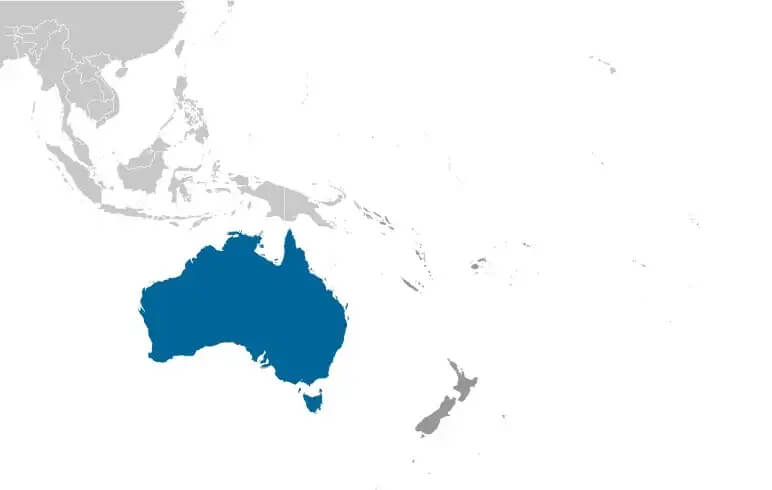
Indonesia - New Zealand - Papua New Guinea - Solomon Islands - Timor Leste - Vanuatu
Geography
Area
total: 7,741,220 sq km
land: 7,682,300 sq km
water: 58,920 sq km
Climate
generally arid to semiarid; temperate in south and east; tropical in north
Natural resources
alumina, coal, iron ore, copper, lithium, tin, gold, silver, uranium, nickel, tungsten, rare earth elements, mineral sands, lead, zinc, diamonds, opals, natural gas, petroleum
People and Society
Population
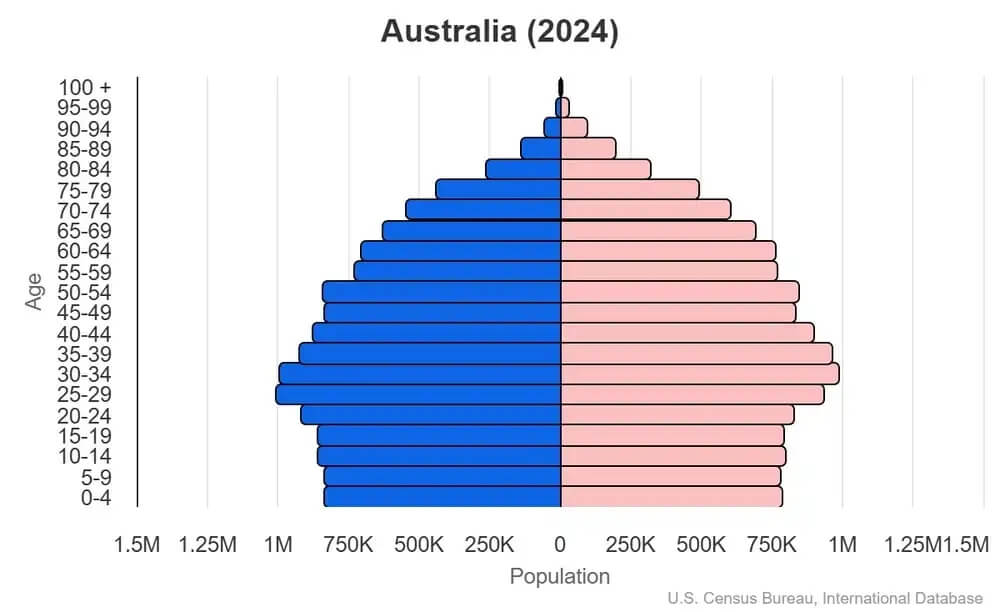
total: 26,768,598 (2024 est.)
Ethnic groups
English 33%, Australian 29.9%, Irish 9.5%, Scottish 8.6%, Chinese 5.5%, Italian 4.4%, German 4%, Indian 3.1%, Australian Aboriginal 2.9%, Greek 1.7%, unspecified 4.7% (2021 est.)
Languages
English 72%, Mandarin 2.7%, Arabic 1.4%, Vietnamese 1.3%, Cantonese 1.2%, other 15.7%, unspecified 5.7% (2021 est.)
Religions
Roman Catholic 20%, Protestant 18.1% (Anglican 9.8%, Uniting Church 2.6%, Presbyterian and Reformed 1.6%, Baptist 1.4%, Pentecostal 1%, other Protestant 1.7%), other Christian 3.5%, Muslim 3.2%, Hindu 2.7%, Buddhist 2.4%, Orthodox 2.3% (Eastern Orthodox 2.1%, Oriental Orthodox 0.2%), other 2.1%, none 38.4%, unspecified 7.3% (2021 est.)
Population growth rate
1.13% (2024 est.)
Government
Government type
federal parliamentary democracy under a constitutional monarchy; a Commonwealth realm
Capital
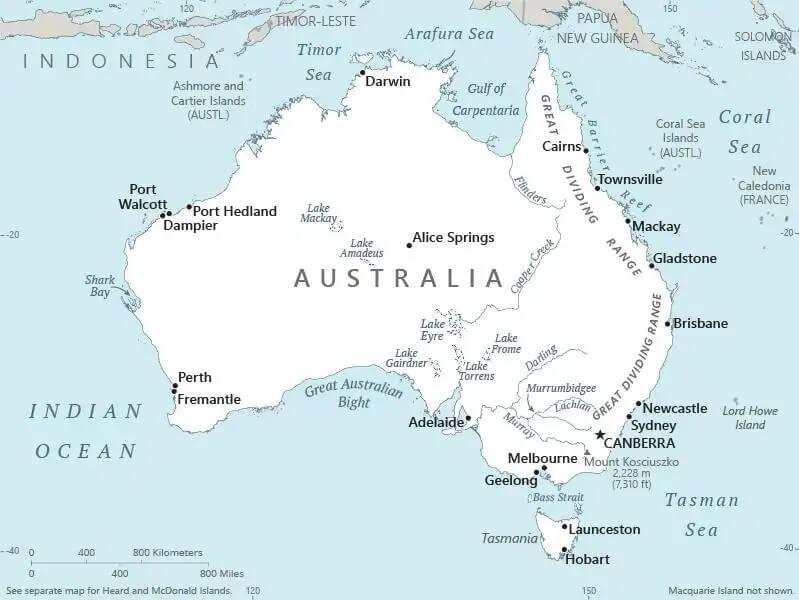
name: Canberra
Executive branch
chief of state: King CHARLES III (since 8 September 2022); represented by Governor General Samantha (Sam) MOSTYN (since 1 July 2024)
head of government: Prime Minister Anthony ALBANESE (since 23 May 2022)
Diplomatic representation in the US
chief of mission: Ambassador Kevin Michael RUDD (since 19 April 2023)
Diplomatic representation from the US
chief of mission: Ambassador (vacant); Chargé d'Affaires Erika OLSON (since January 2025)
Economy
Economic overview
high-income and globally integrated economy; strong mining, manufacturing, and service sectors driving slow but steady growth; net exporter, driven by commodities to East Asian trade partners; weak productivity and aging population straining labor force participation
Real GDP (purchasing power parity)
$1.635 trillion (2024 est.)
$1.611 trillion (2023 est.)
$1.558 trillion (2022 est.)
Real GDP per capita
$60,100 (2024 est.)
$60,500 (2023 est.)
$59,900 (2022 est.)
Exports
$425.16 billion (2024 est.)
$448.507 billion (2023 est.)
$465.99 billion (2022 est.)
Exports - partners
China 37%, Japan 16%, S. Korea 6%, India 5%, Taiwan 5% (2023)
Exports - commodities
iron ore, coal, natural gas, gold, minerals (2023)
Imports
$405.336 billion (2024 est.)
$389.211 billion (2023 est.)
$379.981 billion (2022 est.)
Imports - partners
China 26%, USA 11%, S. Korea 6%, Japan 6%, Thailand 5% (2023)
Imports - commodities
refined petroleum, cars, trucks, broadcasting equipment, garments (2023)
Human Development Index
The country's Human Development Index (HDI) is 0.958, ranking it 7th out of 193 countries tested. (more information)
World Happiness Report
The World Happiness Report ranked the country 19th out of 158 countries tested with a score of 6.822. (more information)