World Book
Timor-Leste
Introduction
Timor-Leste, a nation with a rich history, has been a significant player in Southeast Asian trade networks for centuries. By the 14th century, it was already exporting valuable commodities such as sandalwood, slaves, honey, and wax. The island was colonized by the Portuguese in the mid-16th century, marking the beginning of a long colonial period. In 1976, Timor-Leste was incorporated into Indonesia as the province of Timor Timur (East Timor). After a tumultuous struggle for independence, it achieved international recognition as a sovereign state in 2002, marking a new chapter in its history. Today, Timor-Leste stands as a testament to resilience and the enduring spirit of its people, navigating the complexities of nation-building and development in the 21st century.
Neighboring countries
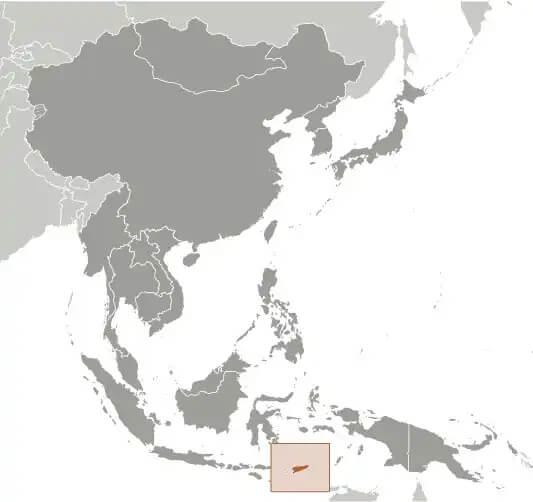
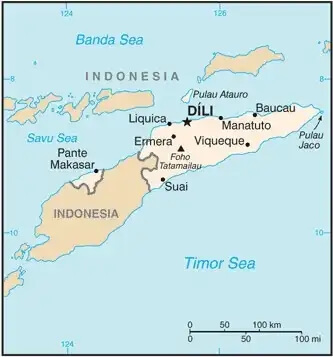
Australia - Indonesia
Geography
Area
Total: 14,874 sq km
Land: 14,874 sq km
Water: 0 sq km
Climate
Timor-Leste experiences a tropical climate characterized by hot and humid conditions, with distinct rainy and dry seasons that significantly influence agricultural practices and daily life.
Natural resources
The country is endowed with a variety of natural resources, including gold, petroleum, natural gas, manganese, and marble, which play a crucial role in its economic potential and development strategies.
People and Society
Population
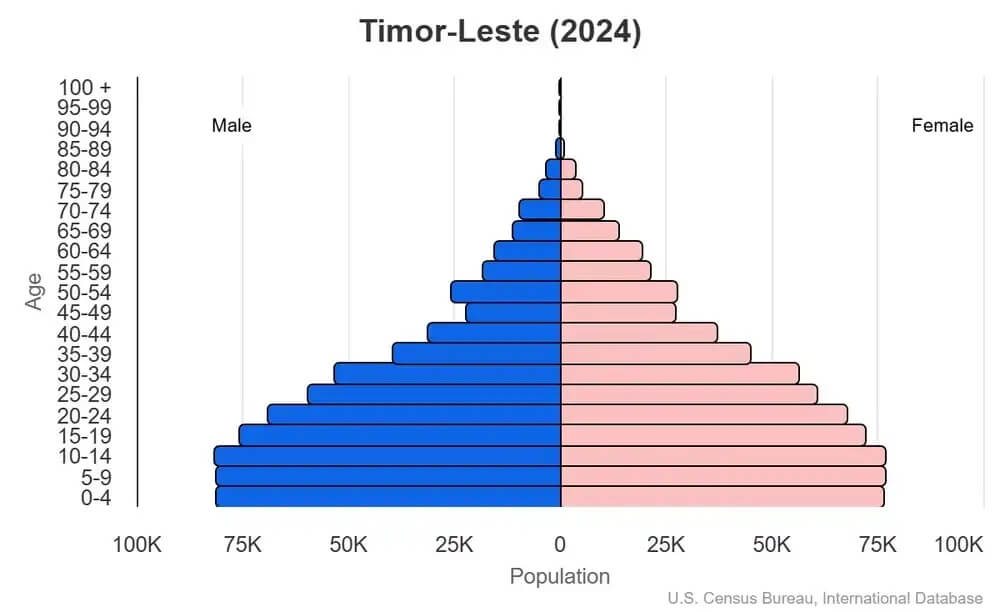
Total: 1,506,909 (2024 estimated)
Ethnic groups
The population is primarily composed of Austronesian (Malayo-Polynesian) groups, which include Tetun, Mambai, Tokodede, Galoli, Kemak, and Baikeno, alongside Melanesian-Papuan groups such as Bunak, Fataluku, and Bakasai. There is also a small Chinese minority, contributing to the cultural diversity of the nation.
Languages
The linguistic landscape is rich, with Tetun Prasa being the most widely spoken language at 30.6%, followed by Mambai at 16.6%, and several other languages including Makasai, Tetun Terik, and Baikenu. This diversity reflects the country's complex cultural heritage and influences communication and education.
Religions
The predominant religion is Roman Catholicism, practiced by 97.6% of the population, followed by Protestant/Evangelical at 2%, and a small Muslim community at 0.2%. This religious composition plays a significant role in shaping the social fabric and cultural practices of Timor-Leste.
Population growth rate
The population growth rate stands at 2.04% (2024 estimated), indicating a youthful demographic that presents both opportunities and challenges for development and resource management.
Government
Government type
Timor-Leste operates as a semi-presidential republic, balancing powers between the executive and legislative branches to ensure democratic governance.
Capital
Name: Dili
Executive branch
The chief of state is President José RAMOS-HORTA (since 20 May 2022), while the head of government is Prime Minister Kay Rala Xanana GUSMAO (since 1 July 2023), who leads the administration in implementing policies and governance.
Diplomatic representation in the US
The chief of mission is Ambassador José Luis GUTERRES (since 17 June 2024), representing Timor-Leste's interests in the United States.
Diplomatic representation from the US
The chief of mission is currently vacant; however, Chargé d’Affaires Bruce BEGNELL has been serving since July 2025, maintaining diplomatic relations.
Economy
Economic overview
Timor-Leste is classified as a lower middle-income economy within Southeast Asia, heavily reliant on government expenditures funded through oil fund drawdowns. The economy faces significant challenges, including endemic corruption that undermines growth prospects, a high dependency on foreign aid, and widespread issues of poverty, unemployment, and illiteracy that hinder overall development.
Real GDP (purchasing power parity)
$5.863 billion (2024 estimated)
$5.995 billion (2023 estimated)
$7.322 billion (2022 estimated)
Real GDP per capita
$4,200 (2024 estimated)
$4,300 (2023 estimated)
$5,300 (2022 estimated)
Exports
$278.047 million (2024 estimated)
$701.808 million (2023 estimated)
$1.858 billion (2022 estimated)
Exports - partners
China 46%, Singapore 25%, Japan 15%, Indonesia 5%, USA 3% (2023)
Exports - commodities
The primary commodities exported include crude petroleum, natural gas, coffee, scrap iron, and telephones (2023), reflecting the country's resource-based economy.
Imports
$1.197 billion (2024 estimated)
$1.169 billion (2023 estimated)
$1.286 billion (2022 estimated)
Imports - partners
The main import partners are Indonesia at 34%, China at 26%, Singapore at 9%, Taiwan at 5%, and India at 4% (2023), indicating a reliance on regional trade.
Imports - commodities
Key imports consist of refined petroleum, rice, cars, plastic products, and trucks (2023), which are essential for meeting domestic needs and supporting economic activities.
Human Development Index
The country's Human Development Index (HDI) is 0.634, ranking it 142nd out of 193 countries tested. (more information)