World Book
Indonesia
World Book Index
65

With a score of 65, the country is ranked 85th out of 158 countries in the World Book ranking. (more information)
Introduction
Indonesia, a nation with a rich tapestry of cultures and histories, emerged from centuries of colonial rule to establish itself as a sovereign state in 1949. Today, it stands as the world's third most populous democracy, a testament to its vibrant political landscape. As the largest archipelagic state globally, Indonesia comprises over 17,000 islands, making it a unique geographical entity. Furthermore, it holds the distinction of being the largest Muslim-majority nation, reflecting the diverse religious and cultural practices that coexist within its borders. This dynamic interplay of history, culture, and governance positions Indonesia as a significant player on the global stage.
Neighboring countries
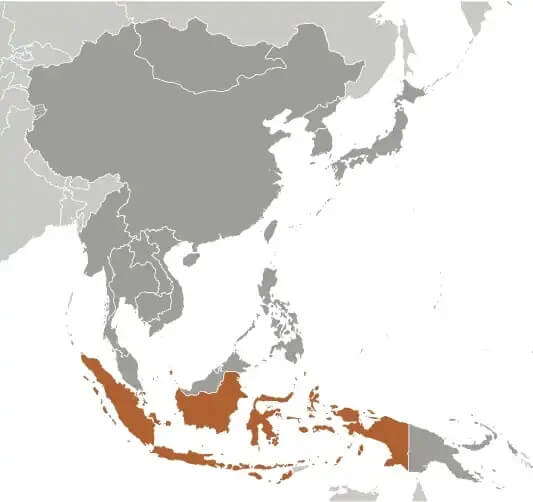
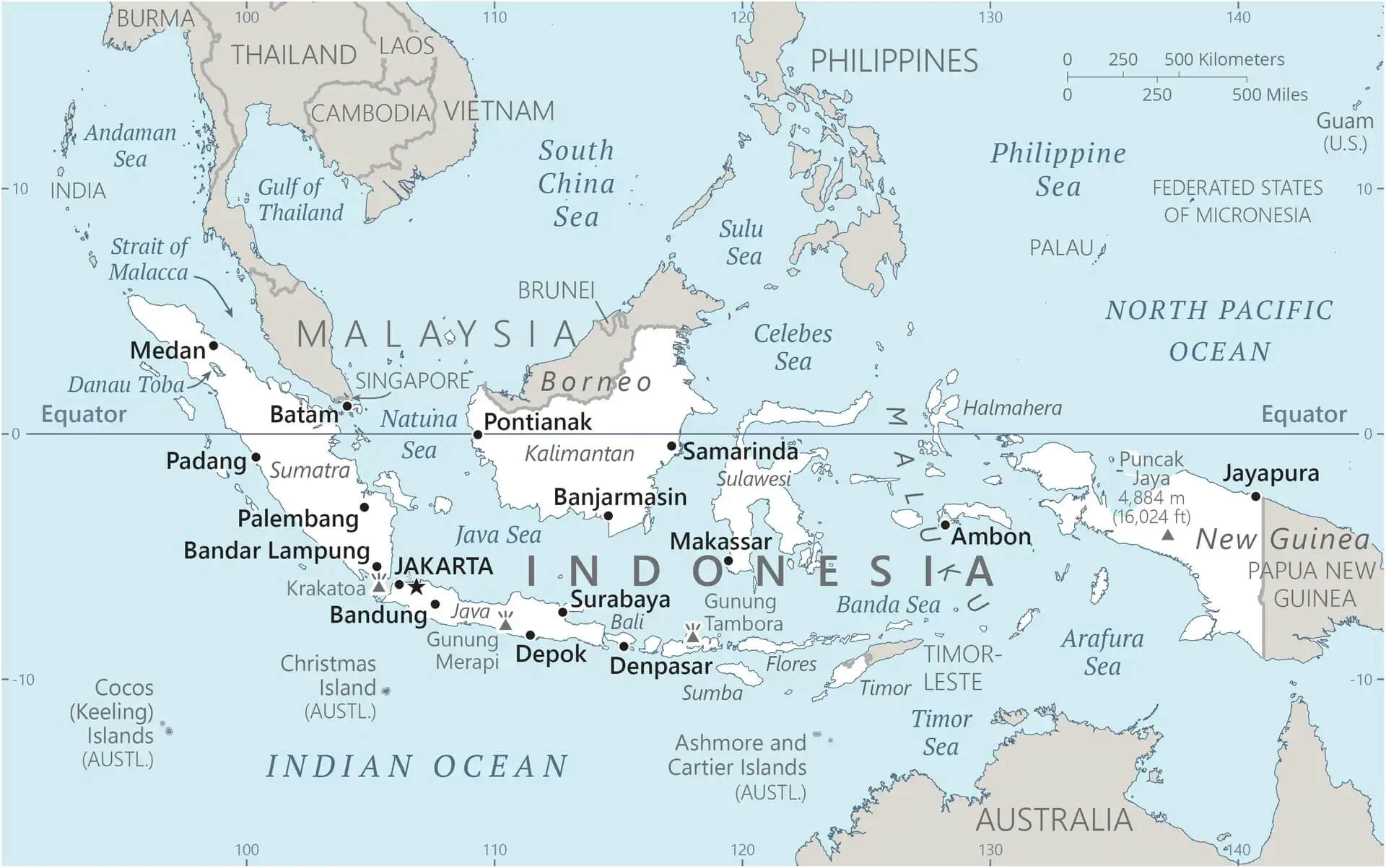
Malaysia - Papua New Guinea - Timor-Leste
Geography
Area
Total: 1,904,569 sq km
Land: 1,811,569 sq km
Water: 93,000 sq km
Indonesia's geographical landscape is characterized by its vast archipelago, which stretches across the equator and is bordered by both the Indian and Pacific Oceans. The country’s total area of 1,904,569 sq km includes a significant landmass of 1,811,569 sq km, complemented by 93,000 sq km of water bodies. This unique positioning not only contributes to Indonesia's rich biodiversity but also influences its climate, which is predominantly tropical. The climate is typically hot and humid, with more moderate conditions found in the highlands, creating a variety of ecosystems that support a wide range of flora and fauna.
Natural resources
Petroleum, tin, natural gas, nickel, timber, bauxite, copper, fertile soils, coal, gold, silver
People and Society
Population
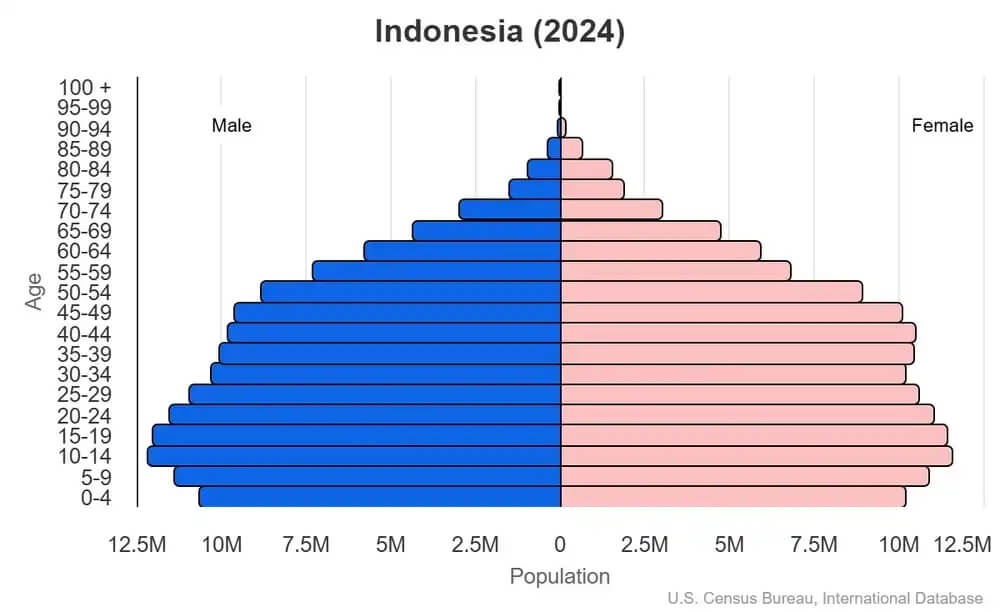
Total: 281,562,465 (2024 estimated)
Ethnic groups
Javanese 40.1%, Sundanese 15.5%, Malay 3.7%, Batak 3.6%, Madurese 3%, Betawi 2.9%, Minangkabau 2.7%, Buginese 2.7%, Bantenese 2%, Banjarese 1.7%, Balinese 1.7%, Acehnese 1.4%, Dayak 1.4%, Sasak 1.3%, Chinese 1.2%, other 15% (2010 estimated)
Languages
Bahasa Indonesia (official, modified form of Malay), English, Dutch, local dialects (of which the most widely spoken is Javanese); note - more than 700 languages are used in Indonesia
Religions
Muslim 87.4%, Protestant 7.5%, Roman Catholic 3.1%, Hindu 1.7%, other 0.8% (includes Buddhist and Confucian) (2022 estimated)
Population growth rate
0.73% (2024 estimated)
Indonesia's population, estimated at 281,562,465 in 2024, reflects a rich mosaic of ethnicities and cultures. The Javanese constitute the largest ethnic group at 40.1%, followed by the Sundanese at 15.5%, and a variety of other groups contributing to the nation's diversity. The linguistic landscape is equally complex, with Bahasa Indonesia serving as the official language, while over 700 local dialects are spoken across the archipelago, highlighting the country's cultural richness. Religiously, Indonesia is predominantly Muslim, with 87.4% of the population adhering to Islam, which plays a significant role in shaping the nation's cultural and social norms. The population growth rate of 0.73% indicates a steady increase, presenting both opportunities and challenges for the country's development.
Government
Government type
Presidential republic
Capital
Name: Jakarta
Executive branch
Chief of state: President PRABOWO Subianto Djojohadikusumo (since 20 October 2024)
Head of government: President PRABOWO Subianto Djojohadikusumo (since 20 October 2024)
Diplomatic representation in the US
Chief of mission: Ambassador-designate INDROYONO Soesilo; Chargé d'Affaires Nidya KARTIKASARI (since 1 September 2025)
Diplomatic representation from the US
Chief of mission: Ambassador (vacant); Chargé d’Affaires Peter M. HAYMOND (since 15 June 2025)
Indonesia operates as a presidential republic, where the President serves as both the head of state and the head of government. The capital city, Jakarta, is not only the political center but also a bustling metropolis that embodies the nation's diversity. The current President, PRABOWO Subianto Djojohadikusumo, has been in office since 20 October 2024, leading the country through a period of significant political and economic challenges. Indonesia's diplomatic representation in the United States is marked by the appointment of Ambassador-designate INDROYONO Soesilo, with the Chargé d'Affaires Nidya KARTIKASARI representing Indonesia since September 2025. This diplomatic framework underscores Indonesia's commitment to fostering international relations and cooperation.
Economy
Economic overview
One of the fastest growing economies and largest in Southeast Asia; upper middle-income country; human capital and competitiveness phase of its 20-year development plan; COVID-19 reversed poverty reduction trajectory; strengthening financial resilience
Real GDP (purchasing power parity)
$4.102 trillion (2024 estimated)
$3.906 trillion (2023 estimated)
$3.718 trillion (2022 estimated)
Real GDP per capita
$14,500 (2024 estimated)
$13,900 (2023 estimated)
$13,300 (2022 estimated)
Exports
$300.868 billion (2024 estimated)
$291.287 billion (2023 estimated)
$315.746 billion (2022 estimated)
Exports - partners
China 24%, USA 9%, India 8%, Japan 8%, Singapore 5% (2023)
Exports - commodities
Coal, palm oil, iron alloys, lignite, garments (2023)
Imports
$279.419 billion (2024 estimated)
$262.694 billion (2023 estimated)
$273.031 billion (2022 estimated)
Imports - partners
China 29%, Singapore 8%, Japan 7%, USA 5%, Malaysia 5% (2023)
Imports - commodities
Refined petroleum, crude petroleum, plastics, vehicle parts/accessories, integrated circuits (2023)
Indonesia's economy is recognized as one of the fastest-growing in Southeast Asia, positioning the country as a significant player in the regional and global markets. With a real GDP estimated at $4.102 trillion in 2024, Indonesia is classified as an upper middle-income country. The nation's economic strategy is currently focused on enhancing human capital and competitiveness as part of a comprehensive 20-year development plan. However, the COVID-19 pandemic has posed challenges, reversing previous gains in poverty reduction and necessitating a renewed focus on strengthening financial resilience. The real GDP per capita is projected to reach $14,500 in 2024, reflecting improvements in living standards. Indonesia's export landscape is diverse, with key partners including China, the USA, and India, and commodities such as coal and palm oil driving economic activity. On the import side, the country relies heavily on refined petroleum and plastics, underscoring the need for sustainable resource management as it continues to develop.
Human Development Index
The country's Human Development Index (HDI) is 0.728, ranking it 113th out of 193 countries tested. (more information)
World Happiness Report
The World Happiness Report ranked the country 78th out of 158 countries tested with a score of 5.725. (more information)