World Book
Bhutan
World Book Index
60

With a score of 60, the country is ranked 101st out of 158 countries in the World Book ranking. (more information)
Introduction
Bhutan, a landlocked kingdom nestled in the Eastern Himalayas, is renowned for its unique approach to governance and development, prioritizing Gross National Happiness over mere economic growth. The historical context of Bhutan's sovereignty is marked by significant events, including the Treaty of Sinchulu in 1865, which established British influence in exchange for annual subsidies. The unification of Bhutan under its first hereditary king in 1907 marked a pivotal moment in its national identity, while the Treaty of Friendship with India in 1949 solidified its independence and shaped its contemporary political landscape. Today, Bhutan stands as a beacon of cultural preservation and environmental sustainability, striving to balance modernization with its rich traditions.
Neighboring countries
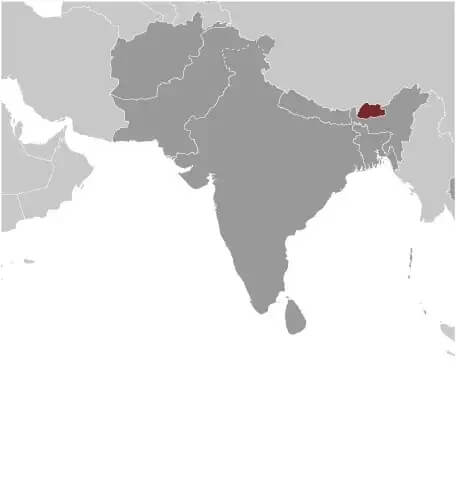
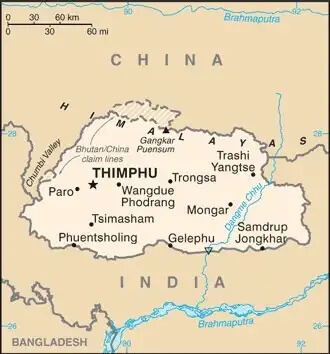
China - India
Geography
Area
Total: 38,394 sq km
Land: 38,394 sq km
Water: 0 sq km
Bhutan's geography is characterized by its dramatic topography, ranging from the lush tropical plains in the south to the rugged mountains of the Himalayas in the north. This diverse landscape not only contributes to the country's stunning natural beauty but also influences its climate, which varies significantly across regions. The southern plains experience a tropical climate, while the central valleys enjoy cool winters and hot summers. In stark contrast, the northern Himalayan regions endure severe winters and cool summers, creating a unique ecological environment. Bhutan is endowed with rich natural resources, including timber, hydropower, gypsum, and calcium carbonate, which play a crucial role in its economic development and sustainability efforts.
People and Society
Population
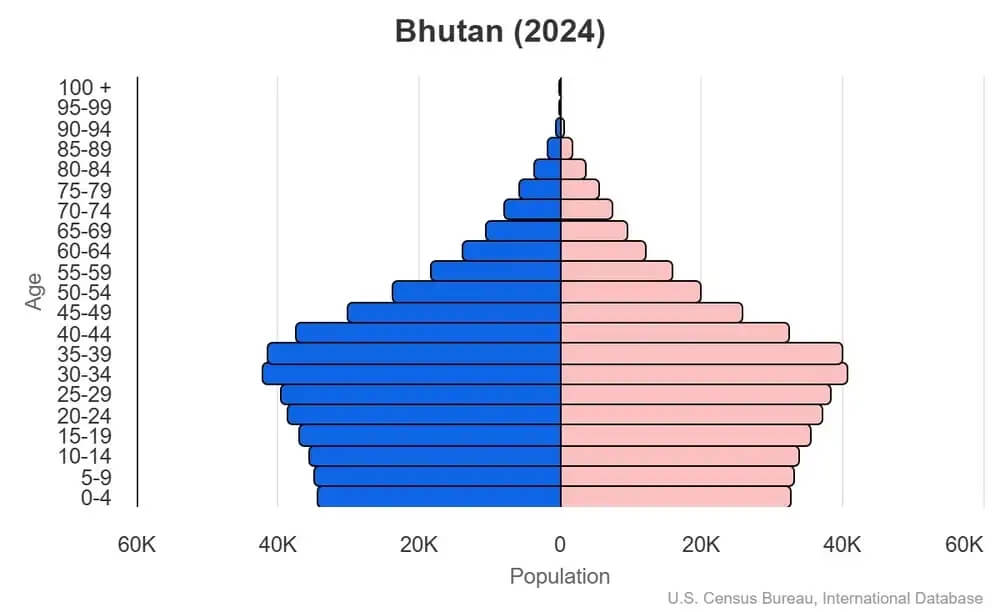
Total: 884,546 (2024 estimated)
Bhutan's population is a tapestry of ethnic diversity, with the Ngalop (or Bhote) making up 50% of the population, followed by ethnic Nepalis at 35%, predominantly represented by the Lhotshampas, and indigenous or migrant tribes comprising the remaining 15%. This ethnic composition reflects the country's rich cultural heritage and influences its social dynamics. The linguistic landscape is equally diverse, with Sharchopkha (28%), Dzongkha (official language, 24%), and Lhotshamkha (22%) being the most spoken languages, alongside a variety of foreign languages. The predominant religion is Lamaistic Buddhism, practiced by 75.3% of the population, while Indian- and Nepali-influenced Hinduism accounts for 22.1%. The population growth rate stands at 0.95% (2024 estimated), indicating a gradual increase in demographic trends that may impact future social and economic policies.
Government
Government type
Constitutional monarchy
Capital
Name: Thimphu
Bhutan operates under a constitutional monarchy, where the King serves as the head of state, embodying the nation's cultural and spiritual values. The current monarch, King Jigme Khesar Namgyel Wangchuck, has been in power since December 14, 2006, and plays a vital role in guiding the country's development and maintaining its unique identity. The head of government, Prime Minister Tshering Tobgay, who took office on January 28, 2024, oversees the executive branch, implementing policies that align with the nation's vision of sustainable development and happiness for its citizens.
Economy
Economic overview
Bhutan's economy is primarily driven by hydropower investments, which are pivotal in spurring economic development and enhancing energy security. The country has adopted a unique Gross National Happiness framework, which prioritizes the well-being of its citizens over traditional economic metrics. This approach has led to significant declines in poverty rates, low inflation, and the establishment of strong monetary and fiscal policies that contribute to economic stability. Bhutan's currency remains stable, and the nation has demonstrated a fairly resilient response to the challenges posed by the COVID-19 pandemic. Key economic and strategic relations with India further bolster Bhutan's economic landscape, although the country faces vulnerabilities related to climate change that could impact its future growth trajectory.
Real GDP (purchasing power parity)
$11.517 billion (2023 estimated)
$10.981 billion (2022 estimated)
$10.437 billion (2021 estimated)
Real GDP per capita
$14,600 (2023 estimated)
$14,100 (2022 estimated)
$13,500 (2021 estimated)
Exports
$944.391 million (2024 estimated)
$867.871 million (2023 estimated)
$791.342 million (2022 estimated)
Exports - partners
India 92%, Italy 4%, Indonesia 1%, China 1%, Singapore 0% (2023)
Exports - commodities
Iron alloys, aircraft, dolomite, semi-finished iron, cement (2023)
Imports
$1.513 billion (2024 estimated)
$1.77 billion (2023 estimated)
$1.581 billion (2022 estimated)
Imports - partners
India 82%, Singapore 8%, China 5%, Thailand 2%, Indonesia 1% (2023)
Imports - commodities
Refined petroleum, gold, plastics, broadcasting equipment, iron reductions (2023)
Human Development Index
The country's Human Development Index (HDI) is 0.698, ranking it 125th out of 193 countries tested. (more information)
World Happiness Report
The World Happiness Report ranked the country 102nd out of 158 countries tested with a score of 5.082. (more information)