World Book
India
World Book Index
53

With a score of 53, the country is ranked 115th out of 158 countries in the World Book ranking. (more information)
Introduction
India, a land of rich history and diverse cultures, is home to one of the world's oldest civilizations, the Indus Valley civilization, which thrived during the 3rd and 2nd millennia B.C. This ancient heritage laid the foundation for a complex social and cultural tapestry that continues to evolve. By the 19th century, India became the focal point of British colonial ambitions, often referred to as the "Jewel in the Crown" of the British Empire. The struggle for independence, marked by a unique approach of nonviolent resistance led by figures such as Mahatma Gandhi, culminated in India gaining its freedom in 1947. Today, India stands as the world's largest democracy, characterized by its vibrant political landscape and a commitment to maintaining its sovereignty and cultural identity amidst globalization.
Neighboring countries
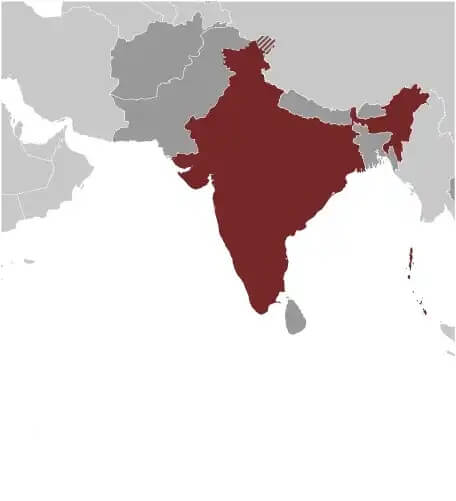
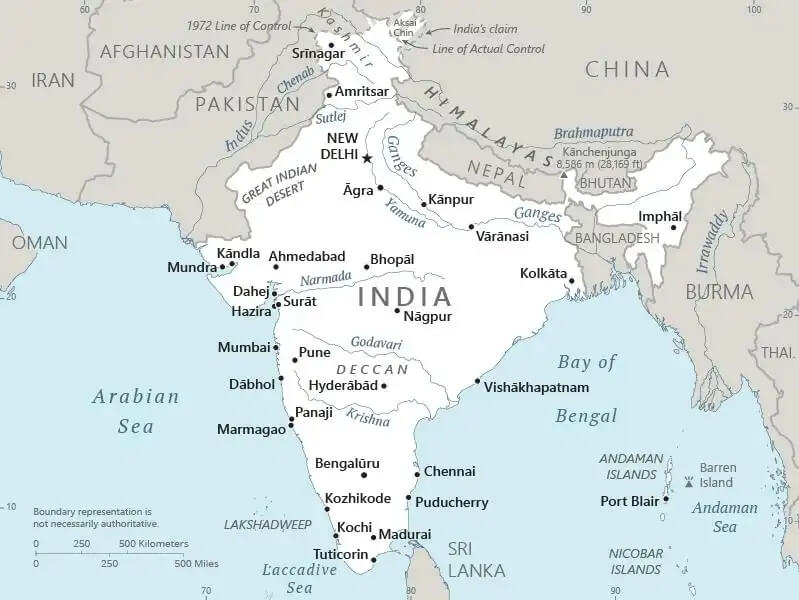
Afghanistan - Bangladesh - Bhutan - Burma - China - Nepal - Pakistan
Geography
Area
Total: 3,287,263 sq km
Land: 2,973,193 sq km
Water: 314,070 sq km
India's geography is as diverse as its culture, featuring a vast expanse that includes the towering Himalayas in the north, fertile plains, and extensive coastlines along the Indian Ocean, Arabian Sea, and Bay of Bengal. The country's climate varies significantly, ranging from the tropical monsoon in the southern regions to temperate conditions in the northern areas. This geographical diversity not only supports a wide array of ecosystems but also plays a crucial role in the agricultural practices and economic activities of the nation. Additionally, India is endowed with a wealth of natural resources, including the fourth-largest reserves of coal in the world, along with significant deposits of antimony, iron ore, lead, manganese, mica, bauxite, rare earth elements, titanium ore, chromite, natural gas, diamonds, petroleum, limestone, and arable land, which are vital for its industrial and economic development.
People and Society
Population
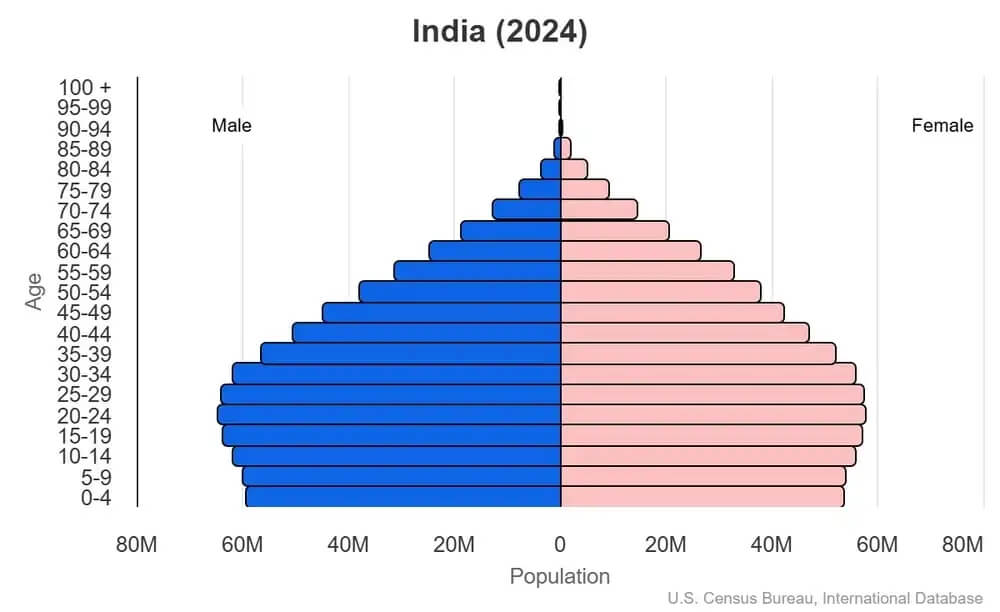
Total: 1,409,128,296 (2024 estimated)
Ethnic groups
Indo-Aryan 72%, Dravidian 25%, and other 3% (2000)
Languages
Hindi 43.6%, Bengali 8%, Marathi 6.9%, Telugu 6.7%, Tamil 5.7%, Gujarati 4.6%, Urdu 4.2%, Kannada 3.6%, Odia 3.1%, Malayalam 2.9%, Punjabi 2.7%, Assamese 1.3%, Maithili 1.1%, other 5.6%; English is the subsidiary official language but is the most important one for national, political, and commercial communication (2011 estimated)
Religions
Hindu 79.8%, Muslim 14.2%, Christian 2.3%, Sikh 1.7%, other and unspecified 2% (2011 estimated)
Population growth rate
0.72% (2024 estimated)
India's population is a reflection of its rich cultural heritage, comprising a multitude of ethnic groups, with the Indo-Aryan and Dravidian communities being the most prominent. The linguistic diversity is equally remarkable, with Hindi and English serving as the primary languages of communication, while numerous regional languages enrich the cultural landscape. The religious composition of the country is predominantly Hindu, followed by significant Muslim and Christian minorities, contributing to a complex social fabric. The population growth rate, although moderate, presents challenges and opportunities for the nation, particularly in terms of resource allocation, education, and employment. As India continues to develop, the interplay between its diverse communities and the need for inclusive growth remains a critical focus for policymakers.
Government
Government type
Federal parliamentary republic
Capital
Name: New Delhi
Executive branch
Chief of state: President Droupadi MURMU (since 25 July 2022)
Head of government: Prime Minister Narendra MODI (since 26 May 2014)
Diplomatic representation in the US
Chief of mission: Ambassador Vinay Mohan KWATRA (since 18 September 2024)
Diplomatic representation from the US
Chief of mission: Ambassador (vacant); Chargé d’Affaires Jorgan K. ANDREWS (since January 2025)
India operates as a federal parliamentary republic, where the President serves as the ceremonial head of state while the Prime Minister holds executive powers as the head of government. The capital city, New Delhi, is the political hub of the nation. The current administration, led by President Droupadi Murmu and Prime Minister Narendra Modi, emphasizes economic growth, national security, and social welfare. India's diplomatic relations, particularly with the United States, are pivotal, with ongoing efforts to strengthen bilateral ties through strategic partnerships and mutual interests.
Economy
Economic overview
India is the largest economy in South Asia, characterized by strong and sustained GDP growth driven primarily by its technology and service sectors. The country has attracted significant foreign investment, bolstered by an improved regulatory framework that encourages business development. However, India faces challenges such as a high poverty rate and income inequality, which necessitate ongoing initiatives focused on infrastructure development, digitization, manufacturing, and enhancing financial access for its citizens.
Real GDP (purchasing power parity)
$14.244 trillion (2024 estimated)
$13.377 trillion (2023 estimated)
$12.251 trillion (2022 estimated)
Real GDP per capita
$9,800 (2024 estimated)
$9,300 (2023 estimated)
$8,600 (2022 estimated)
Exports
$822.046 billion (2024 estimated)
$773.177 billion (2023 estimated)
$767.643 billion (2022 estimated)
Exports - partners
USA 19%, UAE 7%, China 4%, Germany 3%, UK 3% (2023)
Exports - commodities
Refined petroleum, packaged medicine, diamonds, broadcasting equipment, garments (2023)
Imports
$923.081 billion (2024 estimated)
$859.507 billion (2023 estimated)
$902.304 billion (2022 estimated)
Imports - partners
China 19%, Russia 10%, USA 6%, UAE 6%, Saudi Arabia 5% (2023)
Imports - commodities
Crude petroleum, gold, coal, natural gas, integrated circuits (2023)
Human Development Index
The country's Human Development Index (HDI) is 0.685, ranking it 130th out of 193 countries tested. (more information)
World Happiness Report
The World Happiness Report ranked the country 137th out of 158 countries tested with a score of 3.898. (more information)