World Book
Burkina Faso
World Book Index
44

With a score of 44, the country is ranked 145th out of 158 countries in the World Book ranking. (more information)
Introduction
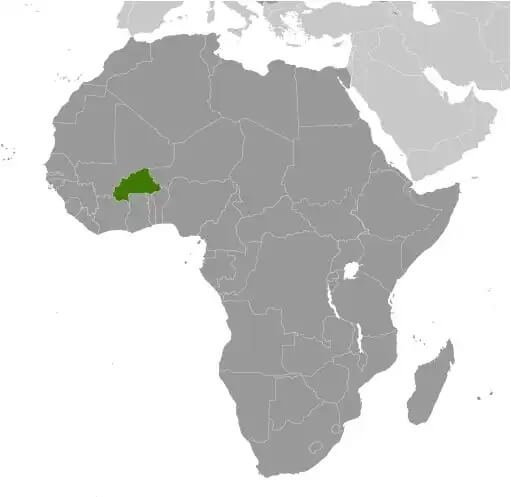
Burkina Faso, a landlocked country in West Africa, gained its independence from France in 1960. Since then, it has experienced a tumultuous political landscape characterized by a series of military coups that have shaped its governance and societal structure. The nation faces significant challenges, including terrorism, which has exacerbated existing issues such as recurring drought, food insecurity, and pervasive poverty. These factors contribute to a complex socio-political environment that continues to evolve as the country seeks stability and development.
Neighboring countries
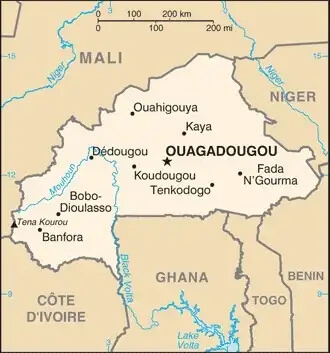
Benin - Cote d'Ivoire - Ghana - Mali - Niger - Togo
Geography
Area
Total: 274,200 sq km
Land: 273,800 sq km
Water: 400 sq km
Burkina Faso is characterized by a diverse geography that encompasses a total area of 274,200 square kilometers. The land area constitutes 273,800 square kilometers, while water bodies cover approximately 400 square kilometers. The country features three distinct climate zones: a hot tropical savanna in the southern half, which experiences a short rainy season; a tropical hot semi-arid steppe climate typical of the Sahel region in the northern half; and a small area of hot desert in the extreme north, bordering the Sahara Desert. This geographical diversity influences not only the climate but also the natural resources available, including significant deposits of gold, manganese, zinc, limestone, marble, phosphates, pumice, and salt, which are vital for the country’s economy.
People and Society
Population
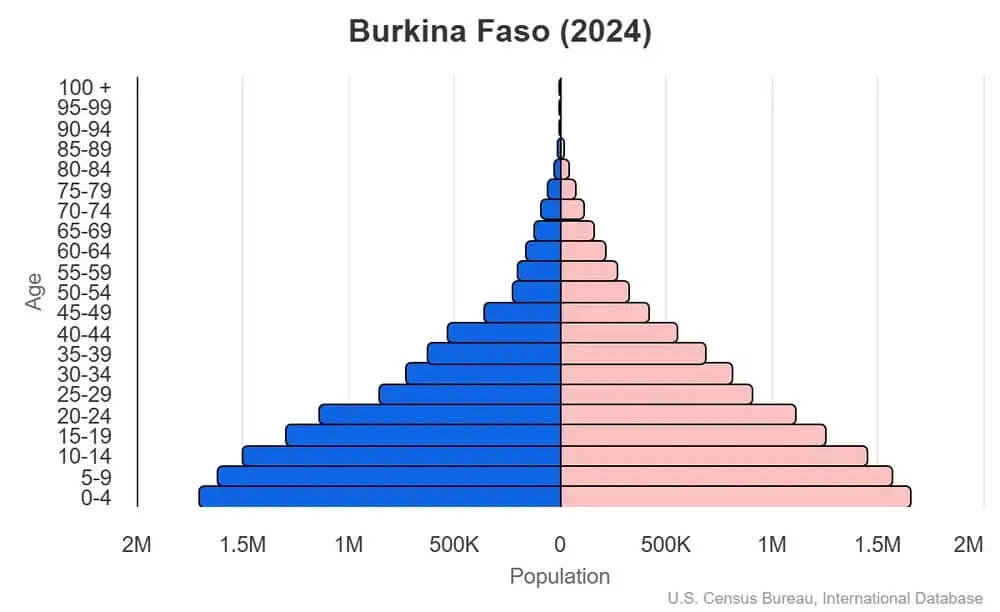
Total: 23,042,199 (2024 estimated)
Ethnic groups
Mossi 53.7%, Fulani (Peuhl) 6.8%, Gurunsi 5.9%, Bissa 5.4%, Gurma 5.2%, Bobo 3.4%, Senufo 2.2%, Bissa 1.5%, Lobi 1.5%, Tuareg/Bella 0.1%, other 12.8%, foreign 0.7% (2021 estimated)
Languages
Mossi 52.9%, Fula 7.8%, Gourmantche 6.8%, Dyula 5.7%, Bissa 3.3%, Gurunsi 3.2%, French (official) 2.2%, Bwamu 2%, Dagara 2%, San 1.7%, Marka 1.6%, Bobo 1.5%, Senufo 1.5%, Lobi 1.2%, other 6.6% (2019 estimated)
Religions
Muslim 63.8%, Roman Catholic 20.1%, Animiste 9%, Protestant 6.2%, other 0.2%, none 0.7% (2019 estimated)
Population growth rate
2.4% (2024 estimated)
Burkina Faso is home to a population of approximately 23 million people, with a growth rate of 2.4% as of 2024. The demographic composition is predominantly ethnic, with the Mossi people constituting 53.7% of the population, followed by the Fulani, Gurunsi, and several other ethnic groups. This rich tapestry of ethnic diversity is reflected in the linguistic landscape, where Mossi is the most widely spoken language, alongside French, which serves as the official language. The religious composition is predominantly Muslim, accounting for 63.8% of the population, with significant representations of Roman Catholics and Animists. This diverse cultural and religious framework plays a crucial role in shaping the social dynamics and community interactions within the country.
Government
Government type
Presidential republic
Capital
Name: Ouagadougou
Executive branch
Chief of state: Transitional President Capt. Ibrahim TRAORE (since 30 September 2022)
Head of government: Prime Minister Joachim KYLEM DE TAMBELA (since 21 October 2022)
Diplomatic representation in the US
Chief of mission: Ambassador Kassoum COULIBALY (since 24 July 2025)
Diplomatic representation from the US
Chief of mission: Ambassador Joann M. LOCKARD (since 28 June 2024)
Burkina Faso operates as a presidential republic, with the capital city being Ouagadougou. The executive branch is led by the Transitional President, Capt. Ibrahim TRAORE, who has been in office since September 30, 2022. The Prime Minister, Joachim KYLEM DE TAMBELA, has been serving since October 21, 2022. This transitional government structure reflects the ongoing political changes and the efforts to stabilize governance following periods of unrest and military intervention.
Economy
Economic overview
Highly agrarian, low-income economy; limited natural resources; widespread poverty; terrorism disrupting potential economic activity; improving trade balance via increases in gold exports; economy inflating after prior deflation; growing public debt but still manageable
Real GDP (purchasing power parity)
$60.001 billion (2024 estimated)
$57.152 billion (2023 estimated)
$55.508 billion (2022 estimated)
Real GDP per capita
$2,500 (2024 estimated)
$2,500 (2023 estimated)
$2,500 (2022 estimated)
Exports
$5.912 billion (2023 estimated)
$5.814 billion (2022 estimated)
$6.234 billion (2021 estimated)
Exports - partners
Switzerland 72%, UAE 10%, India 3%, Mali 3%, Cote d'Ivoire 2% (2023)
Exports - commodities
Gold, cotton, oil seeds, coconuts/brazil nuts/cashews, cement (2023)
Imports
$6.834 billion (2023 estimated)
$6.761 billion (2022 estimated)
$5.835 billion (2021 estimated)
Imports - partners
Cote d'Ivoire 14%, China 13%, Ghana 9%, Russia 9%, France 7% (2023)
Imports - commodities
Refined petroleum, plastic products, cement, electricity, packaged medicine (2023)
The economy of Burkina Faso is primarily agrarian, characterized by low-income levels and a significant reliance on agriculture. Despite its limited natural resources, the country has made strides in improving its trade balance, particularly through increased gold exports, which have become a cornerstone of its economic activity. The real GDP, measured in purchasing power parity, is estimated at $60.001 billion for 2024, reflecting a gradual recovery from previous deflationary pressures. However, the economy continues to grapple with widespread poverty and the disruptive effects of terrorism, which hinder potential economic growth. Public debt is on the rise but remains within manageable limits, indicating a need for careful fiscal management as the country navigates its economic challenges and opportunities for growth.
Human Development Index
The country's Human Development Index (HDI) is 0.459, ranking it 186th out of 193 countries tested. (more information)
World Happiness Report
The World Happiness Report ranked the country 126th out of 158 countries tested with a score of 4.341. (more information)