World Book
Dominican Republic
World Book Index
68

With a score of 68, the country is ranked 72nd out of 158 countries in the World Book ranking. (more information)
Introduction
The Dominican Republic, a vibrant nation located on the island of Hispaniola, boasts a rich tapestry of history and culture. Colonized by Spain and France, the island was divided, with the western third becoming Haiti and the eastern part evolving into the Dominican Republic in 1844. Despite a brief return to Spanish rule, the Dominican people fought valiantly for their independence, achieving it in 1865. Today, the Dominican Republic stands as a testament to resilience and cultural diversity, offering a unique blend of influences from its colonial past and a dynamic present that continues to shape its identity.
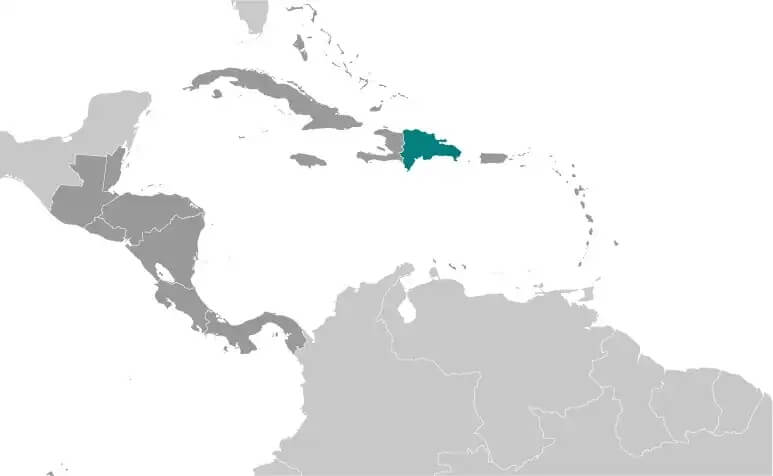
Neighboring countries
The Bahamas - Cuba - Haiti - Jamaica
Geography
Area
Total: 48,670 sq km
Land: 48,320 sq km
Water: 350 sq km
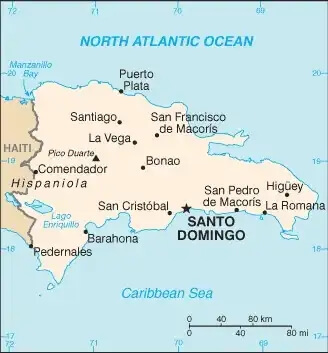
The Dominican Republic is characterized by its diverse geography, which includes mountainous regions, fertile valleys, and stunning coastlines. The country's total area of 48,670 square kilometers encompasses a variety of landscapes, from the rugged peaks of the Cordillera Central to the lush lowlands that support agriculture. The climate is predominantly tropical maritime, marked by minimal seasonal temperature variation but significant differences in rainfall throughout the year. This climatic diversity contributes to the rich natural resources found within the nation, including nickel, bauxite, gold, silver, and arable land, which play a crucial role in its economy and environmental sustainability.
People and Society
Population
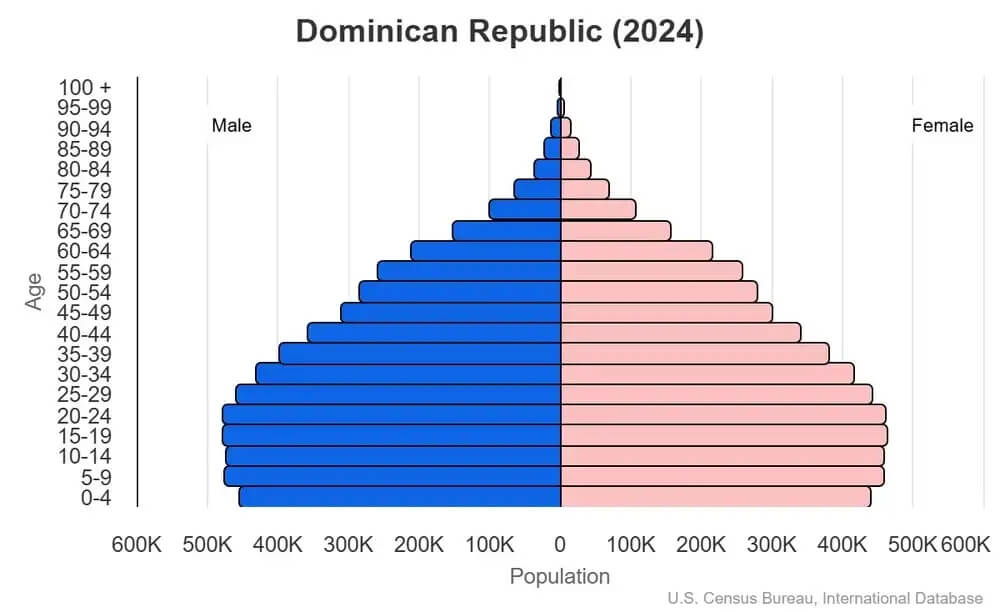
Total: 10,815,857 (2024 estimated)
Ethnic groups
Mixed 70.4% (Mestizo/Indio 58%, Mulatto 12.4%), Black 15.8%, White 13.5%, other 0.3% (2014 estimated)
Languages
Spanish (official)
Religions
Evangelical 50.2%, Roman Catholic 30.1%, none 18.5%, unspecified 1.2% (2023 estimated)
Population growth rate
0.76% (2024 estimated)
The Dominican Republic is home to a population of approximately 10.8 million people, reflecting a rich ethnic diversity that is predominantly mixed, with 70.4% identifying as such. This blend of cultures, primarily Mestizo and Mulatto, contributes to a vibrant social fabric. Spanish is the official language, serving as a unifying medium for communication among the populace. The religious landscape is equally diverse, with a significant portion of the population adhering to Evangelical Christianity, while Roman Catholicism remains influential. The country experiences a population growth rate of 0.76%, indicating a steady increase that poses both opportunities and challenges for social and economic development.
Government
Government type
Presidential republic
Capital
Name: Santo Domingo
Executive branch
Chief of state: President Luis Rodolfo ABINADER Corona (since 16 August 2020)
Head of government: President Luis Rodolfo ABINADER Corona (since 16 August 2020)
Diplomatic representation in the US
Chief of mission: Ambassador María Isabel CASTILLO BÁEZ (since 11 June 2025)
Diplomatic representation from the US
Chief of mission: Ambassador (vacant); Chargé d'Affaires Patricia AGUILERA (since 1 October 2023)
The Dominican Republic operates as a presidential republic, with a political structure that emphasizes the separation of powers among the executive, legislative, and judicial branches. The capital city, Santo Domingo, serves as the political and administrative heart of the nation. The current president, Luis Rodolfo ABINADER Corona, has been in office since August 16, 2020, leading the country through various reforms and initiatives aimed at enhancing governance and public welfare. The Dominican Republic maintains diplomatic relations with the United States, represented by Ambassador María Isabel CASTILLO BÁEZ, who has been in her position since June 11, 2025, reflecting the ongoing importance of international relations in the region.
Economy
Economic overview
The Dominican Republic's economy is characterized by a surging middle-income sector, driven by tourism, construction, mining, and telecommunications. The country has established itself as a significant player in the OECS economy, attracting major foreign direct investment, particularly from the United States, and benefiting from free-trade zones that enhance its economic landscape. Local financial markets are developing, and the government is improving debt management strategies, contributing to a decline in poverty levels. This multifaceted economic environment is poised for continued growth and diversification.
Real GDP (purchasing power parity)
$276.884 billion (2024 estimated)
$263.82 billion (2023 estimated)
$258.16 billion (2022 estimated)
Real GDP per capita
$24,200 (2024 estimated)
$23,300 (2023 estimated)
$23,000 (2022 estimated)
Exports
$28.563 billion (2024 estimated)
$25.79 billion (2023 estimated)
$25.169 billion (2022 estimated)
Exports - partners
USA 52%, Switzerland 7%, Haiti 6%, China 5%, India 3% (2023)
Exports - commodities
Medical instruments, tobacco, gold, garments, power equipment (2023)
Imports
$36.144 billion (2024 estimated)
$34.45 billion (2023 estimated)
$36.838 billion (2022 estimated)
Imports - partners
USA 40%, China 18%, Brazil 4%, Spain 4%, Mexico 3% (2023)
Imports - commodities
Refined petroleum, cars, natural gas, plastic products, crude petroleum (2023)
The Dominican Republic's real GDP, measured in purchasing power parity, is projected to reach $276.884 billion in 2024, reflecting a robust economic trajectory compared to previous years. The real GDP per capita is also on the rise, estimated at $24,200 for 2024, indicating an improvement in living standards. The country's export sector is diverse, with total exports estimated at $28.563 billion in 2024, primarily driven by partnerships with the United States, which accounts for 52% of exports. Key commodities include medical instruments, tobacco, and gold. Conversely, imports are projected at $36.144 billion, with the United States again being the largest partner, supplying 40% of imports, which consist mainly of refined petroleum and vehicles. This dynamic interplay between exports and imports underscores the Dominican Republic's strategic position in regional and global trade.
Human Development Index
The country's Human Development Index (HDI) is 0.776, ranking it 89th out of 193 countries tested. (more information)
World Happiness Report
The World Happiness Report ranked the country 63rd out of 158 countries tested with a score of 5.973. (more information)