World Book
Finland
World Book Index
83

With a score of 83, the country is ranked 4th out of 158 countries in the World Book ranking. (more information)
Introduction
Finland, a Nordic country located in Northern Europe, boasts a rich history that has shaped its unique identity. From its time as a province and grand duchy under Sweden from the 12th to the 19th centuries to its status as an autonomous grand duchy of Russia after 1809, Finland's journey to independence in 1917 marked a significant turning point. The country has since evolved into a modern, democratic state, joining the European Union in 1995 and NATO in April 2023, reflecting its commitment to international cooperation and security.
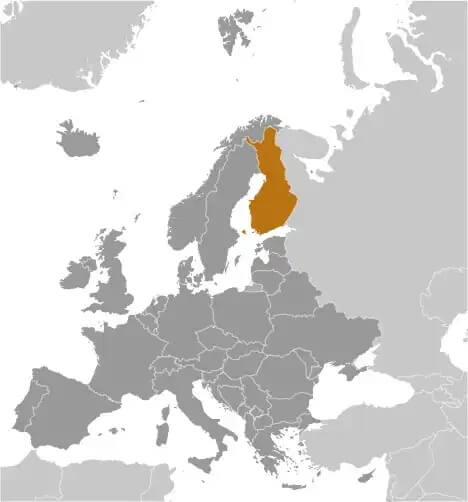
Neighboring countries
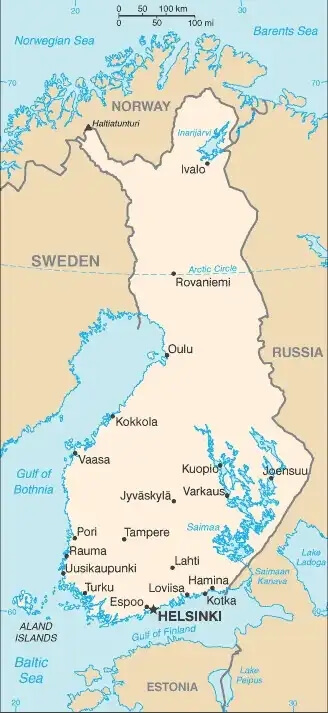
Norway - Russia - Sweden
Geography
Area
Total: 338,145 sq km
Land: 303,815 sq km
Water: 34,330 sq km
Climate
Finland experiences a cold temperate climate, with potential subarctic conditions. However, the moderating influences of the North Atlantic Current, the Baltic Sea, and the presence of over 60,000 lakes contribute to a comparatively mild climate, making it a unique geographical region.
Natural resources
The country is endowed with a wealth of natural resources, including timber, iron ore, copper, lead, zinc, chromite, nickel, gold, silver, and limestone, which play a crucial role in its economy and industrial activities.
People and Society
Population
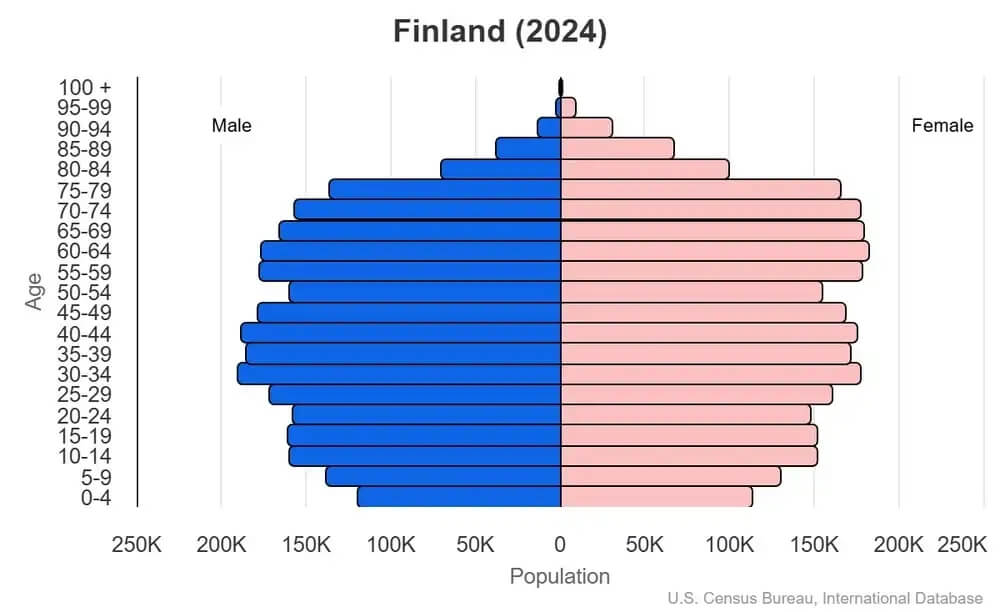
Total: 5,626,414 (2024 estimated)
Ethnic groups
The population of Finland is diverse, comprising Finnish, Swedish, Russian, Estonian, Romani, and Sami ethnic groups, each contributing to the cultural mosaic of the nation.
Languages
Finnish (official) 85.9%, Swedish (official) 5.2%, Russian 1.7%, other 7.2% (2022 estimated) The linguistic landscape reflects the country's historical ties and multicultural heritage, with Finnish and Swedish being the predominant languages.
Religions
Lutheran 66.6%, Greek Orthodox 1.1%, other 1.7%, none 30.6% (2022 estimated) The religious composition indicates a significant Lutheran majority, alongside a small Greek Orthodox community and a notable proportion of individuals identifying as non-religious.
Population growth rate
0.2% (2024 estimated) The modest growth rate suggests a stable demographic environment, influenced by various factors including immigration and natural population changes.
Government
Government type
Finland operates as a parliamentary republic, characterized by a democratic political system that emphasizes the role of the parliament in governance.
Capital
Name: Helsinki
Executive branch
The chief of state is President Alexander STUBB (since 1 March 2024), while the head of government is Prime Minister Petteri ORPO (since 20 June 2023), both playing pivotal roles in shaping national policy and international relations.
Diplomatic representation in the US
Chief of mission: Ambassador Leena-Kaisa MIKKOLA (since 18 September 2024)
Diplomatic representation from the US
Chief of mission: Ambassador (vacant); Chargé d’Affaires J. Chris KARBER (since July 2025)
Economy
Economic overview
Finland's economy is classified as a high-income, export-based system within the EU and eurozone. The country has established major industries in timber, metals, engineering, telecommunications, and electronics. Recently, Finland has been emerging from a recession that was triggered by inflation, weak consumer and export demand, and lower private investment. To address structural rigidities in the labor market, the government has initiated a reform plan aimed at revitalizing economic growth and stability.
Real GDP (purchasing power parity)
$313.591 billion (2024 estimated)
$314.075 billion (2023 estimated)
$317.078 billion (2022 estimated)
Real GDP per capita
$55,600 (2024 estimated)
$56,200 (2023 estimated)
$57,100 (2022 estimated)
Exports
$124.531 billion (2024 estimated)
$127.098 billion (2023 estimated)
$129.389 billion (2022 estimated)
Exports - partners
USA 11%, Germany 11%, Sweden 10%, Netherlands 7%, China 5% (2023)
Exports - commodities
The primary commodities exported include paper, refined petroleum, steel, wood pulp, and ships (2023), which highlight the country's industrial strengths.
Imports
$122.644 billion (2024 estimated)
$126.175 billion (2023 estimated)
$135.119 billion (2022 estimated)
Imports - partners
Germany 14%, Sweden 12%, China 9%, Norway 8%, Netherlands 5% (2023)
Imports - commodities
Finland's imports primarily consist of crude petroleum, cars, refined petroleum, packaged medicine, and broadcasting equipment (2023), reflecting the country's consumption patterns and industrial needs.
Human Development Index
The country's Human Development Index (HDI) is 0.948, ranking it 12th out of 193 countries tested. (more information)
World Happiness Report
The World Happiness Report ranked the country 6th out of 158 countries tested with a score of 7.319. (more information)