World Book
Norway
World Book Index
82

With a score of 82, the country is ranked 9th out of 158 countries in the World Book ranking. (more information)
Introduction
Norway, a nation steeped in rich history and cultural heritage, has undergone significant transformations over the centuries. The Viking Age, marked by extensive raids across Europe, began to wane after the adoption of Christianity in 994. This pivotal moment set the stage for Norway's eventual integration into a union with Denmark in 1397, a political arrangement that endured for over four hundred years. The rise of nationalism in the 19th century catalyzed a movement towards independence, culminating in a referendum in 1905 that restored Norway's sovereignty from Sweden. Today, Norway stands as a testament to resilience and cultural identity, balancing its historical legacy with modern governance and societal values.
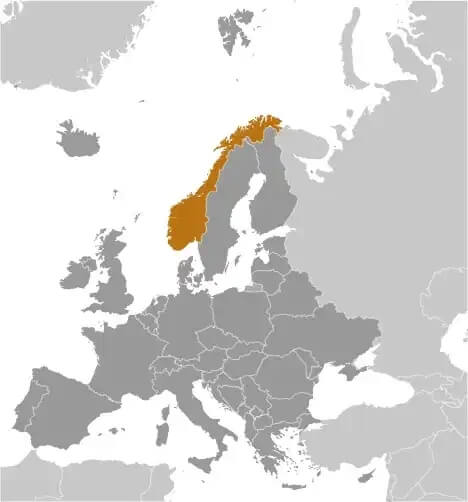
Neighboring countries
Finland - Russia - Sweden
Geography
Area
Total: 323,802 sq km
Land: 304,282 sq km
Water: 19,520 sq km
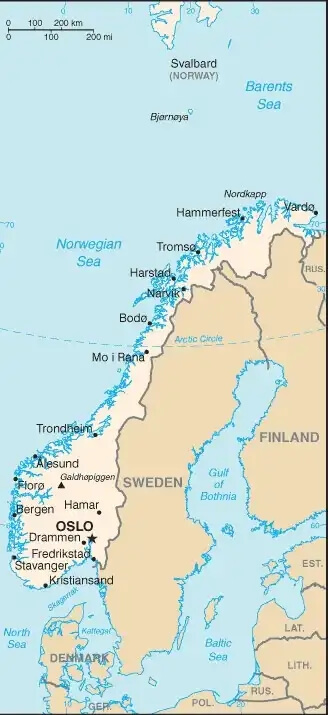
Norway's geography is characterized by its stunning natural landscapes and diverse topography. The country boasts a total area of 323,802 square kilometers, with the majority of this land being terrestrial, covering 304,282 square kilometers. The remaining 19,520 square kilometers consist of water bodies, including fjords, lakes, and rivers that contribute to Norway's breathtaking scenery. The climate varies significantly across the nation, with a temperate climate along the coast influenced by the North Atlantic Current, while the interior experiences colder temperatures and increased precipitation. The western coast is particularly known for its rainy weather year-round, making it a unique ecological zone. Norway is endowed with abundant natural resources, including petroleum, natural gas, iron ore, copper, lead, zinc, titanium, pyrites, nickel, fish, timber, and hydropower, which play a crucial role in its economy and energy production.
People and Society
Population
Total: 5,509,733 (2024 estimated)
Ethnic groups
Norwegian 81.5% (includes about 60,000 Sami), other European 8.9%, other 9.6% (2021 estimated)
Languages
Bokmal Norwegian (official), Nynorsk Norwegian (official), small Sami- and Finnish-speaking minorities
Religions
Church of Norway (Evangelical Lutheran - official) 67.5%, Muslim 3.1%, Roman Catholic 3.1%, other Christian 3.8%, other 2.6%, unspecified 19.9% (2021 estimated)
Population growth rate
0.59% (2024 estimated)
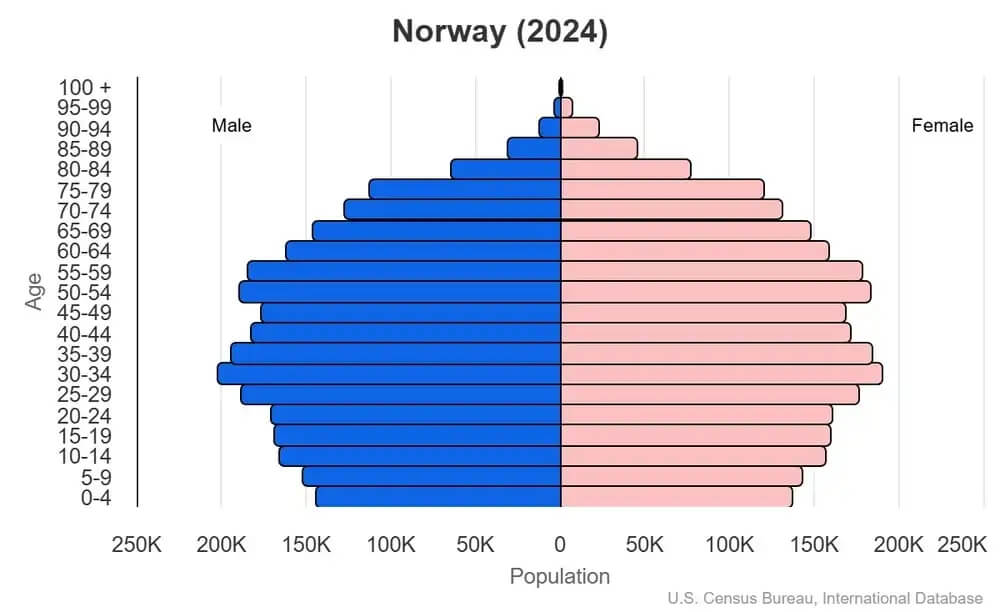
Norway's population, estimated at 5,509,733 in 2024, reflects a diverse and evolving society. The ethnic composition is predominantly Norwegian, accounting for 81.5% of the population, which includes approximately 60,000 Sami, an indigenous group with a rich cultural heritage. Other European ethnicities make up 8.9%, while the remaining 9.6% consists of various other groups, highlighting Norway's multicultural fabric. The official languages, Bokmal and Nynorsk Norwegian, coexist alongside small communities of Sami and Finnish speakers, illustrating the country's commitment to linguistic diversity. In terms of religion, the Church of Norway, an Evangelical Lutheran denomination, is the state church, with 67.5% of the population identifying as members. However, the religious landscape is becoming increasingly pluralistic, with Muslims and Roman Catholics each representing 3.1% of the population, and other Christian denominations comprising 3.8%. The population growth rate of 0.59% indicates a stable demographic trend, influenced by both natural growth and immigration.
Government
Government type
Parliamentary constitutional monarchy
Capital
Name: Oslo
Executive branch
Chief of state: King HARALD V (since 17 January 1991)
Head of government: Prime Minister Jonas Gahr STORE (since 14 October 2021)
Diplomatic representation in the US
Chief of mission: Ambassador Anniken Scharning HUITFELDT (since 18 September 2024)
Diplomatic representation from the US
Chief of mission: Ambassador (vacant); Chargé d'Affaires Eric MEYER (since August 2024)
Norway operates under a parliamentary constitutional monarchy, where the monarchy is largely ceremonial, and the government is run by elected officials. The capital city, Oslo, serves as the political and administrative center of the country. The executive branch is led by the King, currently King HARALD V, who has been in power since January 17, 1991. The head of government is the Prime Minister, Jonas Gahr STORE, who has held office since October 14, 2021. Norway maintains a robust diplomatic presence, with Anniken Scharning HUITFELDT serving as the Ambassador to the United States since September 18, 2024, while the U.S. diplomatic mission in Norway is currently represented by Chargé d'Affaires Eric MEYER, following a vacancy in the ambassadorial position since August 2024.
Economy
Economic overview
Norway is classified as a high-income, non-EU economy that maintains significant trade links through the European Economic Area (EEA). The country plays a pivotal role in European energy security, being a leader in the export of oil, gas, and electricity. Its economy is bolstered by major industries such as fishing, forestry, and oil extraction, which contribute to its wealth and stability. The oil sovereign fund, a crucial component of Norway's economic framework, supports a generous welfare system that ensures a high standard of living for its citizens. The labor market is characterized by low unemployment rates, reflecting a robust economy. Although inflation is moderating, it remains above the target level, indicating ongoing economic challenges. The real GDP, measured by purchasing power parity, is estimated at $507.68 billion for 2024, with a real GDP per capita of $91,100. Exports are projected to reach $229.205 billion in 2024, with Germany, the UK, and Sweden being the primary partners. The import sector is also significant, with total imports estimated at $162.467 billion, highlighting Norway's active participation in global trade.
Real GDP (purchasing power parity)
$507.68 billion (2024 estimated)
$497.236 billion (2023 estimated)
$496.877 billion (2022 estimated)
Real GDP per capita
$91,100 (2024 estimated)
$90,100 (2023 estimated)
$91,100 (2022 estimated)
Exports
$229.205 billion (2024 estimated)
$230.882 billion (2023 estimated)
$323.875 billion (2022 estimated)
Exports - partners
Germany 18%, UK 17%, Sweden 9%, Denmark 7%, Netherlands 6% (2023)
Exports - commodities
Natural gas, crude petroleum, fish, refined petroleum, aluminum (2023)
Imports
$162.467 billion (2024 estimated)
$156.11 billion (2023 estimated)
$160.649 billion (2022 estimated)
Imports - partners
Sweden 11%, Germany 11%, China 11%, USA 7%, Netherlands 5% (2023)
Imports - commodities
Cars, refined petroleum, ships, nickel, garments (2023)
Human Development Index
The country's Human Development Index (HDI) is 0.970, ranking it 2nd out of 193 countries tested. (more information)
World Happiness Report
The World Happiness Report ranked the country 20th out of 158 countries tested with a score of 6.818. (more information)