World Book
Sweden
World Book Index
82

With a score of 82, the country is ranked 10th out of 158 countries in the World Book ranking. (more information)
Introduction
A military power during the 17th century, Sweden has not participated in any war for two centuries. An armed neutrality was preserved in both World Wars. Since then, Sweden has pursued a successful economic formula consisting of a capitalist system intermixed with substantial welfare elements.
Neighboring countries
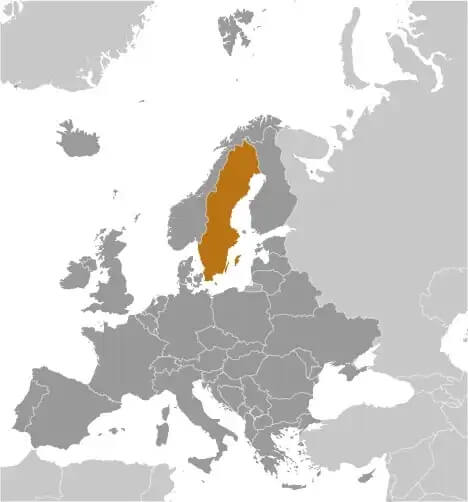
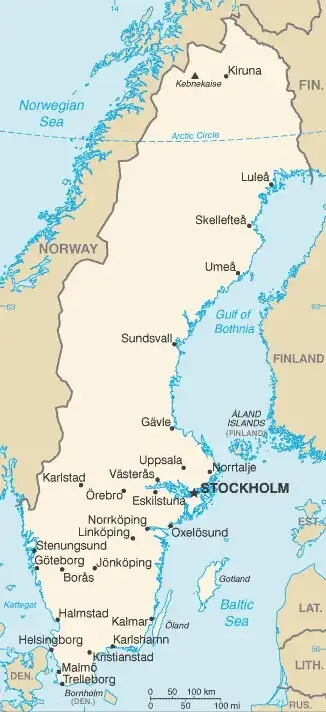
Denmark - Finland - Norway
Geography
Area
total: 450,295 sq km
land: 410,335 sq km
water: 39,960 sq km
Climate
temperate in south with cold, cloudy winters and cool, partly cloudy summers; subarctic in north
Natural resources
iron ore, copper, lead, zinc, gold, silver, tungsten, uranium, arsenic, feldspar, timber, hydropower
People and Society
Population
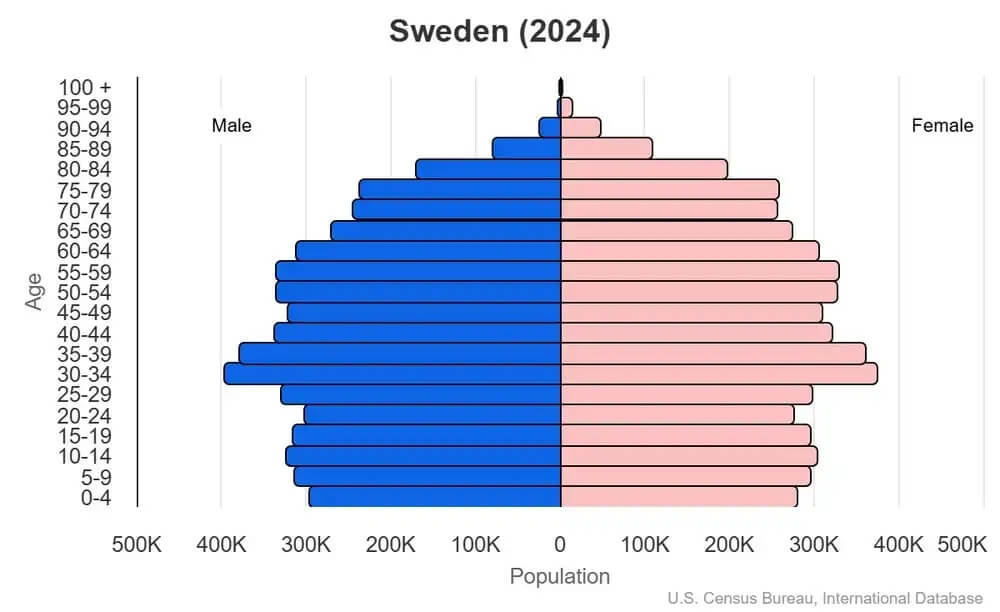
total: 10,589,835 (2024 est.)
Ethnic groups
Swedish 79.6%, Syrian 1.9%, Iraqi 1.4%, Finnish 1.3%, other 15.8%
(2022 est.)
Languages
Swedish (official)
Religions
Church of Sweden (Lutheran) 53.9%, other (includes Roman Catholic, Orthodox, Baptist, Muslim, Jewish, and Buddhist) 8.9%, none or unspecified 37.2% (2021 est.)
Population growth rate
0.51% (2024 est.)
Government
Government type
parliamentary constitutional monarchy
Capital
name: Stockholm
Executive branch
chief of state: King CARL XVI GUSTAF (since 15 September 1973)
head of government: Prime Minister Ulf KRISTERSSON (since 18 October 2022)
Diplomatic representation in the US
chief of mission: Ambassador Urban AHLIN (since 15 September 2023)
Diplomatic representation from the US
chief of mission: Ambassador (vacant); Chargé d’Affaires Viraj LeBAILLY (since August 2025)
Economy
Economic overview
high-income, largest Nordic economy; EU member but does not use the euro; export-oriented, led by automotive, electronics, machinery, and pharmaceuticals; highly ranked for competitiveness, R&D investments and governance; recovery, with falling inflation and real wage growth balanced by risks from trade uncertainty
Real GDP (purchasing power parity)
$668.628 billion (2024 est.)
$662.18 billion (2023 est.)
$662.937 billion (2022 est.)
Real GDP per capita
$63,300 (2024 est.)
$62,800 (2023 est.)
$63,200 (2022 est.)
Exports
$338.852 billion (2024 est.)
$329.332 billion (2023 est.)
$318.203 billion (2022 est.)
Exports - partners
Germany 10%, USA 10%, Denmark 8%, Norway 6%, Netherlands 5% (2023)
Exports - commodities
cars, refined petroleum, packaged medicine, paper, vehicle parts/accessories (2023)
Imports
$309.526 billion (2024 est.)
$304.194 billion (2023 est.)
$304.101 billion (2022 est.)
Imports - partners
Germany 17%, Netherlands 10%, Norway 9%, Denmark 6%, China 6% (2023)
Imports - commodities
cars, crude petroleum, refined petroleum, vehicle parts/accessories, garments (2023)
Human Development Index
The country's Human Development Index (HDI) is 0.959, ranking it 5th out of 193 countries tested. (more information)
World Happiness Report
The World Happiness Report ranked the country 18th out of 158 countries tested with a score of 6.838. (more information)