World Book
Georgia
World Book Index
70

With a score of 70, the country is ranked 60th out of 158 countries in the World Book ranking. (more information)
Introduction
Georgia, a nation steeped in rich history, was once home to the ancient kingdoms of Colchis and Kartli-Iberia, which played pivotal roles in the region's early civilization. Over the centuries, the territory has been influenced and dominated by various powers, notably the Russian Empire in the 19th century. Following a tumultuous period, Georgia was forcibly integrated into the Soviet Union in 1921, only to reclaim its independence after the Soviet collapse in 1991. In a significant step towards European integration, Georgia achieved EU candidate status in December 2023, reflecting its aspirations for closer ties with Western Europe and a commitment to democratic reforms.
Neighboring countries
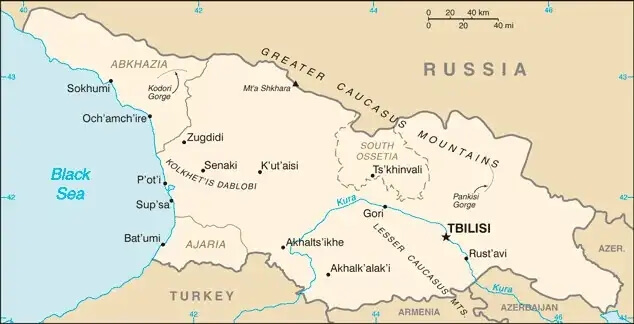
Armenia - Azerbaijan - Russia - Turkey
Geography
Area
Total: 69,700 sq km
Land: 69,700 sq km
Water: 0 sq km
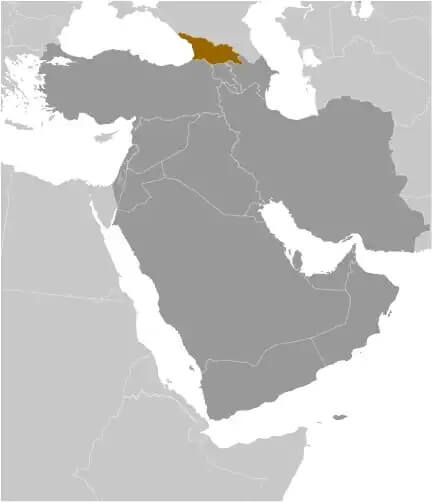
Georgia is strategically located at the crossroads of Eastern Europe and Western Asia, bordered by the Black Sea to the west. The country's diverse geography includes mountainous regions, fertile valleys, and a picturesque coastline, contributing to its Mediterranean-like climate along the Black Sea coast. The climate is generally warm and pleasant, which supports a variety of agricultural activities. Georgia is endowed with significant natural resources, including timber, hydropower, manganese deposits, iron ore, and copper. The favorable coastal climate and rich soils also facilitate the cultivation of tea and citrus fruits, making agriculture a vital sector of the economy.
People and Society
Population
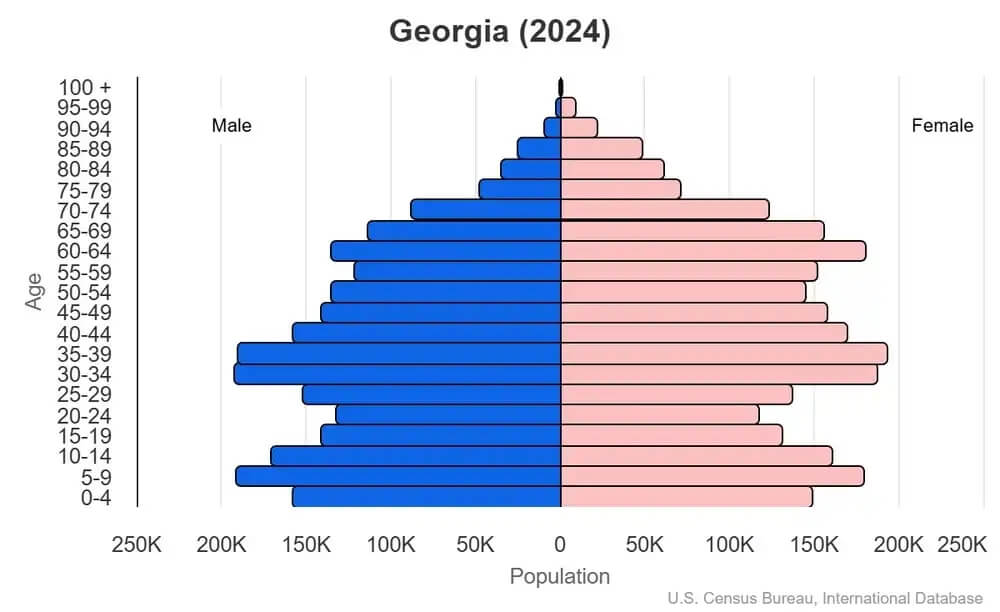
Total: 4,900,961 (2024 estimated)
Ethnic groups
Georgian 86.8%, Azeri 6.3%, Armenian 4.5%, other 2.3% (includes Russian, Ossetian, Yazidi, Ukrainian, Kist, Greek) (2014 estimated)
Languages
Georgian (official) 87.6%, Azeri 6.2%, Armenian 3.9%, Russian 1.2%, other 1% (including Abkhaz, the official language in Abkhazia) (2014 estimated)
Religions
Eastern Orthodox Christian (official) 83.4%, Muslim 10.7%, Armenian Apostolic Christian 2.9%, other 1.2% (includes Roman Catholic Christian, Jehovah's Witness, Yazidi, Protestant Christian, Jewish), none 0.5%, unspecified/no answer 1.2% (2014 estimated)
Population growth rate
-0.5% (2024 estimated)
Georgia's population is characterized by a rich tapestry of ethnic diversity, with Georgians making up the majority at 86.8%. The country also hosts significant Azeri and Armenian communities, reflecting its historical connections and regional dynamics. The official language, Georgian, is spoken by the vast majority, while other languages such as Azeri and Armenian are also prevalent. The predominant religion is Eastern Orthodox Christianity, which plays a crucial role in shaping the cultural identity of the nation. However, the country faces demographic challenges, including a declining population growth rate of -0.5%, which raises concerns about future economic and social sustainability.
Government
Government type
Semi-presidential republic
Capital
Name: Tbilisi
Executive branch
Chief of state: President Mikheil KAVELASHVILI (since 29 December 2024)
Head of government: Prime Minister Irakli KOBAKHIDZE (since 8 February 2024)
Diplomatic representation in the US
Chief of mission: Ambassador Tamar TALIASHVILI (since 24 July 2025)
Diplomatic representation from the US
Chief of mission: Ambassador Robin L. DUNNIGAN (since 12 October 2023)
Georgia operates as a semi-presidential republic, where the President serves as the head of state and the Prime Minister acts as the head of government. The capital city, Tbilisi, is the political and cultural heart of the nation. The current President, Mikheil KAVELASHVILI, took office in late December 2024, while Prime Minister Irakli KOBAKHIDZE has been in office since February 2024. Georgia's government structure reflects a commitment to democratic principles, although it faces challenges related to political stability and governance.
Economy
Economic overview
Upper-middle income, fast-growing South Caucasus economy; regionally focused exporter of cars, metal ores, and energy; financial and migrant inflows resulting from Ukraine conflict; EU accession talks suspended over disputed election and foreign influence law; low inflation but persistent high unemployment
Real GDP (purchasing power parity)
$91.849 billion (2024 estimated)
$83.935 billion (2023 estimated)
$77.838 billion (2022 estimated)
Real GDP per capita
$25,000 (2024 estimated)
$22,600 (2023 estimated)
$21,000 (2022 estimated)
Exports
$16.321 billion (2024 estimated)
$15.173 billion (2023 estimated)
$13.24 billion (2022 estimated)
Exports - partners
Azerbaijan 13%, Turkey 11%, Armenia 11%, Russia 10%, Kyrgyzstan 8% (2023)
Exports - commodities
Cars, copper ore, electricity, garments, wine (2023)
Imports
$18.915 billion (2024 estimated)
$17.816 billion (2023 estimated)
$15.665 billion (2022 estimated)
Imports - partners
Turkey 16%, USA 13%, Russia 11%, China 8%, Germany 6% (2023)
Imports - commodities
Cars, refined petroleum, packaged medicine, natural gas, garments (2023)
Human Development Index
The country's Human Development Index (HDI) is 0.844, ranking it 57th out of 193 countries tested. (more information)
World Happiness Report
The World Happiness Report ranked the country 81st out of 158 countries tested with a score of 5.696. (more information)