World Book
Turkey
World Book Index
67

With a score of 67, the country is ranked 80th out of 158 countries in the World Book ranking. (more information)
Introduction
Turkey, a nation that bridges Europe and Asia, has a rich tapestry of history and culture. Founded in 1923 by the visionary reformer and national hero Mustafa KEMAL, Turkey emerged from the ashes of the Ottoman Empire, marking a significant transformation in its national identity. Since joining the United Nations in 1945 and NATO in 1952, Turkey has played a pivotal role in regional and global affairs. The commencement of EU accession talks in 2005 reflects its ongoing quest for integration with Europe. In 2017, Turkey transitioned from a parliamentary to a presidential system, a move that has reshaped its political landscape and governance structure, emphasizing the centralization of power within the executive branch.
Neighboring countries
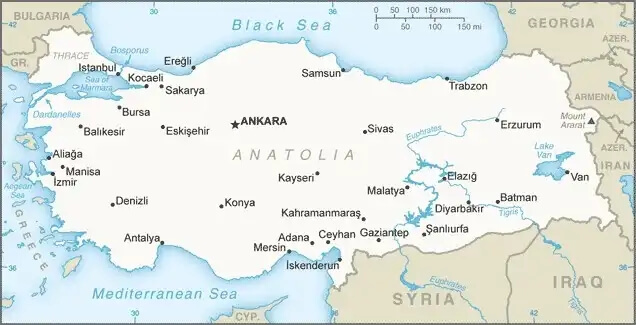
Armenia - Azerbaijan - Bulgaria - Georgia - Greece - Iran - Iraq - Syria
Geography
Area
Total: 783,562 sq km
Land: 769,632 sq km
Water: 13,930 sq km
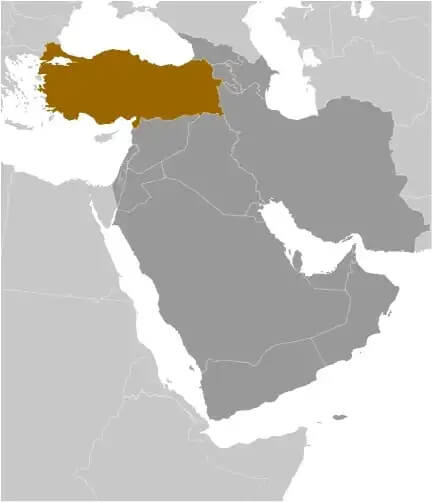
Turkey's geographical landscape is characterized by its unique position straddling two continents, Europe and Asia. This strategic location not only enhances its geopolitical significance but also contributes to its diverse climatic conditions. The climate is predominantly temperate, featuring hot, dry summers and mild, wet winters, although the interior regions experience harsher weather patterns. The country's rich natural resources include coal, iron ore, copper, and gold, among others, which play a vital role in its economy. The vast arable land and hydropower potential further underscore Turkey's agricultural and energy capabilities, making it a key player in the region.
People and Society
Population
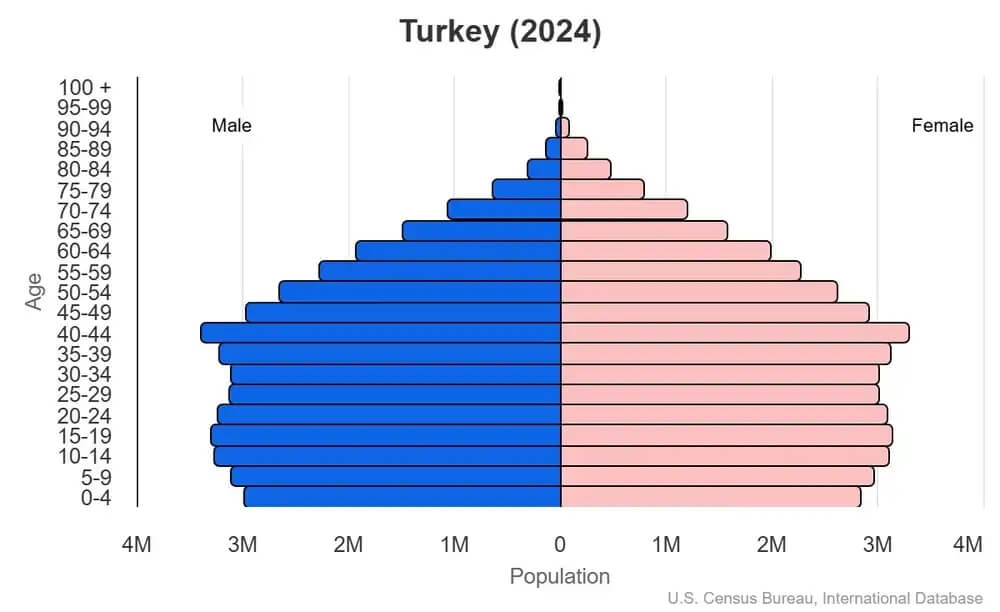
Total: 84,119,531 (2024 estimated)
Ethnic groups
Turkish 70-75%, Kurdish 19%, other minorities 6-11% (2016 estimated)
Languages
Turkish (official), Kurdish, other minority languages
Religions
Muslim 99.8% (mostly Sunni), other 0.2% (mostly Christians and Jews)
Population growth rate
0.61% (2024 estimated)
Turkey's population is a vibrant mosaic of ethnicities and cultures, with the Turkish people comprising the majority at 70-75%, followed by a significant Kurdish minority at 19%. The presence of other ethnic groups adds to the country's rich cultural diversity. Turkish is the official language, while Kurdish and various minority languages reflect the multilingual nature of society. The overwhelming majority of the population identifies as Muslim, predominantly Sunni, which influences the cultural and social fabric of the nation. With a population growth rate of 0.61%, Turkey continues to experience demographic changes that impact its social dynamics and economic development.
Government
Government type
Presidential republic
Capital
Name: Ankara
Executive branch
Chief of state: President Recep Tayyip ERDOGAN (since 28 August 2014)
Head of government: President Recep Tayyip ERDOGAN (since 9 July 2018)
Diplomatic representation in the US
Chief of mission: Ambassador Sedat ÖNAL (since 17 June 2024)
Diplomatic representation from the US
Chief of mission: Ambassador Thomas J. BARRACK (since 14 May 2025)
Turkey operates as a presidential republic, where the President serves as both the head of state and the head of government, consolidating significant authority within the executive branch. The capital city, Ankara, is the political heart of the nation. President Recep Tayyip ERDOGAN has been in power since 2014, with his leadership marked by significant political changes and a focus on strengthening Turkey's position on the global stage. The diplomatic landscape is also evolving, with key representatives in the United States reflecting Turkey's strategic alliances and international relations.
Economy
Economic overview
Upper-middle-income, diversified Middle Eastern economy; industrializing economy that maintains large agricultural base; key energy, tourism, and construction sectors; high inflation, interest rates, and foreign debt pose risk to financial stability
Real GDP (purchasing power parity)
$3.018 trillion (2024 estimated)
$2.925 trillion (2023 estimated)
$2.783 trillion (2022 estimated)
Real GDP per capita
$35,300 (2024 estimated)
$34,300 (2023 estimated)
$32,700 (2022 estimated)
Exports
$372.756 billion (2024 estimated)
$357.588 billion (2023 estimated)
$346.602 billion (2022 estimated)
Exports - partners
Germany 9%, USA 6%, UK 6%, UAE 5%, Iraq 5% (2023)
Exports - commodities
Garments, cars, gold, refined petroleum, vehicle parts/accessories (2023)
Imports
$367.022 billion (2024 estimated)
$386.602 billion (2023 estimated)
$383.7 billion (2022 estimated)
Imports - partners
China 13%, Russia 9%, Germany 9%, Switzerland 6%, USA 5% (2023)
Imports - commodities
Gold, refined petroleum, cars, plastics, natural gas (2023)
Human Development Index
The country's Human Development Index (HDI) is 0.853, ranking it 51st out of 193 countries tested. (more information)
World Happiness Report
The World Happiness Report ranked the country 110th out of 158 countries tested with a score of 4.879. (more information)