World Book

Armenia
World Book Index
69

With a score of 69, the country is ranked 66th out of 158 countries in the World Book ranking. (more information)
Introduction
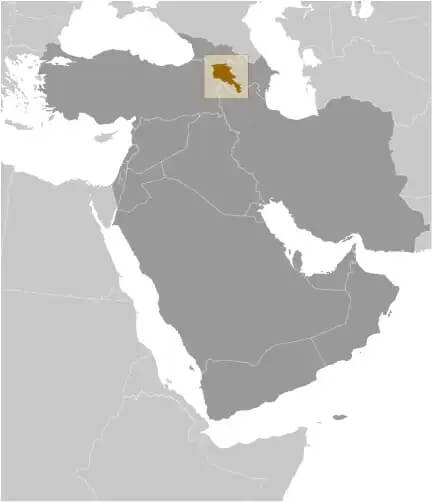
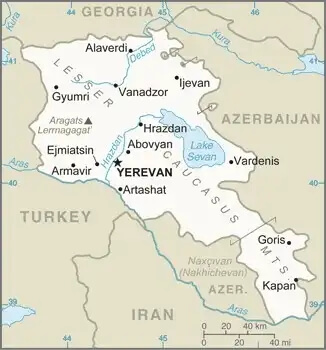
Armenia is a landlocked country located in the South Caucasus region of Eurasia, serving as a vital crossroads between Western Asia and Eastern Europe. Its strategic position is underscored by its borders with Azerbaijan, Georgia, Iran, and Turkey. The country is characterized by its mountainous terrain, predominantly situated in the Lesser Caucasus Mountains, and is interspersed with fast-flowing rivers that enhance its natural beauty and ecological diversity. Armenia's rich history and cultural heritage, combined with its unique geographical features, make it a fascinating subject of study in the context of regional dynamics and international relations.
Neighboring countries
Azerbaijan - Georgia - Iran - Turkey
Geography
Area
Total: 29,743 sq km
Land: 28,203 sq km
Water: 1,540 sq km
Climate
Armenia experiences a highland continental climate, characterized by hot summers and cold winters, which significantly influences its agricultural practices and lifestyle.
Natural resources
The country possesses small deposits of valuable minerals, including gold, copper, molybdenum, zinc, and bauxite, which play a crucial role in its economy and export profile.
People and Society
Population
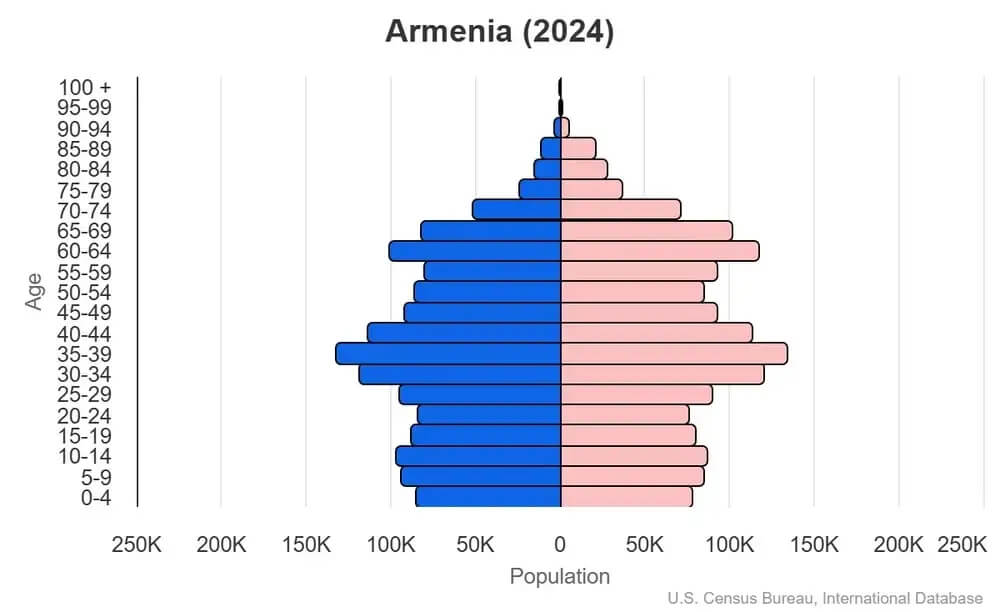
Total: 2,976,765 (2024 estimated)
Ethnic groups
Armenian 98.1%, Yezidi 1.1%, other 0.8% (2022 estimated)
Languages
Armenian (official) 97.9%, Kurmanji (spoken by Yezidi minority) 1%, other 1.1%; note - Russian is widely spoken (2011 estimated)
Religions
Armenian Apostolic Christian 95.2%, other Christian 1.6%, other 0.9%, none 0.6%, unspecified 1.7% (2022 estimated)
Population growth rate
-0.42% (2024 estimated)
The demographic landscape of Armenia is predominantly Armenian, with a small but significant Yezidi minority. The linguistic landscape is similarly homogenous, with Armenian as the official language, although Russian remains widely spoken, reflecting historical ties with the former Soviet Union. The religious composition is overwhelmingly Christian, with the Armenian Apostolic Church playing a central role in the cultural and social life of the nation. However, the country faces challenges related to population decline, as indicated by the negative growth rate, which raises concerns about the future demographic and economic sustainability.
Government
Government type
Armenia operates as a parliamentary democracy, a system that was solidified through constitutional changes adopted in December 2015, transitioning from a presidential to a parliamentary system. This shift aimed to enhance political stability and governance efficiency.
Capital
Name: Yerevan
Executive branch
Chief of state: President Vahagn KHACHATURYAN (since 13 March 2022)
Head of government: Prime Minister Nikol PASHINYAN (since 10 September 2021)
Diplomatic representation in the US
Chief of mission: Ambassador Narek MKRTCHYAN (since 19 September 2025)
Diplomatic representation from the US
Chief of mission: Ambassador Kristina A. KVIEN (since 21 February 2023)
The governance structure of Armenia reflects its commitment to democratic principles, with a clear separation of powers and an emphasis on parliamentary authority. The capital city, Yerevan, serves as the political and cultural heart of the nation, where key decisions regarding domestic and foreign policy are made. The presence of diplomatic missions underscores Armenia's active engagement in international relations, particularly with the United States, which is crucial for its geopolitical strategy.
Economy
Economic overview
Armenia is classified as an upper-middle-income country, characterized by a fast-growing economy within the Caucasus region. The nation has established a stable fiscal and monetary regime, although it remains vulnerable to geopolitical shocks that can impact its economic stability. While Armenia maintains strong economic and energy ties with Russia, there is an ongoing effort to diversify its trade relationships, particularly with the European Union and the United States. The country is a key exporter of copper and gold, which are vital to its economic framework. Recent reforms aimed at fostering a business-friendly environment and combating corruption have been implemented, although persistent unemployment remains a challenge. Additionally, the influx of migrants due to the Ukraine war has contributed to demographic shifts and economic adjustments.
Real GDP (purchasing power parity)
$60.909 billion (2024 estimated)
$57.516 billion (2023 estimated)
$53.108 billion (2022 estimated)
Real GDP per capita
$20,100 (2024 estimated)
$19,400 (2023 estimated)
$17,900 (2022 estimated)
Exports
$18.618 billion (2024 estimated)
$14.338 billion (2023 estimated)
$10.118 billion (2022 estimated)
Exports - partners
Russia 37%, UAE 25%, Hong Kong 7%, China 5%, Georgia 4% (2023)
Exports - commodities
Gold, diamonds, copper ore, broadcasting equipment, jewelry (2023)
Imports
$19.087 billion (2024 estimated)
$14.532 billion (2023 estimated)
$10.265 billion (2022 estimated)
Imports - partners
Russia 29%, China 12%, Vietnam 6%, Georgia 5%, Iran 4% (2023)
Imports - commodities
Cars, gold, diamonds, broadcasting equipment, natural gas (2023)
Human Development Index
The country's Human Development Index (HDI) is 0.811, ranking it 69th out of 193 countries tested. (more information)
World Happiness Report
The World Happiness Report ranked the country 74th out of 158 countries tested with a score of 5.816. (more information)