World Book

Greece
World Book Index
75

With a score of 75, the country is ranked 45th out of 158 countries in the World Book ranking. (more information)
Introduction
Greece, a nation steeped in history and culture, achieved independence from the Ottoman Empire in 1830, marking the beginning of its journey as a sovereign state. Transitioning from a monarchy to a parliamentary republic in 1974, Greece has since embraced democratic governance. Its membership in the European Union, which began in 1981, has significantly influenced its political and economic landscape, integrating it further into the fabric of Europe and enhancing its global standing.
Neighboring countries
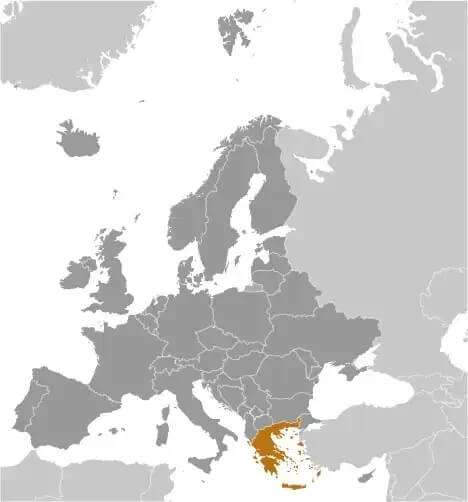
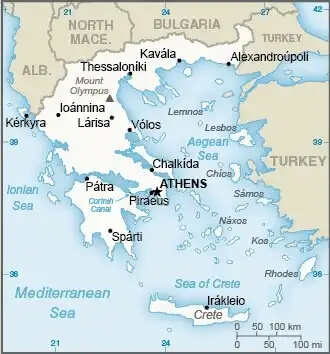
Albania - Bulgaria - North Macedonia - Turkey
Geography
Area
Total: 131,957 sq km
Land: 130,647 sq km
Water: 1,310 sq km
Greece is characterized by its diverse geography, which includes a mountainous mainland and numerous islands scattered throughout the Aegean and Ionian Seas. The country enjoys a temperate climate, featuring mild, wet winters and hot, dry summers that contribute to its rich agricultural output and vibrant tourism sector. Greece is endowed with a variety of natural resources, including lignite, petroleum, iron ore, and marble, which play a crucial role in its economy and development.
People and Society
Population
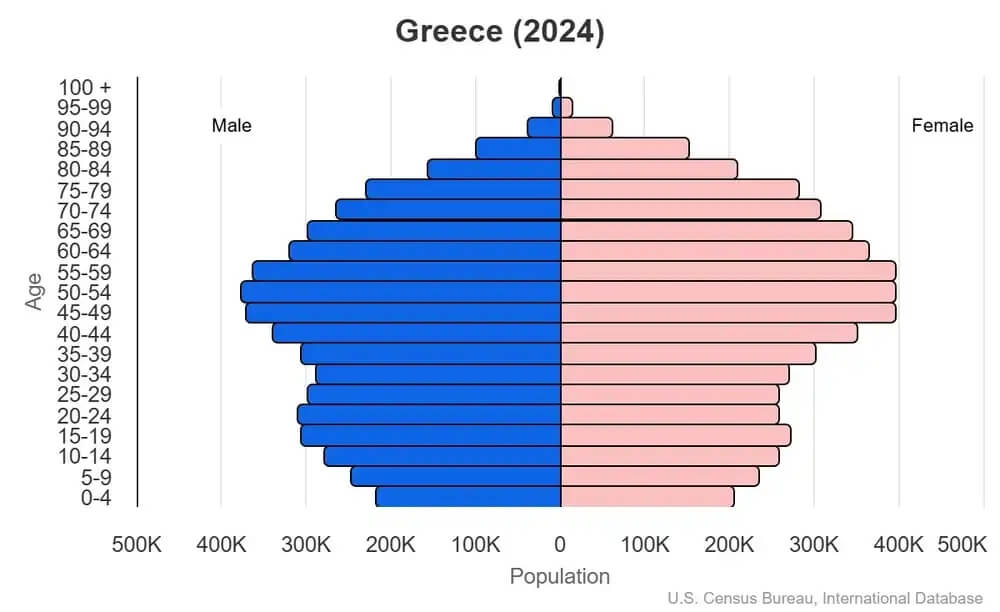
Total: 10,461,091 (2024 estimated)
Ethnic groups
Greek 91.6%, Albanian 4.4%, other 4% (2011 estimated)
Languages
Greek (official) 99%, other (includes English and French) 1%
Religions
Greek Orthodox 81-90%, Muslim 2%, other 3%, none 4-15%, unspecified 1% (2015 estimated)
Population growth rate
-0.35% (2024 estimated)
Greece's population is predominantly Greek, with a small percentage of ethnic Albanians and other groups contributing to its cultural mosaic. The official language is Greek, reflecting the nation's rich heritage. The majority of the population identifies as Greek Orthodox, which plays a significant role in shaping societal values and traditions. However, the country faces demographic challenges, including a declining population growth rate, which raises concerns about the sustainability of its social systems and economic vitality in the long term.
Government
Government type
Parliamentary republic
Capital
Name: Athens
Executive branch
Chief of state: President Konstantinos TASOULAS (since 13 March 2025)
Head of government: Prime Minister Kyriakos MITSOTAKIS (since 26 June 2023)
Diplomatic representation in the US
Chief of mission: Ambassador Ekaterini NASSIKA (since 27 February 2024)
Diplomatic representation from the US
Chief of mission: Ambassador (vacant); Chargé d’Affaires Josh HUCK (since 1 August 2025)
Greece operates as a parliamentary republic, with a political system that emphasizes democratic principles and the rule of law. The capital, Athens, serves as the political and cultural heart of the nation. The executive branch is led by President Konstantinos Tasoulas and Prime Minister Kyriakos Mitsotakis, who are responsible for steering the country through contemporary challenges while maintaining its democratic values and international relations.
Economy
Economic overview
Greece boasts a high-income economy within the EU and eurozone, characterized by growth rates that surpass the euro average. This growth is primarily driven by robust private consumption and significant investments from EU funds. Structural reforms have been implemented to strengthen public finances and enhance the resilience of the banking system. Despite a decline in unemployment rates, the country grapples with low labor productivity and skill shortages, which pose challenges to its economic potential.
Real GDP (purchasing power parity)
$392.205 billion (2024 estimated)
$383.493 billion (2023 estimated)
$374.753 billion (2022 estimated)
Real GDP per capita
$37,800 (2024 estimated)
$36,900 (2023 estimated)
$35,900 (2022 estimated)
Exports
$108.424 billion (2024 estimated)
$107.218 billion (2023 estimated)
$106.189 billion (2022 estimated)
Exports - partners
Italy 12%, Germany 6%, Cyprus 6%, Bulgaria 4%, USA 4% (2023)
Exports - commodities
Refined petroleum, packaged medicine, aluminum, olive oil, tobacco (2023)
Imports
$122.408 billion (2024 estimated)
$119.234 billion (2023 estimated)
$127.82 billion (2022 estimated)
Imports - partners
Germany 10%, China 10%, Italy 8%, Iraq 7%, Netherlands 6% (2023)
Imports - commodities
Crude petroleum, refined petroleum, natural gas, cars, packaged medicine (2023)
Human Development Index
The country's Human Development Index (HDI) is 0.908, ranking it 34th out of 193 countries tested. (more information)
World Happiness Report
The World Happiness Report ranked the country 55th out of 158 countries tested with a score of 6.058. (more information)