World Book
Guyana
Introduction
Guyana, a nation steeped in rich history and cultural diversity, was originally a Dutch colony in the 17th century before becoming a British possession by 1815. The country gained its independence from the United Kingdom in 1966, marking a significant turning point in its political landscape. Since then, Guyana has been predominantly governed by socialist-oriented administrations, reflecting its commitment to social equity and development. As the only English-speaking nation in South America, Guyana serves as a cultural bridge to the Anglophone Caribbean, fostering unique historical and social ties that enrich its national identity.
Neighboring countries
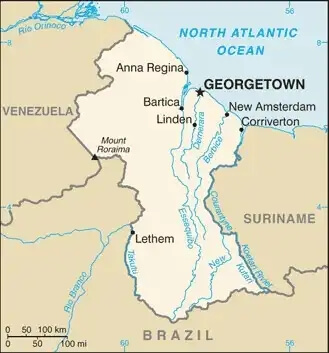
Brazil - Suriname - Venezuela
Geography
Area
Total: 214,969 sq km
Land: 196,849 sq km
Water: 18,120 sq km
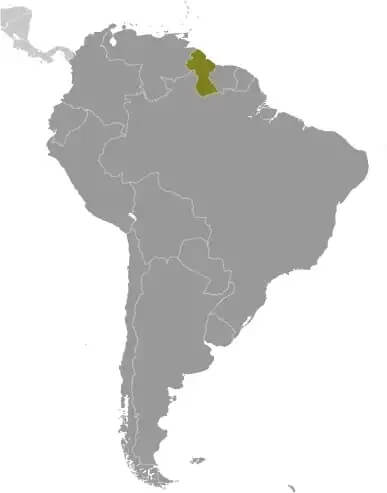
Guyana is characterized by its diverse geographical features, which include vast rainforests, savannas, and a network of rivers that play a crucial role in the ecosystem. The country is situated on the northeastern coast of South America, bordered by the Atlantic Ocean to the north. Its climate is tropical, marked by high humidity and temperatures, which are moderated by the northeast trade winds. Guyana experiences two distinct rainy seasons, from May to August and November to January, which significantly influence agricultural practices and water resources. The nation is endowed with abundant natural resources, including bauxite, gold, diamonds, hardwood timber, shrimp, and fish, which are vital to its economy and environmental sustainability.
People and Society
Population
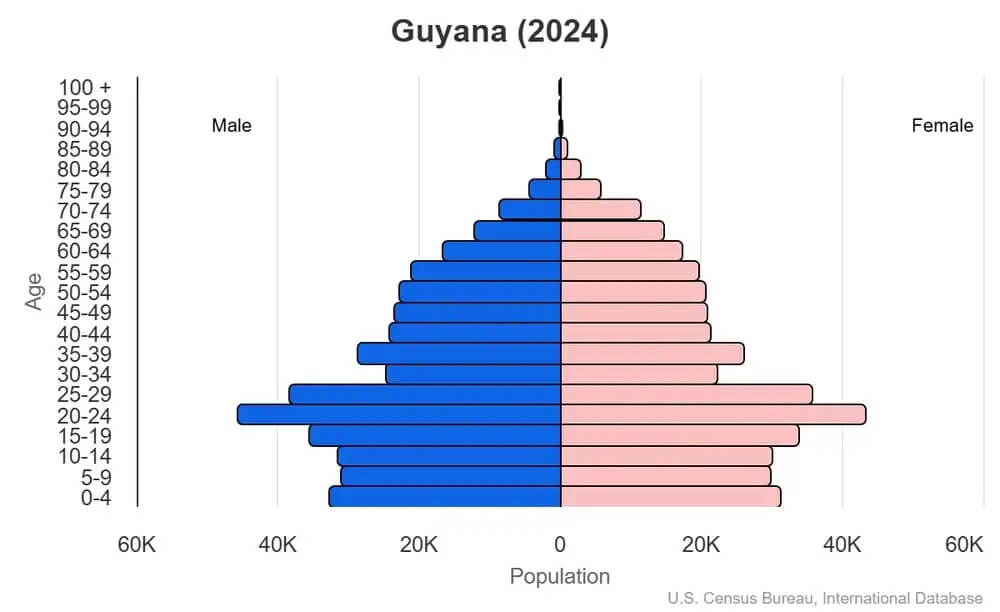
Total: 794,099 (2024 estimated)
Ethnic groups
East Indian 39.8%, African descent 29.3%, mixed 19.9%, Indigenous 10.5%, other 0.5% (includes Portuguese, Chinese, White) (2012 estimated)
Languages
English (official), Guyanese Creole, Amerindian languages (including Caribbean and Arawak languages), Indian languages (including Caribbean Hindustani, a dialect of Hindi), Chinese (2014 estimated)
Religions
Protestant 34.8% (Pentecostal 22.8%, Seventh Day Adventist 5.4%, Anglican 5.2%, Methodist 1.4%), Hindu 24.8%, other Christian 20.8%, Roman Catholic 7.1%, Muslim 6.8%, Jehovah's Witness 1.3%, Rastafarian 0.5%, other 0.9%, none 3.1% (2012 estimated)
Population growth rate
0.32% (2024 estimated)
Guyana's population is a tapestry of ethnic diversity, with significant groups including East Indians, individuals of African descent, and Indigenous peoples, among others. This multicultural composition contributes to a vibrant society where various languages and religions coexist. English serves as the official language, while Guyanese Creole and several Indigenous languages reflect the country's rich cultural heritage. The religious landscape is equally diverse, with a majority identifying as Protestant or Hindu, alongside other faiths. The population growth rate, currently at 0.32%, indicates a gradual increase, which may have implications for social services and economic development in the coming years.
Government
Government type
Parliamentary republic
Capital
Name: Georgetown
Executive branch
Chief of state: President Mohammed Irfaan ALI (since 2 August 2020)
Head of government: President Mohammed Irfaan ALI (since 2 August 2020)
Diplomatic representation in the US
Chief of mission: Ambassador Samuel Archibald HINDS (since 7 July 2021)
Diplomatic representation from the US
Chief of mission: Ambassador Nicole THERIOT (since 14 October 2023)
Guyana operates as a parliamentary republic, where the President serves as both the head of state and government. The capital city, Georgetown, is the political and administrative heart of the nation. President Mohammed Irfaan Ali, who has been in office since August 2020, leads the executive branch, overseeing the implementation of policies and governance. The country maintains diplomatic relations with various nations, including the United States, where it is represented by Ambassador Samuel Archibald Hinds. The political framework is designed to promote democratic governance, although it faces challenges related to political stability and social cohesion.
Economy
Economic overview
Guyana's economy is characterized as a small, hydrocarbon-driven export economy, with a significant emphasis on the sustainable management of its natural resources. The country boasts extensive forest coverage, which is being strategically leveraged in carbon credit offsets to promote environmental preservation. The financial sector is strengthening, supported by the burgeoning oil industry, which is expected to play a pivotal role in the nation's economic future. Additionally, Guyana is rich in bauxite and gold resources, which contribute to its export revenues and economic resilience.
Real GDP (purchasing power parity)
$58.423 billion (2024 estimated)
$40.749 billion (2023 estimated)
$30.457 billion (2022 estimated)
Real GDP per capita
$70,300 (2024 estimated)
$49,300 (2023 estimated)
$37,100 (2022 estimated)
Exports
$13.739 billion (2023 estimated)
$11.517 billion (2022 estimated)
$4.594 billion (2021 estimated)
Exports - partners
USA 20%, Trinidad & Tobago 11%, Netherlands 10%, Singapore 10%, Germany 7% (2023)
Exports - commodities
Crude petroleum, railway cargo containers, gold, ships, rice (2023)
Imports
$10.956 billion (2023 estimated)
$7.033 billion (2022 estimated)
$6.588 billion (2021 estimated)
Imports - partners
USA 28%, China 13%, Trinidad & Tobago 11%, Brazil 5%, Bahamas, The 4% (2023)
Imports - commodities
Refined petroleum, ships, construction vehicles, excavation machinery, cars (2023)
Guyana's economic landscape is rapidly evolving, with a projected Real GDP of $58.423 billion in 2024, reflecting significant growth driven by the oil sector. The Real GDP per capita is also on the rise, indicating improved living standards for the population. The country's export profile is diverse, with crude petroleum leading the way, followed by gold and agricultural products like rice. The United States remains the largest export partner, accounting for 20% of total exports. On the import side, refined petroleum and machinery are key commodities, with the USA being the primary source of imports. This dynamic economic environment presents both opportunities and challenges as Guyana navigates its development trajectory in the context of global market fluctuations.
Human Development Index
The country's Human Development Index (HDI) is 0.776, ranking it 89th out of 193 countries tested. (more information)