World Book
Hong Kong
World Book Index
72

With a score of 72, the country is ranked 55th out of 158 countries in the World Book ranking. (more information)
Introduction
Hong Kong, a vibrant metropolis, has a rich history that dates back to its seizure by the United Kingdom in 1841. The formal cession of the territory occurred the following year, leading to the establishment of a unique cultural and economic landscape. Throughout the 19th century, various adjacent lands were incorporated, further shaping its identity. The pivotal moment came in 1984 when an agreement between the UK and China set the stage for Hong Kong to transition into the Hong Kong Special Administrative Region of the People's Republic of China on 1 July 1997. This transition marked a significant shift, as it allowed Hong Kong to maintain a high degree of autonomy under the principle of "one country, two systems," fostering its development as a global financial hub and a melting pot of cultures.
Neighboring countries
China - The Philippines - Vietnam
Geography
Area
Total: 1,108 sq km
Land: 1,073 sq km
Water: 35 sq km
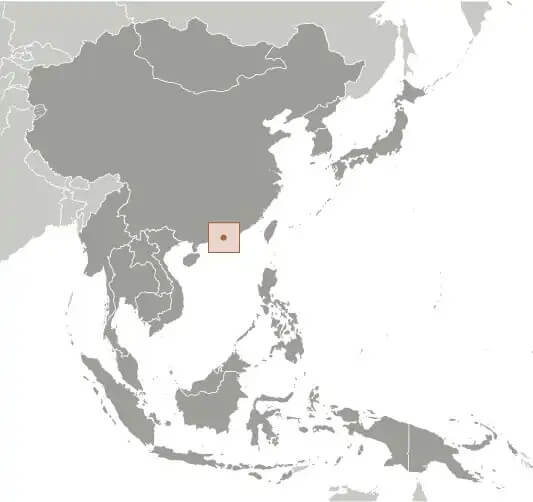
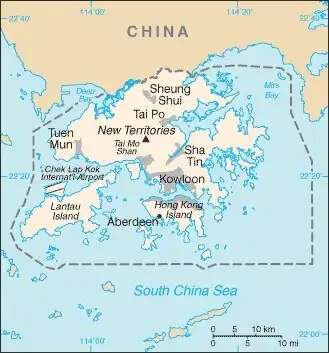
Hong Kong is situated on the southern coast of China, bordered by the South China Sea. Its geographical features are characterized by a rugged terrain, comprising numerous islands and a mountainous landscape. The region's subtropical monsoon climate contributes to its diverse ecosystems, with distinct seasonal variations. Winters are cool and humid, while summers are hot and rainy, creating an environment conducive to lush vegetation. The outstanding deepwater harbor serves as a critical asset for maritime trade, enhancing Hong Kong's status as a global financial center. Additionally, the presence of feldspar as a natural resource adds to the region's economic potential, although the primary focus remains on its service-oriented economy.
People and Society
Population
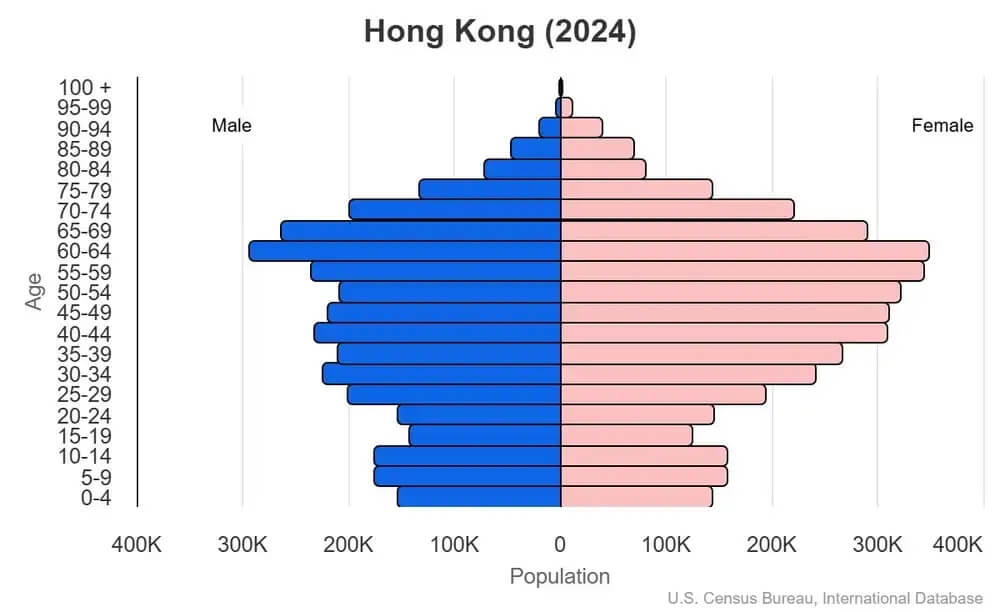
Total: 7,297,821 (2024 estimated)
Ethnic groups
Chinese 91.6%, Filipino 2.7%, Indonesian 1.9%, other 3.7% (2021 estimated)
Languages
Cantonese (official) 85.4%, English (official) 4.5%, Putonghua (official) 2.2%, other Chinese dialects 2.8%, other 2%, persons under 5 or mute 3.2% (2021 estimated)
Religions
Buddhist or Taoist 27.9%, Protestant 6.7%, Roman Catholic 5.3%, Muslim 4.2%, Hindu 1.4%, Sikh 0.2%, other or none 54.3% (2016 estimated)
Population growth rate
0.12% (2024 estimated)
Hong Kong's population is a dynamic tapestry of cultures, predominantly composed of ethnic Chinese, who represent 91.6% of the population. The region also hosts a significant number of expatriates, particularly from the Philippines and Indonesia, contributing to its multicultural environment. The official languages reflect this diversity, with Cantonese being the most widely spoken, followed by English and Putonghua. This linguistic variety is indicative of Hong Kong's historical ties and its role as a global city. The religious landscape is equally diverse, with a majority identifying as Buddhist or Taoist, while a notable portion adheres to Christianity and Islam. The population growth rate remains modest at 0.12%, suggesting a stable demographic environment amidst ongoing social and economic changes.
Government
Government type
Presidential limited democracy; a special administrative region of the People's Republic of China
Executive branch
Chief of state: President of China XI Jinping (since 14 March 2013)
Head of government: Chief Executive John LEE Ka-chiu (since 1 July 2022)
Diplomatic representation in the US
Chief of mission: none (Special Administrative Region of China)
Diplomatic representation from the US
Chief of mission: Consul General Julie EADEH (since August 2025); note - also accredited to Macau
Hong Kong operates under a unique political framework as a special administrative region of China, characterized by a presidential limited democracy. The governance structure allows for a degree of autonomy, with the Chief Executive serving as the head of government, currently held by John LEE Ka-chiu since 1 July 2022. The Chief of State is the President of China, XI Jinping, who has been in office since 14 March 2013. This political arrangement facilitates a complex relationship with the central government in Beijing, influencing both domestic policies and international relations. Notably, Hong Kong does not have a chief of mission in the United States, reflecting its status as a region rather than an independent nation, while the US maintains a Consul General in Hong Kong, further emphasizing the region's unique diplomatic standing.
Economy
Economic overview
High-income tourism- and services-based economy; global financial hub; COVID-19 and political protests fueled recent recession; ongoing recovery but lower-skilled unemployment remains high; investing in job-reskilling programs
Real GDP (purchasing power parity)
$497.88 billion (2024 estimated)
$485.541 billion (2023 estimated)
$470.42 billion (2022 estimated)
Real GDP per capita
$66,200 (2024 estimated)
$64,400 (2023 estimated)
$64,000 (2022 estimated)
Exports
$739.915 billion (2024 estimated)
$673.738 billion (2023 estimated)
$697.583 billion (2022 estimated)
Exports - partners
China 22%, Vietnam 12%, S. Korea 8%, Netherlands 5%, Switzerland 4% (2023)
Exports - commodities
gold, integrated circuits, gas turbines, broadcasting equipment, jewelry (2023)
Imports
$723.397 billion (2024 estimated)
$671.492 billion (2023 estimated)
$682.881 billion (2022 estimated)
Imports - partners
China 40%, Taiwan 10%, Singapore 7%, Japan 5%, S. Korea 4% (2023)
Imports - commodities
integrated circuits, broadcasting equipment, gold, machine parts, jewelry (2023)
Human Development Index
The country's Human Development Index (HDI) is 0.955, ranking it 8th out of 193 countries tested. (more information)
World Happiness Report
The World Happiness Report ranked the country 106th out of 158 countries tested with a score of 4.969. (more information)