World Book
Vietnam
World Book Index
67

With a score of 67, the country is ranked 76th out of 158 countries in the World Book ranking. (more information)
Introduction
Vietnam, a country rich in history and culture, has undergone significant transformations since the mid-19th century. The French colonization that began in 1858 led to Vietnam becoming part of French Indochina by 1887. The struggle for independence culminated in 1954 with the defeat of French forces, resulting in the division of the country into North and South Vietnam. The reunification in 1975 under communist rule marked a new chapter, but the country faced economic stagnation until the introduction of the Đổi Mới reforms in 1986, which shifted the economy towards a more market-oriented approach, paving the way for rapid growth and development.
Neighboring countries
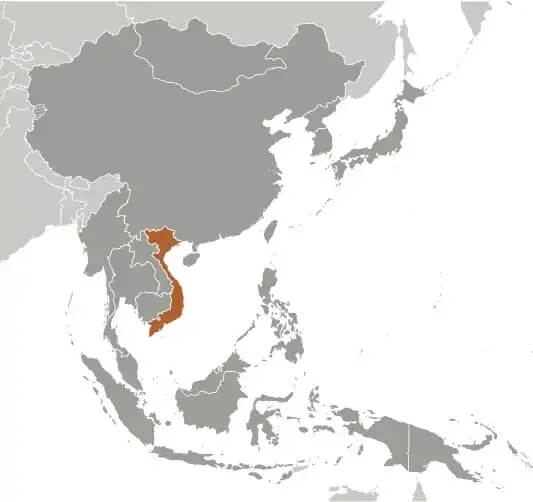
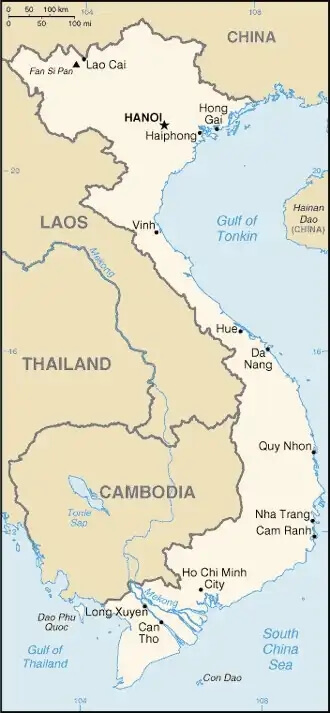
Cambodia - China - Indonesia - Laos - Malaysia - Philippines - Thailand
Geography
Area
Total: 331,210 sq km
Land: 310,070 sq km
Water: 21,140 sq km
Vietnam's geography is characterized by a diverse landscape that includes mountains, forests, and a long coastline along the South China Sea. The country is situated in Southeast Asia, bordered by China to the north, and shares its western borders with Laos and Cambodia. The climate varies significantly across regions; the southern part experiences a tropical climate, while the northern regions are influenced by monsoonal patterns, featuring a hot, rainy season from May to September and a warm, dry season from October to March. Vietnam is endowed with rich natural resources, including antimony, phosphates, coal, manganese, rare earth elements, bauxite, chromate, and offshore oil and gas deposits, alongside abundant timber and arable land, which are crucial for its agricultural sector.
People and Society
Population
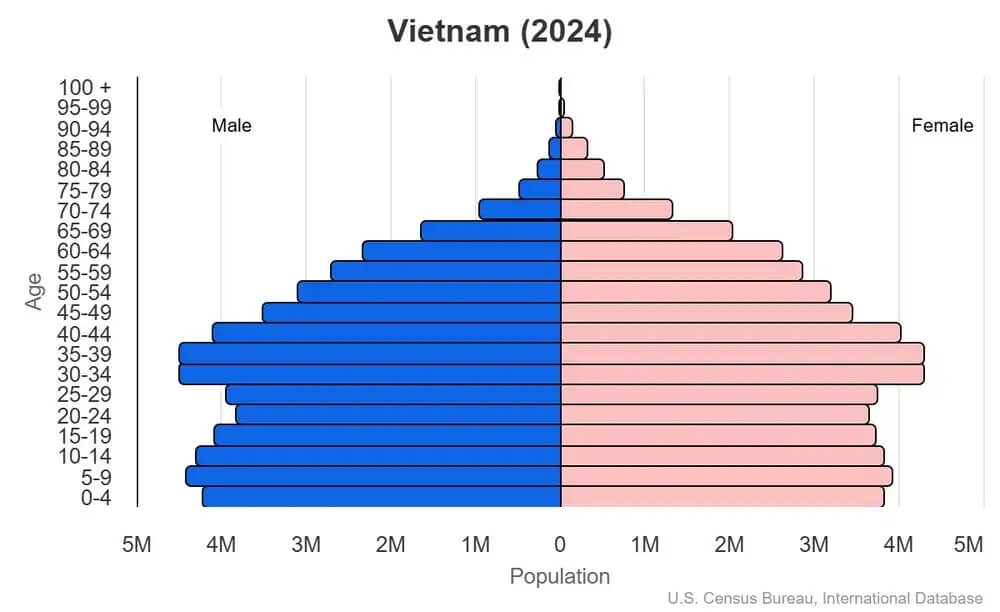
Total: 105,758,975 (2024 estimated)
Ethnic groups
Kinh (Viet) 85.3%, Tay 1.9%, Thai 1.9%, Muong 1.5%, Khmer 1.4%, Mong 1.4%, Nung 1.1%, other 5.5% (2019 estimated)
Languages
Vietnamese (official); English (often as a second language); some French, Chinese, and Khmer; mountain-area languages (including Mon-Khmer and Malayo-Polynesian)
Religions
Catholic 6.1%, Buddhist 5.8%, Protestant 1%, other 0.8%, none 86.3% (2019 estimated)
Population growth rate
0.89% (2024 estimated)
Vietnam's population is a tapestry of ethnic diversity, with the Kinh (Viet) being the predominant group, making up 85.3% of the population. The country is home to various ethnic minorities, including the Tay, Thai, Muong, Khmer, Mong, and Nung, each contributing to the rich cultural heritage of Vietnam. The official language is Vietnamese, but English is widely spoken as a second language, reflecting the country's increasing integration into the global economy. The religious landscape is predominantly secular, with a significant portion of the population identifying as having no religion. However, Buddhism and Catholicism also play important roles in the cultural and spiritual lives of many Vietnamese. The population growth rate of 0.89% indicates a steady increase, which poses both opportunities and challenges for the country's development.
Government
Government type
Communist party-led state
Capital
Name: Hanoi (Ha Noi)
Executive branch
Chief of state: President Luong CUONG (since 21 Oct 2024)
Head of government: Prime Minister Pham Minh CHINH (since 26 July 2021)
Diplomatic representation in the US
Chief of mission: Ambassador Nguyen Quoc DZUNG (since 19 April 2022)
Diplomatic representation from the US
Chief of mission: Ambassador Marc KNAPPER (since 11 February 2022)
Vietnam operates as a one-party state led by the Communist Party, which plays a central role in the governance and political landscape of the country. The capital, Hanoi, serves as the political and administrative center. The executive branch is headed by President Luong CUONG, who took office in October 2024, and Prime Minister Pham Minh CHINH, who has been in office since July 2021. Vietnam maintains diplomatic relations with various countries, including the United States, where it is represented by Ambassador Nguyen Quoc DZUNG. The political framework emphasizes the party's leadership, which influences all aspects of governance and policy-making.
Economy
Economic overview
Lower middle-income socialist East Asian economy; rapid economic growth since Đổi Mới reforms; strong investment and productivity growth; tourism and manufacturing hub; TPP signatory; declining poverty aside from ethnic minorities; systemic corruption
Real GDP (purchasing power parity)
$1.456 trillion (2024 estimated)
$1.359 trillion (2023 estimated)
$1.294 trillion (2022 estimated)
Real GDP per capita
$14,400 (2024 estimated)
$13,500 (2023 estimated)
$13,000 (2022 estimated)
Exports
$429.383 billion (2024 estimated)
$374.986 billion (2023 estimated)
$385.241 billion (2022 estimated)
Exports - partners
USA 28%, China 20%, Japan 6%, Hong Kong 4%, Germany 3% (2023)
Exports - commodities
Broadcasting equipment, garments, integrated circuits, machine parts, footwear (2023)
Imports
$398.672 billion (2024 estimated)
$339.785 billion (2023 estimated)
$369.746 billion (2022 estimated)
Imports - partners
China 49%, Singapore 6%, Japan 6%, Hong Kong 5%, Taiwan 4% (2023)
Imports - commodities
Integrated circuits, broadcasting equipment, fabric, plastics, telephones (2023)
Vietnam's economy is classified as a lower middle-income socialist economy, characterized by rapid growth since the implementation of the Đổi Mới reforms in the late 1980s. These reforms have catalyzed strong investment and productivity growth, positioning Vietnam as a significant hub for tourism and manufacturing in the region. The country's real GDP, estimated at $1.456 trillion in 2024, reflects its robust economic performance, with a GDP per capita of $14,400. Exports play a crucial role in the economy, with total exports reaching $429.383 billion in 2024, primarily driven by partnerships with the USA, China, and Japan. Key export commodities include broadcasting equipment, garments, and integrated circuits. On the import side, Vietnam relies heavily on China, which accounts for 49% of its imports, including essential goods such as integrated circuits and broadcasting equipment. Despite the impressive economic growth, challenges remain, particularly concerning poverty among ethnic minorities and systemic corruption that affects various sectors of the economy.
Human Development Index
The country's Human Development Index (HDI) is 0.766, ranking it 93rd out of 193 countries tested. (more information)
World Happiness Report
The World Happiness Report ranked the country 67th out of 158 countries tested with a score of 5.934. (more information)