World Book
Japan
World Book Index
75

With a score of 75, the country is ranked 48th out of 158 countries in the World Book ranking. (more information)
Introduction
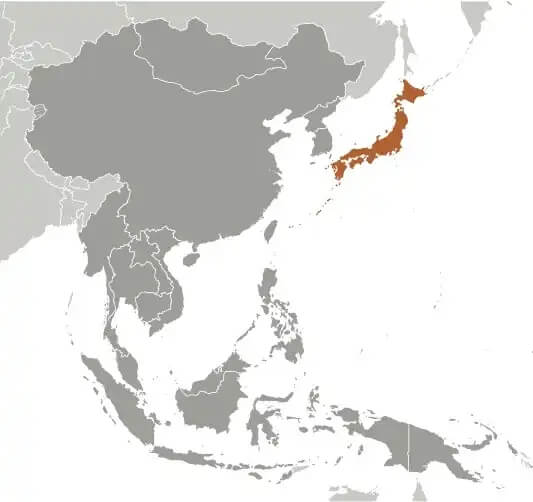
Japan, an archipelago located in East Asia, has a rich history marked by its transformation from a feudal society to a modern industrial power. The country opened its ports in 1854, initiating a period of rapid modernization and industrialization that propelled it into the ranks of regional powers by the late 19th and early 20th centuries. Following its defeat in World War II, Japan underwent a remarkable recovery, evolving into a major economic power and a key ally of the United States. Today, the emperor serves as a symbolic figure of national unity, while the real political power resides with elected officials who navigate the complexities of governance in a modern democratic framework.
Neighboring countries
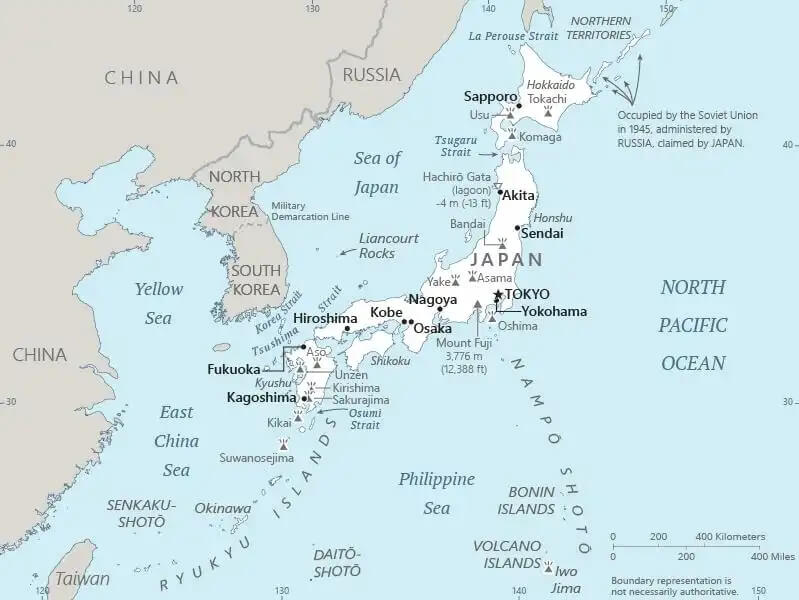
China - North Korea - Russia - South Korea
Geography
Area
Total: 377,915 sq km
Land: 364,485 sq km
Water: 13,430 sq km
Climate
Japan's climate varies significantly from tropical conditions in the south to cool temperate climates in the north, creating diverse ecosystems and influencing agricultural practices across the nation.
Natural resources
Japan possesses negligible mineral resources, yet it is rich in marine resources, particularly fish, which play a crucial role in its economy and cultural identity.
People and Society
Population
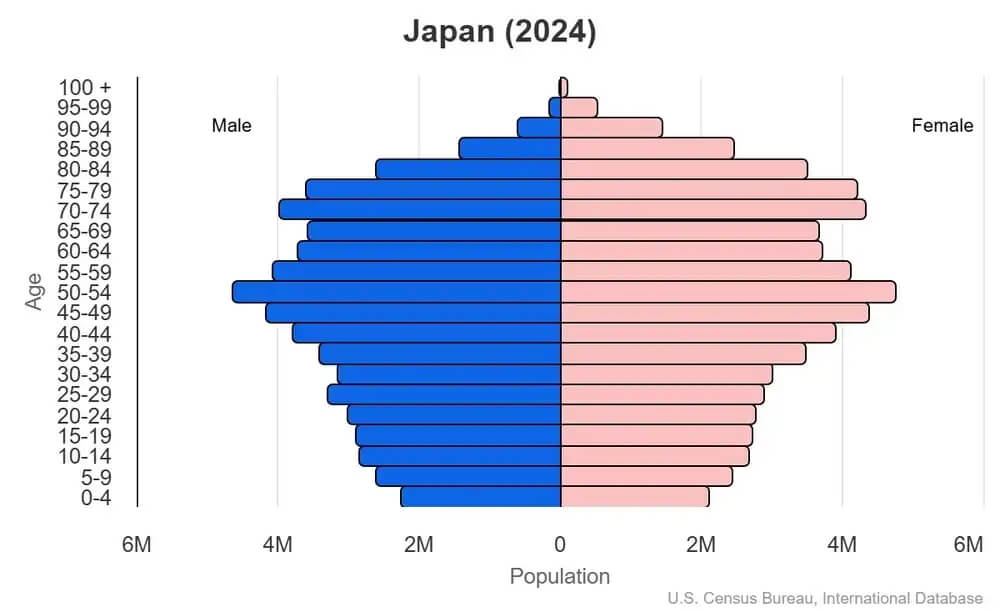
Total: 123,201,945 (2024 estimated)
Ethnic groups
Japanese 97.5%, Chinese 0.6%, Vietnamese 0.4%, South Korean 0.3%, other 1.2% (includes Filipino, Brazilian, Nepalese, Indonesian, American, and Taiwanese) (2022 estimated)
Languages
Japanese
Religions
Shintoism 48.6%, Buddhism 46.4%, Christianity 1.1%, other 4% (2021 estimated)
Population growth rate
-0.43% (2024 estimated)
The demographic landscape of Japan is characterized by a predominantly homogeneous society, with the Japanese ethnic group comprising 97.5% of the population. This homogeneity is accompanied by a rich tapestry of cultural practices and traditions rooted in Shintoism and Buddhism, which together influence the daily lives and values of the populace. However, Japan faces significant demographic challenges, including a declining population growth rate of -0.43%, which poses potential risks to its economic vitality and social structure. The aging population further complicates labor force participation, necessitating innovative solutions to sustain economic productivity and social welfare.
Government
Government type
Parliamentary constitutional monarchy
Capital
Name: Tokyo
Executive branch
Chief of state: Emperor NARUHITO (since 1 May 2019)
Head of government: vacant (since 7 September 2025)
Diplomatic representation in the US
Chief of mission: Ambassador YAMADA Shigeo (since 27 February 2024)
Diplomatic representation from the US
Chief of mission: Ambassador George GLASS (since 17 July 2025)
Japan operates under a parliamentary constitutional monarchy, where the emperor serves as the ceremonial head of state, embodying the cultural and historical continuity of the nation. The real power lies with elected officials within a parliamentary system, which allows for a dynamic political landscape. The current vacancy in the head of government position since September 2025 highlights the potential for political instability and the need for effective governance to address pressing national issues.
Economy
Economic overview
Japan is the second-largest economy in East Asia, characterized by its trade-oriented and highly diversified economic structure. Despite facing high public debt levels, the country has managed to maintain economic stability through gradual increases in interest rates aimed at addressing inflation and the depreciation of the yen. The tourism sector has shown a strong rebound, contributing positively to the economy. However, the aging population presents significant challenges to labor force participation, necessitating strategic policies to enhance workforce engagement and productivity.
Real GDP (purchasing power parity)
$5.715 trillion (2024 estimated)
$5.71 trillion (2023 estimated)
$5.627 trillion (2022 estimated)
Real GDP per capita
$46,100 (2024 estimated)
$45,900 (2023 estimated)
$45,000 (2022 estimated)
Exports
$922.447 billion (2024 estimated)
$923.488 billion (2023 estimated)
$922.813 billion (2022 estimated)
Exports - partners
USA 19%, China 18%, Taiwan 6%, S. Korea 6%, Hong Kong 4% (2023)
Exports - commodities
Cars, integrated circuits, machinery, vehicle parts/accessories, construction vehicles (2023)
Imports
$965.047 billion (2024 estimated)
$996.364 billion (2023 estimated)
$1.081 trillion (2022 estimated)
Imports - partners
China 22%, USA 11%, Australia 8%, UAE 5%, Saudi Arabia 5% (2023)
Imports - commodities
Crude petroleum, natural gas, coal, integrated circuits, broadcasting equipment (2023)
Human Development Index
The country's Human Development Index (HDI) is 0.925, ranking it 23rd out of 193 countries tested. (more information)
World Happiness Report
The World Happiness Report ranked the country 76th out of 158 countries tested with a score of 5.785. (more information)