World Book
South Korea
World Book Index
77

With a score of 77, the country is ranked 26th out of 158 countries in the World Book ranking. (more information)
Introduction
South Korea, officially known as the Republic of Korea, has a rich history characterized by its resilience and transformation. Following its establishment as an independent kingdom, the nation has evolved significantly, particularly after World War II when it embraced a democratic government. The Korean War in 1950 marked a pivotal moment, as South Korea successfully defended itself against a North Korean invasion. This conflict catalyzed a period of remarkable economic growth, propelling South Korea into the ranks of a fully functioning modern democracy and a global economic powerhouse. Today, it stands as a testament to the strength of its people and institutions, showcasing a vibrant culture and a commitment to innovation and progress.
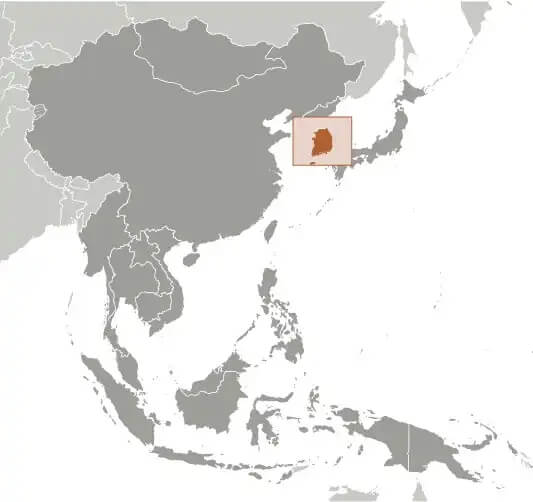
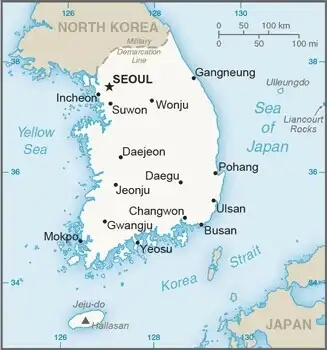
Neighboring countries
China - Japan - North Korea - Philippines
Geography
Area
Total: 99,720 sq km
Land: 96,920 sq km
Water: 2,800 sq km
Climate
The climate of South Korea is predominantly temperate, characterized by four distinct seasons. Rainfall is heavier during the summer months, while winters can be quite cold, creating a diverse environment that supports a variety of ecosystems.
Natural resources
South Korea is endowed with several natural resources, including coal, tungsten, graphite, molybdenum, lead, and significant hydropower potential. These resources play a crucial role in supporting the country's industrial activities and energy needs.
People and Society
Population
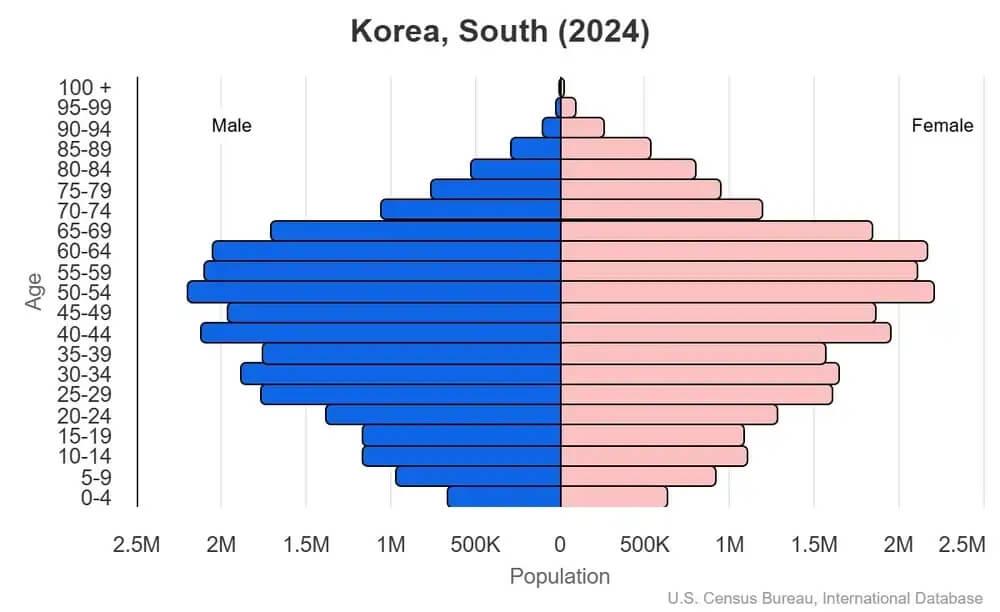
Total: 52,081,799 (2024 estimated)
Ethnic groups
The population is largely homogeneous, with a predominant ethnic Korean identity that shapes the cultural landscape of the nation.
Languages
The official language is Korean, with English also widely spoken, particularly in urban areas and among the younger population.
Religions
The religious landscape is diverse, with Protestantism (17%), Buddhism (16%), and Catholicism (6%) being the major faiths. Notably, a significant portion of the population (60%) identifies as having no religious affiliation (2021 estimated), reflecting a trend towards secularism in contemporary society.
Population growth rate
The population growth rate stands at 0.21% (2024 estimated), indicating a gradual increase that poses both opportunities and challenges for the country in terms of demographic management and social services.
Government
Government type
South Korea operates as a presidential republic, where the President serves as both the head of state and government, ensuring a separation of powers within its democratic framework.
Capital
Name: Seoul
Executive branch
The chief of state is President LEE Jae-myung (since 4 June 2025), while the head of government is Prime Minister KIM Min-seok (since 3 July 2025). This leadership structure reflects the country's commitment to democratic governance and political stability.
Diplomatic representation in the US
The chief of mission is currently an Ambassador (vacant); however, Chargé d'Affaires LEE Joon Ho has been serving since 12 July 2025, maintaining diplomatic relations with the United States.
Diplomatic representation from the US
The chief of mission from the US is also an Ambassador (vacant), with Chargé d'Affaires Ambassador Joseph (Joe) YUN serving since January 2025, highlighting the ongoing diplomatic engagement between the two nations.
Economy
Economic overview
South Korea boasts a high-income, export- and technology-oriented economy that is a cornerstone of East Asia's economic landscape. The manufacturing sector is primarily driven by the semiconductor and automotive industries, which are vital for the country's economic performance. However, the economy faces challenges such as slow growth attributed to declining construction investment, export risks, and recent political instability. Additionally, an aging workforce presents a long-term challenge for sustainable economic growth. The government has adopted a more restrained fiscal policy while still supporting key industries through various initiatives to foster innovation and competitiveness.
Real GDP (purchasing power parity)
$2.607 trillion (2023 estimated)
$2.572 trillion (2022 estimated)
$2.507 trillion (2021 estimated)
Real GDP per capita
$50,400 (2023 estimated)
$49,800 (2022 estimated)
$48,400 (2021 estimated)
Exports
$835.149 billion (2024 estimated)
$769.243 billion (2023 estimated)
$825.961 billion (2022 estimated)
Exports - partners
China 25%, USA 18%, Hong Kong 4%, Japan 4%, Taiwan 4% (2023)
Exports - commodities
The primary commodities exported include integrated circuits, cars, refined petroleum, plastics, and machine parts (2023), reflecting the country's advanced manufacturing capabilities.
Imports
$758.724 billion (2024 estimated)
$758.41 billion (2023 estimated)
$817.594 billion (2022 estimated)
Imports - partners
The main import partners are China (31%), USA (13%), Japan (9%), Germany (5%), and Australia (4%) (2023), indicating a diverse trade network.
Imports - commodities
Key imports consist of integrated circuits, natural gas, crude petroleum, machinery, and cars (2023), underscoring the country's reliance on foreign resources to support its industrial base.
Human Development Index
The country's Human Development Index (HDI) is 0.937, ranking it 20th out of 193 countries tested. (more information)
World Happiness Report
The World Happiness Report ranked the country 54th out of 158 countries tested with a score of 6.06. (more information)