World Book
Liechtenstein
Introduction
The Principality of Liechtenstein, a small yet significant nation nestled in the heart of Europe, was established within the Holy Roman Empire in 1719. It achieved the status of a sovereign state in 1806 and became a member of the German Confederation in 1815. The dissolution of the Confederation in 1866 marked the beginning of Liechtenstein's full independence. Since World War II, during which Liechtenstein maintained a stance of neutrality, the country has experienced remarkable economic growth, largely driven by its favorable tax policies. This unique blend of historical significance and modern economic prowess positions Liechtenstein as a notable player on the European stage.
Neighboring countries
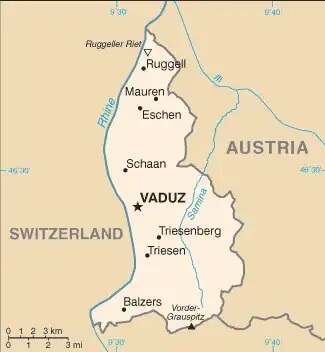
Austria - Switzerland
Geography
Area
Total: 160 sq km
Land: 160 sq km
Water: 0 sq km
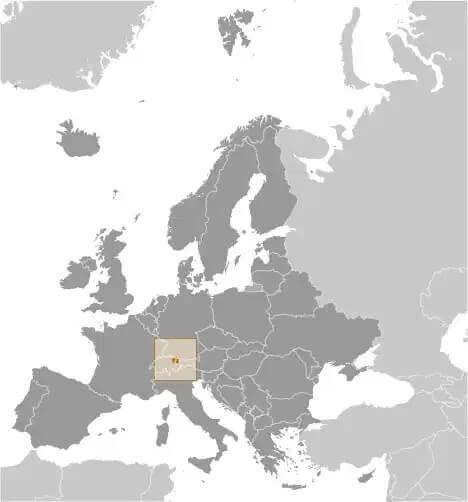
Liechtenstein is a landlocked country situated in Central Europe, bordered by Austria to the east and Switzerland to the west. Its total area of 160 square kilometers is characterized by a mountainous terrain, with the Rhine River forming a natural boundary to the west. The climate is classified as continental, featuring cold, cloudy winters that often bring snow or rain, while summers are cool to moderately warm, marked by humidity and cloud cover. The country possesses natural resources such as hydroelectric potential and arable land, which contribute to its economic activities and sustainability efforts.
People and Society
Population
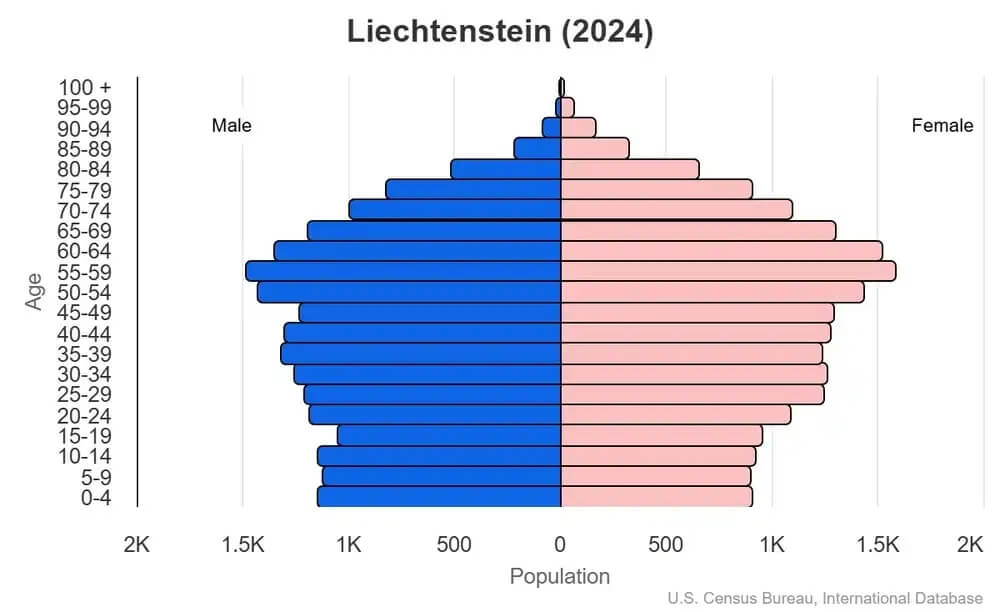
Total: 40,272 (2024 estimated)
Ethnic groups
Liechtensteiner 65.6%, Swiss 9.6%, Austrian 5.8%, German 4.5%, Italian 3.1%, other 11.4% (2021 estimated)
Languages
German 91.5% (official, Alemannic is the main dialect), Italian 1.5%, Turkish 1.3%, Portuguese 1.1%, other 4.6% (2015 estimated)
Religions
Roman Catholic (official) 73.4%, Protestant Reformed 6.3%, Muslim 5.9%, Christian Orthodox 1.3%, Lutheran 1.2%, other Protestant 0.7%, other Christian 0.3%, other 0.8%, none 7%, unspecified 3.3% (2015 estimated)
Population growth rate
0.69% (2024 estimated)
Liechtenstein's population, estimated at 40,272 in 2024, reflects a diverse ethnic composition, with Liechtensteiners constituting the majority at 65.6%. The presence of Swiss, Austrian, and other nationalities highlights the country's interconnectedness with its neighbors. The official language is German, predominantly spoken in the Alemannic dialect, while a variety of other languages are also represented, reflecting the multicultural fabric of society. The predominant religion is Roman Catholicism, which plays a significant role in the cultural and social life of the nation. With a population growth rate of 0.69%, Liechtenstein continues to experience gradual demographic changes, influenced by both natural growth and migration.
Government
Government type
Constitutional monarchy
Capital
Name: Vaduz
Executive branch
Chief of state: Prince HANS-ADAM II (since 13 November 1989, assumed executive powers on 26 August 1984)
Head of government: Prime Minister Brigitte HAAS (since 10 April 2025)
Diplomatic representation in the US
Chief of mission: Ambassador Georg SPARBER (since 1 December 2021)
Liechtenstein operates under a constitutional monarchy, where the Prince serves as the head of state, holding significant powers alongside a democratically elected parliament. The capital city, Vaduz, is not only the political center but also a cultural hub. The current chief of state is Prince HANS-ADAM II, who has been in power since 1989, while the head of government is Prime Minister Brigitte HAAS, who took office in April 2025. The country maintains diplomatic relations with various nations, including the United States, represented by Ambassador Georg SPARBER since December 2021.
Economy
Economic overview
High-income European economy; Schengen Area participant; key European financial leader; integrated with Swiss economy and franc currency user; one of the highest GDP per capita countries; relies on US and Eurozone markets for exports
Real GDP (purchasing power parity)
$7.172 billion (2024 estimated)
$7.031 billion (2023 estimated)
$6.885 billion (2022 estimated)
Real GDP per capita
$210,600 (2024 estimated)
$201,200 (2023 estimated)
$187,700 (2022 estimated)
Exports
$3.217 billion (2015 estimated)
$3.774 billion (2014 estimated)
Exports - commodities
Small specialty machinery, connectors for audio and video, parts for motor vehicles, dental products, hardware
Imports - commodities
Agricultural products, raw materials, energy products, machinery, metal goods, textiles, foodstuffs, motor vehicles
Liechtenstein boasts a high-income economy characterized by its integration into the European financial landscape. As a participant in the Schengen Area, it enjoys the benefits of free movement and trade with neighboring countries. The economy is closely linked with that of Switzerland, utilizing the Swiss franc as its currency, which further enhances its financial stability. With one of the highest GDP per capita figures globally, estimated at $210,600 in 2024, Liechtenstein's economic success is largely attributed to its robust export sector, which includes small specialty machinery and automotive components. The country relies heavily on markets in the United States and the Eurozone for its exports, making it a vital player in international trade. The import sector is diverse, encompassing agricultural products, raw materials, and machinery, which are essential for sustaining its economic growth and development.
Human Development Index
The country's Human Development Index (HDI) is 0.938, ranking it 17th out of 193 countries tested. (more information)