World Book
Mexico
World Book Index
73

With a score of 73, the country is ranked 53rd out of 158 countries in the World Book ranking. (more information)
Introduction
Mexico, a nation rich in history and culture, was once the cradle of several advanced Amerindian civilizations, including the Olmec, Toltec, Teotihuacan, Zapotec, Maya, and Aztec. The Spanish conquest in the early 16th century marked a significant turning point, leading to three centuries of colonial rule as the Viceroyalty of New Spain. Following a protracted struggle, Mexico achieved independence in the early 19th century, setting the stage for its complex and vibrant national identity that continues to evolve today.
Neighboring countries
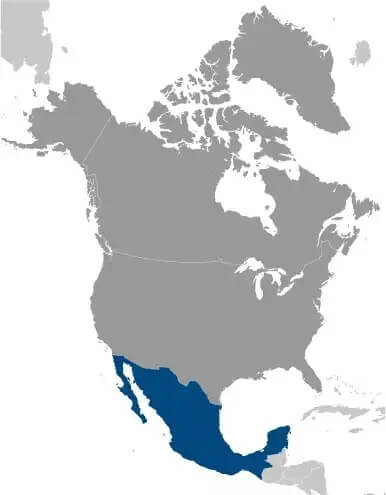
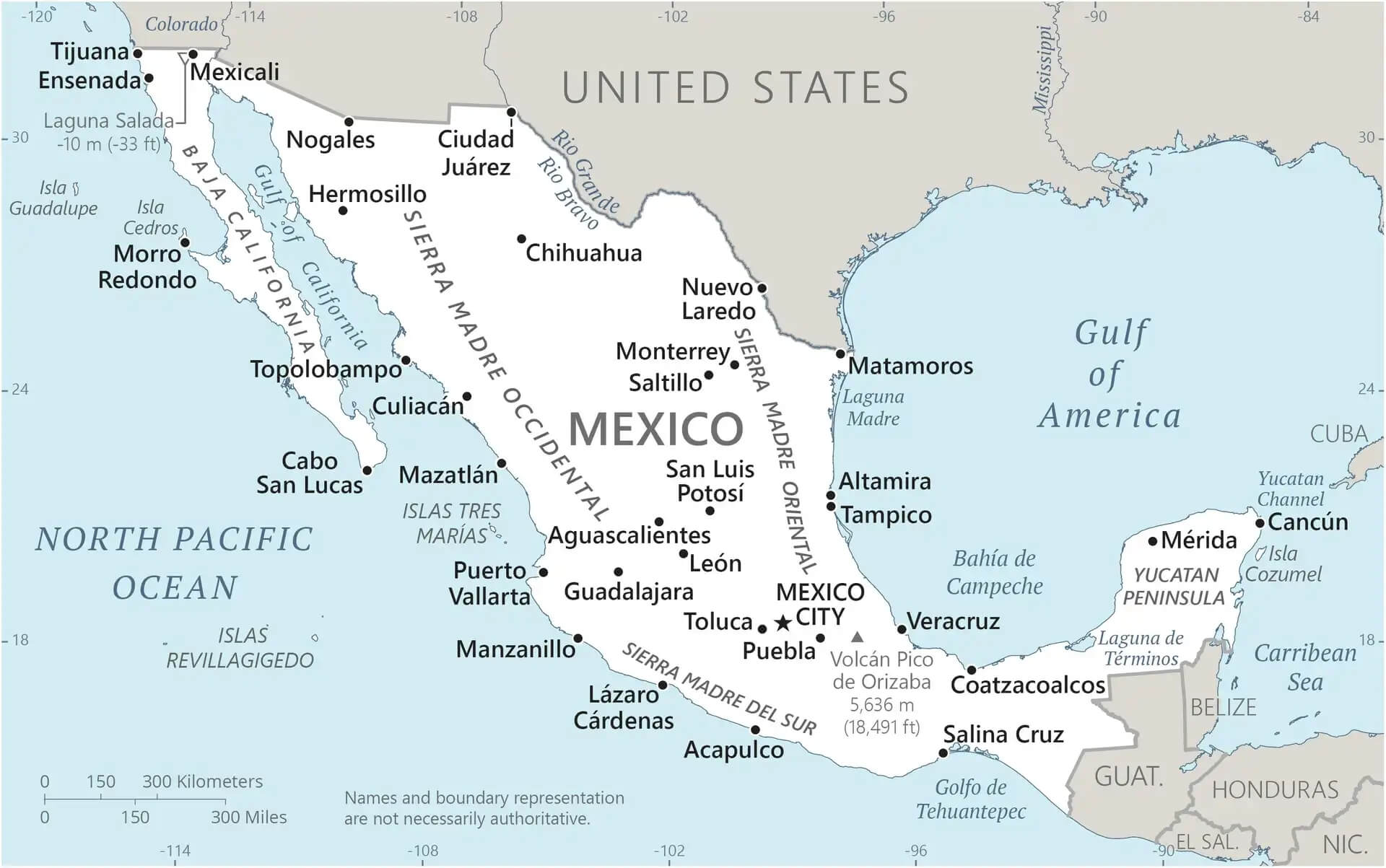
Belize - Guatemala - United States
Geography
Area
Total: 1,964,375 sq km
Land: 1,943,945 sq km
Water: 20,430 sq km
Climate
Mexico's climate is diverse, ranging from tropical regions in the south to arid desert conditions in the north. This variation contributes to the country's rich biodiversity and agricultural potential, influencing both the economy and the lifestyle of its inhabitants.
Natural resources
The country is endowed with a wealth of natural resources, including petroleum, silver, antimony, copper, gold, lead, zinc, natural gas, and timber. These resources play a crucial role in Mexico's economy, providing both domestic and export opportunities.
People and Society
Population
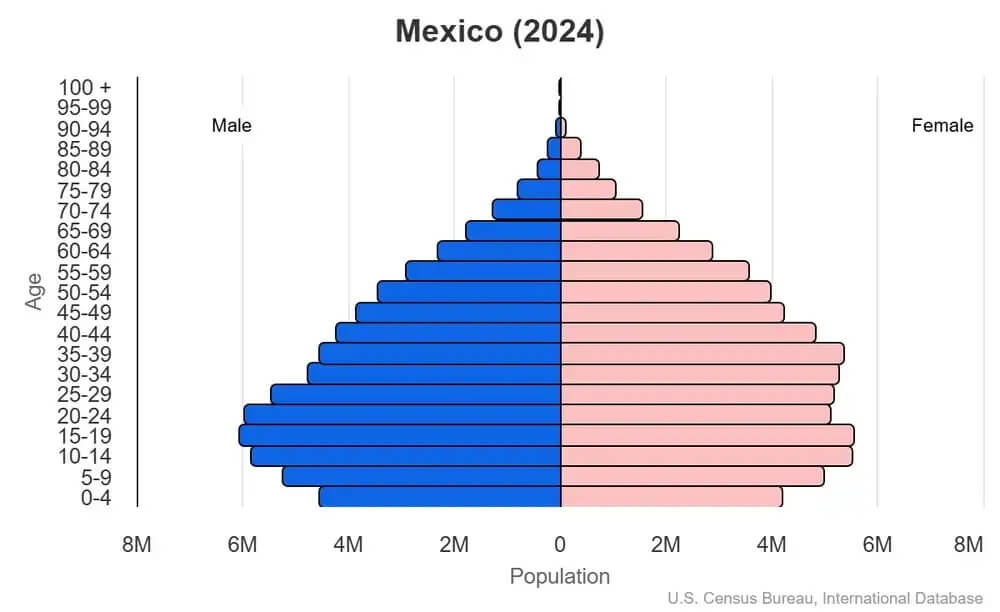
Total: 130,739,927 (2024 estimated)
Ethnic groups
The population is predominantly Mestizo (Indigenous-Spanish) at 62%, with 21% identifying as predominantly Indigenous, 7% as Indigenous, and 10% as other ethnicities, primarily European (2012 estimated). This ethnic diversity is a testament to Mexico's rich cultural tapestry and historical influences.
Languages
Spanish is the dominant language, spoken by 93.8% of the population, while 5.4% of the population speaks both Spanish and indigenous languages, including Mayan and Nahuatl. A small fraction, 0.6%, speaks indigenous languages exclusively, reflecting the country's linguistic heritage (2020 estimated).
Religions
The religious landscape is predominantly Roman Catholic, comprising 78% of the population, followed by Protestant/evangelical Christians at 11.2%. Other religions account for 0.002%, while 10.6% of the population is unaffiliated, including atheists (2020 estimated). This religious diversity influences social norms and cultural practices across the nation.
Population growth rate
The population growth rate stands at 0.72% (2024 estimated), indicating a gradual increase that poses both opportunities and challenges for the country's development and resource management.
Government
Government type
Mexico operates as a federal presidential republic, characterized by a system that combines federal and state governance.
Capital
Name: Mexico City (Ciudad de Mexico)
Executive branch
The chief of state and head of government is President Claudia SHEINBAUM Pardo, who has been in office since 1 October 2024, leading the country through a pivotal period of reform and development.
Diplomatic representation in the US
The chief of mission is Ambassador Esteban MOCTEZUMA Barragán, who has served since 20 April 2021, fostering bilateral relations and cooperation.
Diplomatic representation from the US
The chief of mission is Ambassador Ronald D. JOHNSON, who has been in position since 19 May 2025, representing US interests in Mexico.
Economy
Economic overview
Mexico is classified as an upper-middle-income economy, deeply integrated with the United States through trade and nearshore manufacturing. Despite its robust trade relationships, the country faces challenges such as weak domestic demand, fiscal consolidation, and trade uncertainties that contribute to sluggish economic growth. The unemployment rate remains low; however, significant issues such as income inequality, corruption, and cartel-based violence persist, impacting overall stability and development.
Real GDP (purchasing power parity)
$2.883 trillion (2024 estimated)
$2.842 trillion (2023 estimated)
$2.751 trillion (2022 estimated)
Real GDP per capita
$22,000 (2024 estimated)
$21,900 (2023 estimated)
$21,400 (2022 estimated)
Exports
$680.798 billion (2024 estimated)
$649.729 billion (2023 estimated)
$630.347 billion (2022 estimated)
Exports - partners
USA 76%, Canada 5%, China 2%, Germany 2%, Spain 1% (2023)
Exports - commodities
The primary exports include cars, vehicle parts/accessories, crude petroleum, trucks, and computers (2023).
Imports
$697.067 billion (2024 estimated)
$674.695 billion (2023 estimated)
$672.914 billion (2022 estimated)
Imports - partners
The main import partners are the USA at 46%, China at 20%, Germany at 4%, Japan at 3%, and South Korea at 3% (2023).
Imports - commodities
Key imports consist of vehicle parts/accessories, refined petroleum, integrated circuits, broadcasting equipment, and cars (2023).
Human Development Index
The country's Human Development Index (HDI) is 0.789, ranking it 81st out of 193 countries tested. (more information)
World Happiness Report
The World Happiness Report ranked the country 22nd out of 158 countries tested with a score of 6.743. (more information)