World Book
Nepal
World Book Index
56

With a score of 56, the country is ranked 109th out of 158 countries in the World Book ranking. (more information)
Introduction
The history of Nepal is marked by its unique geographical position and cultural diversity. During the late 18th and 19th centuries, the principality of Gorkha played a pivotal role in unifying various principalities and states of the sub-Himalayan region into a cohesive Nepali Kingdom. This unification was significant not only for the region's political landscape but also for the cultural identity that emerged from it. Following the Anglo-Nepalese War of 1814-16, Nepal successfully retained its independence, establishing a foundation for two centuries of amicable relations with Britain. The political landscape evolved further in 1990 when a multiparty democracy was introduced, allowing for a constitutional monarchy that aimed to balance traditional governance with modern democratic principles.
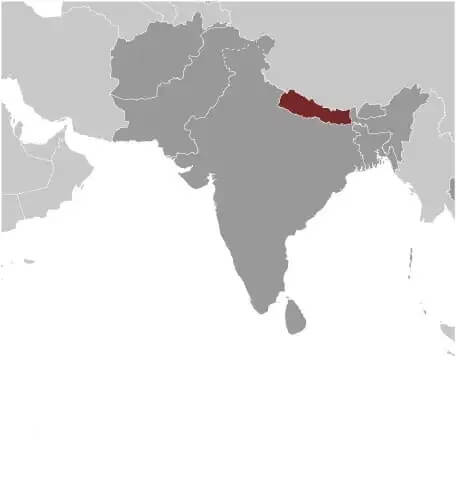
Neighboring countries
China - India
Geography
Area
Total: 147,181 sq km
Land: 143,351 sq km
Water: 3,830 sq km
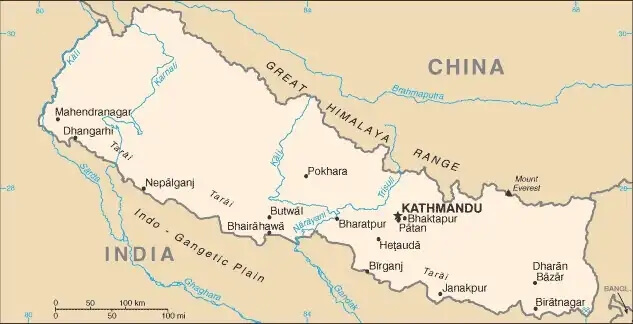
Nepal's geography is characterized by its diverse topography, ranging from the towering peaks of the Himalayas in the north to the lowland Terai plains in the south. This unique landscape not only contributes to the country's stunning natural beauty but also influences its climate, which varies significantly across different regions. The northern regions experience cool summers and severe winters, while the southern areas enjoy subtropical summers and mild winters. The country is endowed with a wealth of natural resources, including quartz, water, timber, and hydropower, which play a crucial role in its economy. Additionally, Nepal's scenic beauty attracts tourists from around the world, further enhancing its economic potential. However, the country also faces challenges due to its environmentally fragile economy, particularly in the wake of natural disasters such as earthquakes.
People and Society
Population
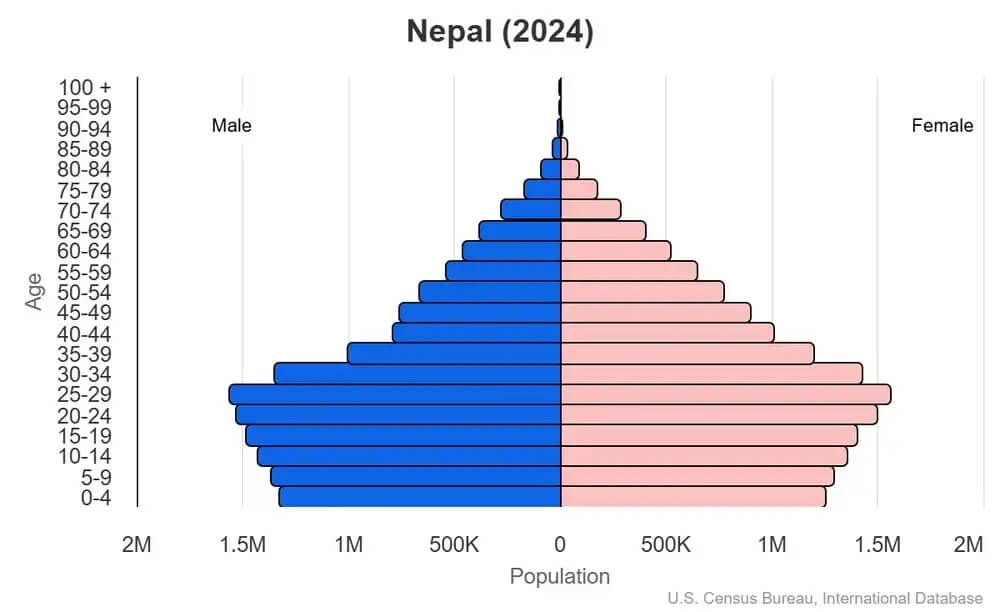
Total: 31,122,387 (2024 estimated)
Nepal is a tapestry of ethnic diversity, with a population that reflects a rich cultural heritage. The largest ethnic groups include Chhettri (16.5%), Brahman-Hill (11.3%), and Magar (6.9%), among others. This ethnic composition contributes to a vibrant societal fabric, where multiple languages and traditions coexist. The official language, Nepali, is spoken by 44.9% of the population, while other languages such as Maithali (11.1%) and Bhojpuri (6.2%) are also prevalent. The religious landscape is predominantly Hindu (81.2%), followed by Buddhism (8.2%) and Islam (5.1%). This diversity is a source of strength for the nation, fostering a sense of community and resilience. However, the population growth rate of 0.7% (2024 estimated) indicates a gradual demographic shift that may influence social dynamics and resource allocation in the future.
Government
Government type
Federal parliamentary republic
Capital
Name: Kathmandu
The government of Nepal operates as a federal parliamentary republic, which allows for a division of powers between the central government and various provincial governments. The capital, Kathmandu, serves as the political and cultural heart of the nation. The executive branch is led by President Ram Chandra Poudel, who has been in office since 13 March 2023. The head of government is Prime Minister Sushila Karki, who assumed the role as interim prime minister on 12 September 2025, following the resignation of Khadga Prasad Sharma Oli amidst civil unrest. Karki's leadership is expected to guide the country until elections are held in March 2026, marking a crucial period in Nepal's political evolution. The diplomatic representation in the United States is headed by Ambassador Lok Darshan Regmi, who has been in position since 11 June 2025, while the U.S. is represented in Nepal by Ambassador Dean R. Thompson since October 2022.
Economy
Economic overview
Nepal's economy is classified as a low-income South Asian economy, characterized by a post-conflict fiscal federalism that is gradually increasing stability. The COVID-19 pandemic significantly impacted trade and tourism, leading to widening current account deficits. The economy is also environmentally fragile, particularly vulnerable to natural disasters such as earthquakes. However, there are signs of growth in relations with China, which has led to increased investments and economic opportunities. The real GDP (purchasing power parity) is estimated at $149.643 billion for 2024, reflecting a steady increase from previous years ($144.352 billion in 2023 and $141.546 billion in 2022). The real GDP per capita is projected to be $5,000 in 2024, up from $4,900 in 2023 and $4,800 in 2022. Exports are expected to reach $3.744 billion in 2024, with India being the largest partner, accounting for 67% of total exports. Imports are projected at $17.777 billion for 2024, with India again being the primary source, providing 71% of imports. The economy's reliance on commodities such as knotted carpets, garments, and refined petroleum highlights both its potential and vulnerabilities in the global market.
Human Development Index
The country's Human Development Index (HDI) is 0.622, ranking it 145th out of 193 countries tested. (more information)
World Happiness Report
The World Happiness Report ranked the country 98th out of 158 countries tested with a score of 5.166. (more information)