World Book
Oman
World Book Index
73

With a score of 73, the country is ranked 51th out of 158 countries in the World Book ranking. (more information)
Introduction
Oman, a nation steeped in history, has long been a vital player in Indian Ocean trade, leveraging its strategic location to foster economic prosperity. The late 18th century marked a significant turning point when the emerging sultanate in Muscat established a series of friendship treaties with Britain, laying the groundwork for a relationship that would shape Oman's political landscape. As the years progressed, the sultanate's reliance on British political and military advisors deepened, influencing its governance and international relations. The pivotal moment came in 1970 when Sultan QABOOS bin Said Al-Said overthrew his father, embarking on a transformative 50-year reign that propelled Oman into the modern era, characterized by significant social and economic advancements.
Neighboring countries
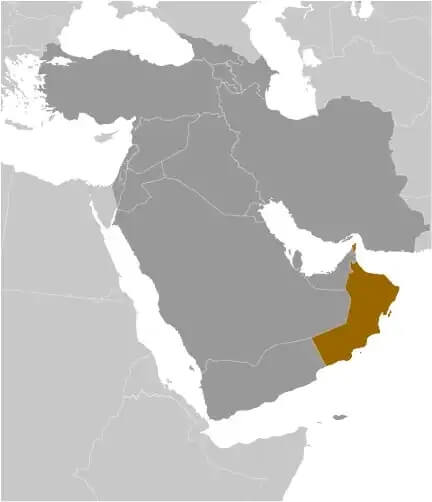
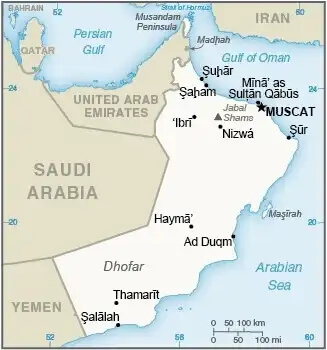
Saudi Arabia - United Arab Emirates - Yemen
Geography
Area
Total: 309,500 sq km
Land: 309,500 sq km
Water: 0 sq km
Oman's geography is defined by its diverse landscapes, ranging from rugged mountains to expansive deserts. The country experiences a dry desert climate, with hot and humid conditions along the coast, while the interior is characterized by extreme heat and aridity. The southern regions are influenced by a strong southwest summer monsoon from May to September, which brings seasonal rains. This unique climatic pattern, combined with the country's geographical features, shapes its natural resources, including significant deposits of petroleum, copper, and natural gas, alongside minerals such as limestone and gypsum, which are vital for its economy.
People and Society
Population
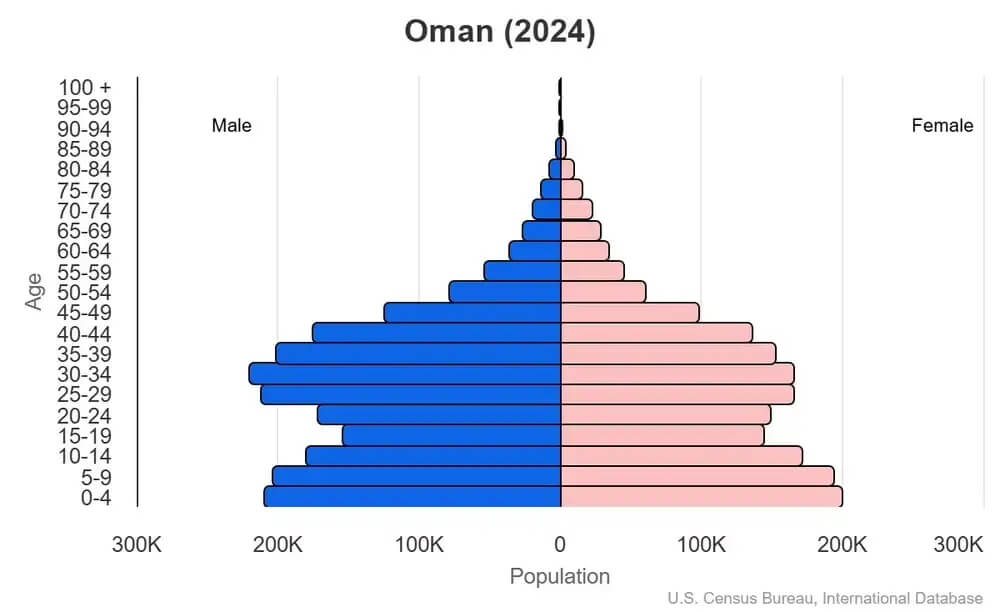
Total: 3,901,992 (2024 estimated)
Oman's population is a rich tapestry of ethnic diversity, comprising primarily Arabs, with significant communities of Baluchi and South Asians, including Indians, Pakistanis, Sri Lankans, and Bangladeshis, as well as a smaller African demographic. The official language is Arabic, but English is widely spoken, reflecting the country's historical ties and its role in global commerce. Other languages such as Baluchi, Swahili, Urdu, and various Indian dialects also contribute to the linguistic landscape. The religious composition is predominantly Muslim (85.9%), with Christians (6.4%) and Hindus (5.7%) making up the minority, alongside a small percentage of other faiths and unaffiliated individuals. The population growth rate of 1.75% indicates a dynamic demographic trend, influenced by both natural growth and immigration, which plays a crucial role in shaping Oman's societal structure and cultural identity.
Government
Government type
Absolute monarchy
Capital
Name: Muscat
Oman's government operates as an absolute monarchy, with the Sultan serving as both the chief of state and head of government. Sultan HAITHAM bin Tarik Al Said has been in power since 11 January 2020, continuing the legacy of his predecessor while navigating the complexities of modern governance. The Sultan's role encompasses not only domestic affairs but also international diplomacy, as evidenced by Oman's diplomatic representation in the United States, led by Ambassador Talal Sulaiman AL-RAHBI since 24 July 2025. The governance structure reflects a blend of traditional authority and contemporary statecraft, positioning Oman uniquely in the region.
Economy
Economic overview
Oman's economy is classified as high-income and is heavily reliant on oil, which forms the backbone of its economic structure. The country has developed a large welfare system to support its citizens, but this has led to growing government debt, necessitating a shift towards a more sustainable economic model. The government has implemented a citizenship-based labor force growth policy to enhance employment opportunities for Omanis, while also engaging in a US free trade agreement to bolster economic ties. Efforts to diversify the economy are underway, with a focus on sectors beyond oil, and there is a notable increase in female labor force participation, reflecting broader social changes.
Real GDP (purchasing power parity)
$193.591 billion (2024 estimated)
$190.403 billion (2023 estimated)
$188.169 billion (2022 estimated)
Real GDP per capita
$36,700 (2024 estimated)
$37,700 (2023 estimated)
$39,800 (2022 estimated)
Exports
$64.749 billion (2023 estimated)
$69.483 billion (2022 estimated)
$46.572 billion (2021 estimated)
Exports - partners
China 43%, India 6%, Saudi Arabia 5%, UAE 5%, South Africa 4% (2023)
Exports - commodities
Crude petroleum, refined petroleum, natural gas, semi-finished iron, fertilizers (2023)
Imports
$47.412 billion (2023 estimated)
$46.682 billion (2022 estimated)
$37.216 billion (2021 estimated)
Imports - partners
UAE 25%, Saudi Arabia 12%, India 8%, China 7%, Qatar 5% (2023)
Imports - commodities
Refined petroleum, cars, crude petroleum, iron ore, iron pipes (2023)
Human Development Index
The country's Human Development Index (HDI) is 0.858, ranking it 50th out of 193 countries tested. (more information)
World Happiness Report
The World Happiness Report ranked the country 49th out of 158 countries tested with a score of 6.197. (more information)