World Book
Sierra Leone
World Book Index
39

With a score of 39, the country is ranked 155th out of 158 countries in the World Book ranking. (more information)
Introduction
Sierra Leone, a nation with a rich historical tapestry, was established as a British trading post in the 17th century, specifically near the present-day city of Freetown. Over the 19th century, the colony expanded its reach into the interior, reflecting the broader patterns of colonial expansion in West Africa. The country achieved independence in 1961, marking a significant turning point in its history. However, the subsequent decades were marred by an authoritarian regime in the 1960s, which ultimately led to a devastating civil war that lasted until 2002. Since the end of the conflict, Sierra Leone has made strides towards democratic governance, conducting elections that reflect the will of its people, yet it continues to grapple with the legacies of its tumultuous past.
Neighboring countries
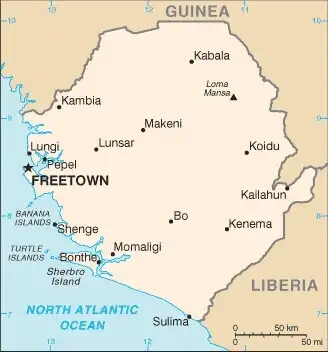
Guinea - Liberia
Geography
Area
Total: 71,740 sq km
Land: 71,620 sq km
Water: 120 sq km
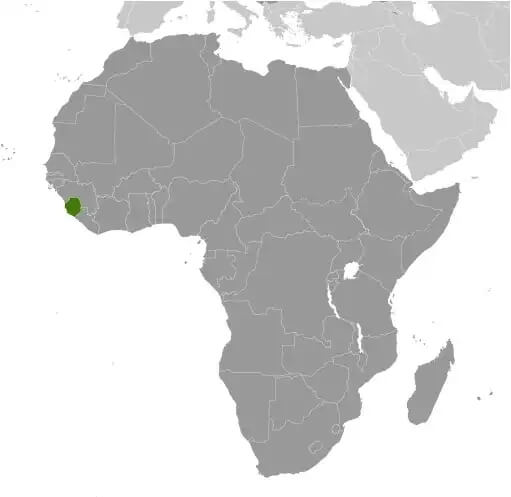
Sierra Leone is situated on the southwestern coast of West Africa, bordered by the Atlantic Ocean to the southwest. The country's geography is characterized by a diverse landscape that includes coastal plains, rolling hills, and mountainous regions. The climate is tropical, marked by a hot and humid atmosphere, with a distinct summer rainy season from May to December and a winter dry season from December to April. This climatic pattern supports a rich biodiversity and a variety of ecosystems. The nation is endowed with significant natural resources, including diamonds, titanium ore, bauxite, iron ore, gold, and chromite, which play a crucial role in its economy and development prospects.
People and Society
Population
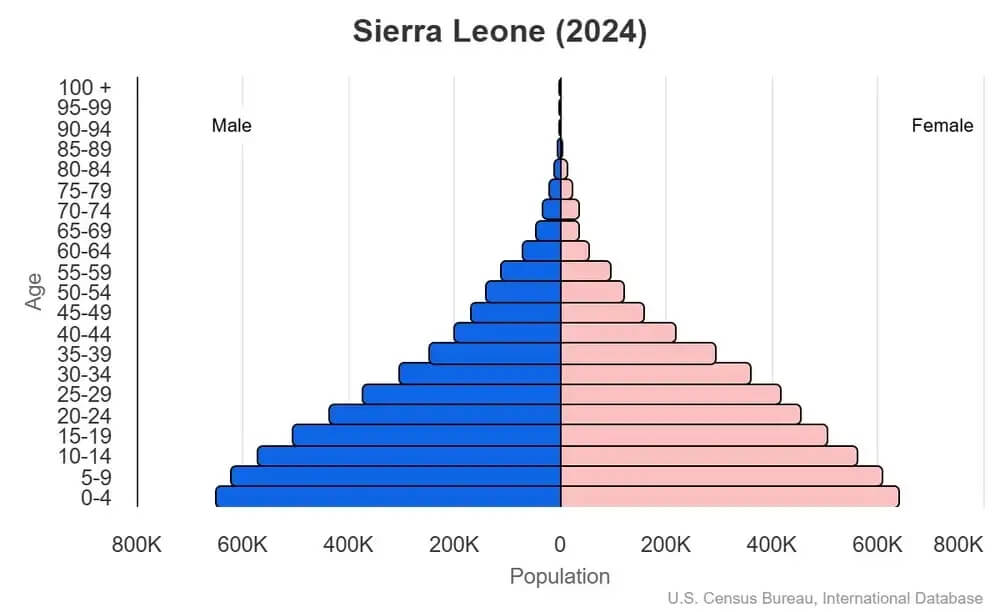
Total: 9,121,049 (2024 estimated)
Sierra Leone is home to a diverse population that reflects a rich tapestry of ethnic identities. The major ethnic groups include the Temne (35.4%), Mende (30.8%), Limba (8.8%), Kono (4.3%), and Korankoh (4%), among others. The Creole community, descendants of freed Jamaican slaves settled in the late 18th century, constitutes about 1.2% of the population and plays a unique role in the cultural landscape. The official language is English, although its regular use is limited to a literate minority. Mende and Temne serve as the principal vernaculars in the south and north, respectively, while Krio, an English-based Creole, is widely understood by approximately 95% of the population. The religious landscape is predominantly Muslim (77.1%), with Christians making up 22.9%. The population growth rate stands at 2.32% (2024 estimated), indicating a youthful demographic that presents both opportunities and challenges for the nation's development.
Government
Government type
Presidential republic
Capital
Name: Freetown
The government of Sierra Leone operates as a presidential republic, with the President serving as both the head of state and the head of government. Currently, President Julius Maada BIO has been in office since June 27, 2023. The capital city, Freetown, serves as the political and administrative center of the country. Diplomatic relations with the United States are represented by Ambassador Amara Sheikh Mohammed SOWA, who has been in position since July 24, 2025, while the U.S. is represented by Ambassador Bryan David HUNT since September 8, 2023. This structure reflects Sierra Leone's commitment to fostering international relations and engaging with the global community.
Economy
Economic overview
Sierra Leone's economy is classified as a low-income West African economy, heavily reliant on subsistence agriculture. The country has faced significant challenges, including the suspension of key iron and diamond mining activities, which are vital to its economic health. The slow recovery from the civil war of the 1990s has been compounded by systemic corruption, high-risk debt, and high youth unemployment rates. Despite these challenges, Sierra Leone is rich in natural resources, which, if managed effectively, could provide a pathway to economic growth and development.
Real GDP (purchasing power parity)
$26.728 billion (2024 estimated)
$25.7 billion (2023 estimated)
$24.312 billion (2022 estimated)
Real GDP per capita
$3,100 (2024 estimated)
$3,000 (2023 estimated)
$2,900 (2022 estimated)
Exports
$1.382 billion (2023 estimated)
$1.202 billion (2022 estimated)
$928.689 million (2021 estimated)
Exports - partners
China 67%, India 6%, Belgium 5%, Netherlands 4%, Ireland 3% (2023)
Exports - commodities
Iron ore, titanium ore, diamonds, aluminum ore, cocoa beans (2023)
Imports
$2.264 billion (2023 estimated)
$2.074 billion (2022 estimated)
$1.91 billion (2021 estimated)
Imports - partners
China 32%, India 15%, UAE 5%, USA 5%, Turkey 5% (2023)
Imports - commodities
Rice, plastic products, packaged medicine, cement, cars (2023)
Human Development Index
The country's Human Development Index (HDI) is 0.467, ranking it 185th out of 193 countries tested. (more information)
World Happiness Report
The World Happiness Report ranked the country 155th out of 158 countries tested with a score of 3.186. (more information)