World Book
Singapore
World Book Index
77

With a score of 77, the country is ranked 24th out of 158 countries in the World Book ranking. (more information)
Introduction
Singapore, a vibrant city-state located at the crossroads of global trade, has a rich history that dates back to the 14th century when it was known as Temasek, a Malay trading port. Over the centuries, the island witnessed various changes in control, ultimately leading to its destruction in the 17th century. The modern era of Singapore began in 1819 when the British established it as a trading colony, laying the foundation for its transformation into a global financial hub. After a brief period as part of the Malaysian Federation from 1963 to 1965, Singapore emerged as an independent nation, charting its own course towards prosperity and development.
Neighboring countries
Indonesia - Malaysia
Geography
Area
Total: 719 sq km
Land: 709.2 sq km
Water: 10 sq km
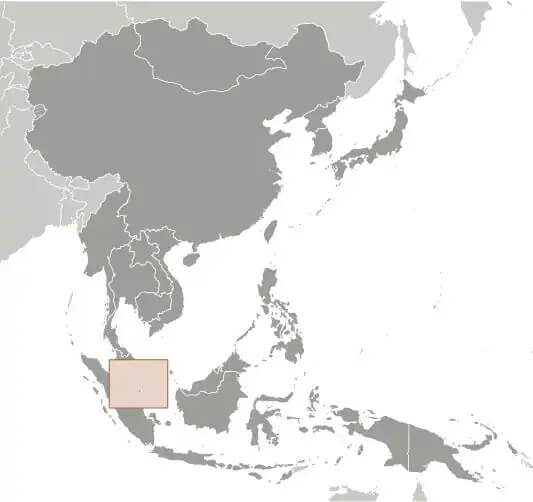
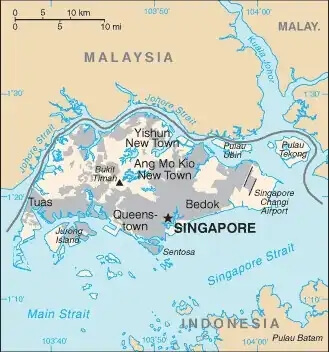
Singapore is a small island nation located at the southern tip of the Malay Peninsula, characterized by its strategic maritime position. The total area of 719 sq km comprises predominantly land, with only 10 sq km covered by water. The geography of Singapore is marked by a tropical climate, which is hot and humid throughout the year, with distinct monsoon seasons that bring heavy rainfall. The northeastern monsoon occurs from December to March, while the southwestern monsoon lasts from June to September, often resulting in frequent afternoon and early evening thunderstorms. The nation is endowed with natural resources such as fish and deepwater ports, which play a crucial role in its economy and trade.
People and Society
Population
Total: 6,028,459 (2024 estimated)
Ethnic groups
Chinese 74.2%, Malay 13.7%, Indian 8.9%, other 3.2% (2021 estimated)
Languages
English (official) 48.3%, Mandarin (official) 29.9%, other Chinese dialects (includes Hokkien, Cantonese, Teochew, Hakka) 8.7%, Malay (official) 9.2%, Tamil (official) 2.5%, other 1.4% (2020 estimated)
Religions
Buddhist 31.1%, Christian 18.9%, Muslim 15.6%, Taoist 8.8%, Hindu 5%, other 0.6%, none 20% (2020 estimated)
Population growth rate
0.87% (2024 estimated)
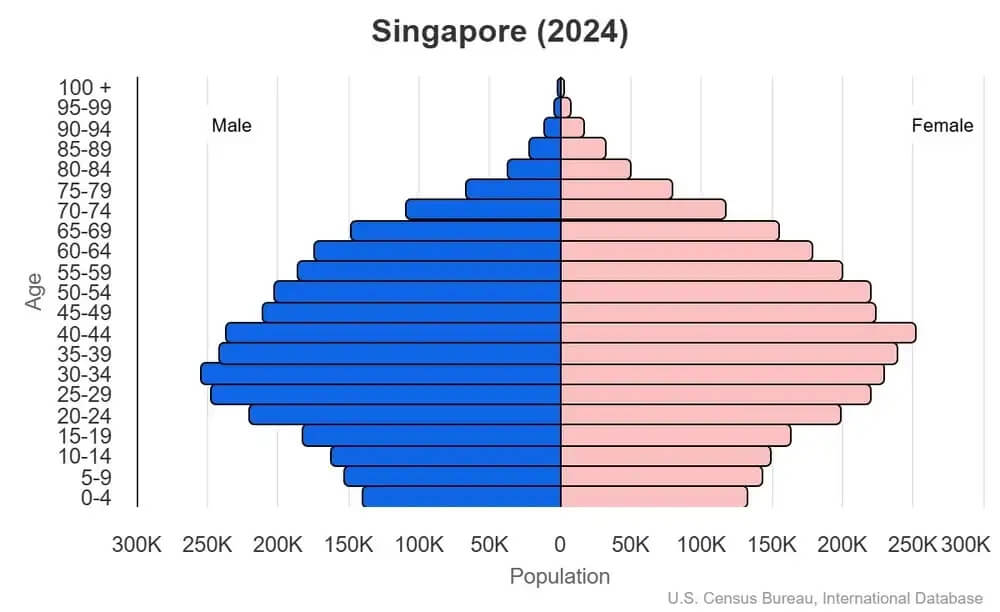
Singapore's population of approximately 6 million is a melting pot of cultures, primarily composed of ethnic Chinese (74.2%), followed by Malays (13.7%) and Indians (8.9%). This diverse demographic landscape is reflected in the country's multilingual society, where English serves as the official language, alongside Mandarin, Malay, and Tamil. The religious composition is equally varied, with Buddhism being the most practiced faith, followed by Christianity and Islam. The population growth rate of 0.87% indicates a stable demographic trend, although challenges such as an aging population and the need for social integration persist in this cosmopolitan society.
Government
Government type
Parliamentary republic
Capital
Name: Singapore
Executive branch
Chief of state: President THARMAN Shanmugaratnam (since 14 September 2023)
Head of government: Prime Minister Lawrence WONG (since 15 May 2024)
Diplomatic representation in the US
Chief of mission: Ambassador LUI Tuck Yew (since 30 June 2023)
Diplomatic representation from the US
Chief of mission: Ambassador (vacant); Chargé d’Affaires Graham MAYER (since August 2025)
Singapore operates as a parliamentary republic, with a political system that emphasizes democratic governance. The capital city, Singapore, serves as the political and administrative center of the nation. The executive branch is led by President THARMAN Shanmugaratnam, who has been in office since September 2023, and Prime Minister Lawrence WONG, who assumed office in May 2024. The country maintains active diplomatic relations, including representation in the United States, where Ambassador LUI Tuck Yew has been serving since mid-2023, while the U.S. diplomatic mission is currently led by Chargé d’Affaires Graham MAYER.
Economy
Economic overview
High-income, service-based economy; global financial hub; business-friendly policies and open to investment and trade; inflation easing but persistent in services; public investments in education, healthcare, and infrastructure; strong human capital development challenged by aging population.
Real GDP (purchasing power parity)
$800.304 billion (2024 estimated)
$766.662 billion (2023 estimated)
$752.948 billion (2022 estimated)
Real GDP per capita
$132,600 (2024 estimated)
$129,600 (2023 estimated)
$133,600 (2022 estimated)
Exports
$978.597 billion (2024 estimated)
$917.683 billion (2023 estimated)
$947.355 billion (2022 estimated)
Exports - partners
Hong Kong 13%, China 11%, USA 10%, Malaysia 9%, S. Korea 6% (2023)
Exports - commodities
Integrated circuits, refined petroleum, machinery, vaccines, gold (2023)
Imports
$786.02 billion (2024 estimated)
$728.5 billion (2023 estimated)
$744.364 billion (2022 estimated)
Imports - partners
China 15%, Malaysia 11%, Taiwan 11%, USA 10%, S. Korea 6% (2023)
Imports - commodities
Integrated circuits, refined petroleum, crude petroleum, gold, gas turbines (2023)
Human Development Index
The country's Human Development Index (HDI) is 0.946, ranking it 13th out of 193 countries tested. (more information)
World Happiness Report
The World Happiness Report ranked the country 56th out of 158 countries tested with a score of 6.048. (more information)