World Book
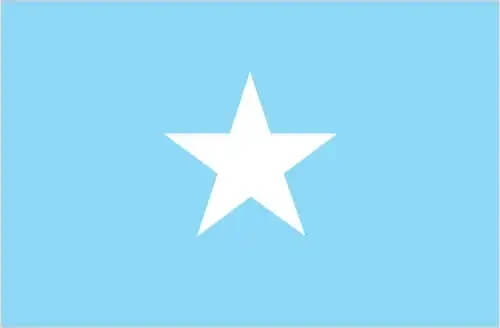
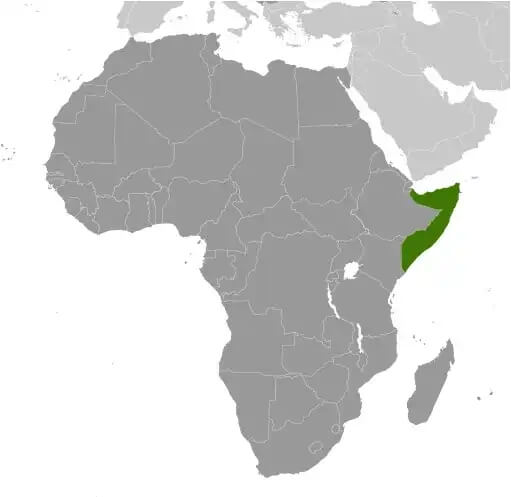
Somalia
World Book Index
41

With a score of 41, the country is ranked 151st out of 158 countries in the World Book ranking. (more information)
Introduction
The historical narrative of Somalia is marked by a complex tapestry of colonial influences and post-colonial struggles. In the late 19th century, the region was divided between British and Italian colonial powers, laying the groundwork for future national identity. The unification of these territories in 1960 marked the birth of Somalia as an independent nation. However, the subsequent decades have been marred by civil war and political fragmentation, leading to the emergence of various regional administrations. The rise of the terrorist group al-Shabaab has further complicated the socio-political landscape, as it exerts control over significant portions of the country, challenging the central government's authority and stability.
Neighboring countries
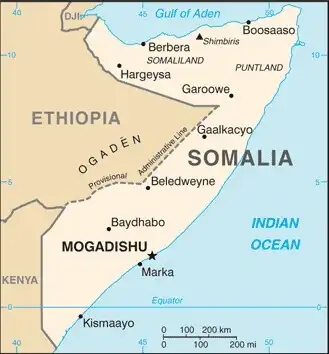
Djibouti - Ethiopia - Kenya
Geography
Area
Total: 637,657 sq km
Land: 627,337 sq km
Water: 10,320 sq km
Somalia is strategically located on the Horn of Africa, bordered by the Indian Ocean to the east, which provides it with a long coastline that is vital for trade and fishing. The country's geography is characterized by a predominantly arid climate, with the majority of its landmass consisting of flat plains and plateaus. The climate is primarily desert, with the northeast monsoon occurring from December to February, bringing moderate temperatures to the northern regions, while the southern areas experience hotter conditions. The southwest monsoon, from May to October, results in torrid weather in the north and hot conditions in the south, with rainfall being irregular. Somalia is endowed with natural resources, including uranium and largely unexploited reserves of iron ore, tin, gypsum, bauxite, copper, salt, natural gas, and potential oil reserves, which remain largely untapped due to ongoing instability.
People and Society
Population
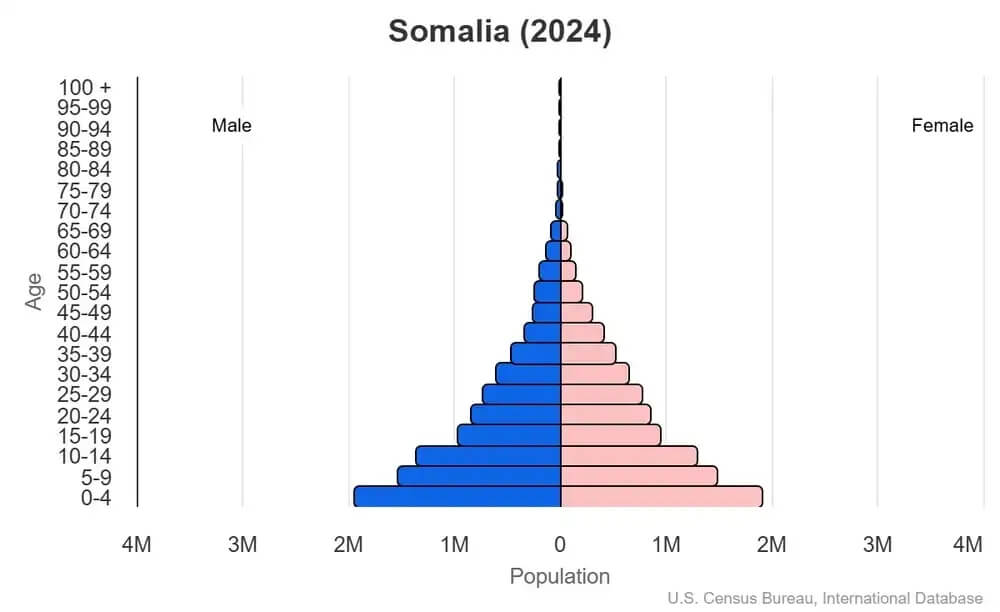
Total: 13,017,273 (2024 estimated)
Ethnic groups
Predominantly Somali with lesser numbers of Arabs, Bantus, and others
Languages
Somali (official), Arabic (official), Italian, English
Religions
Muslim 99.9% (Sunni Muslim 98.1%, Shia Muslim 1.2%, Islamic schismatic 0.6%), ethnic religionist 0.1% (2020 estimated)
Population growth rate
2.55% (2024 estimated)
Somalia's population is predominantly Somali, with a rich cultural heritage that reflects a blend of various influences, including Arab and Bantu communities. The official languages, Somali and Arabic, highlight the country's Islamic identity and historical ties to the Arab world. The overwhelming majority of the population practices Islam, with Sunni Muslims constituting the vast majority. The population growth rate of 2.55% indicates a youthful demographic, which presents both opportunities and challenges for the nation in terms of education, employment, and social services. The societal fabric is deeply influenced by clan affiliations, which play a significant role in social organization and political dynamics.
Government
Government type
Federal parliamentary republic
Capital
Name: Mogadishu
Executive branch
Chief of state: President HASSAN SHEIKH Mohamud (since 23 May 2022)
Head of government: Prime Minister Hamza Abdi BARRE (since 25 June 2022)
Diplomatic representation in the US
Chief of mission: Ambassador DAHIR Hassan Abdi (since 18 September 2024)
Diplomatic representation from the US
Chief of mission: Ambassador Richard H. RILEY (since 20 June 2024)
Somalia operates as a federal parliamentary republic, where the President serves as the head of state and the Prime Minister acts as the head of government. The capital, Mogadishu, is the political and administrative center of the country. The current leadership, under President HASSAN SHEIKH Mohamud and Prime Minister Hamza Abdi BARRE, has been tasked with navigating the complexities of governance amidst ongoing challenges, including security threats from extremist groups and the need for national reconciliation. The diplomatic landscape is also evolving, with Somalia seeking to strengthen its international relations, particularly with the United States, as evidenced by the recent appointments of ambassadors.
Economy
Economic overview
Somalia's economy is classified as a low-income economy within the African Horn, severely impacted by three decades of conflict and instability that have stunted its economic potential. The reliance on remittances from the Somali diaspora has become a crucial lifeline for many households, providing essential support for basic survival. In recent years, the government has adopted a new fiscal federalism approach aimed at stabilizing the economy and addressing unsustainable debt levels. The country faces significant environmental challenges, which complicate development efforts. However, there are ongoing initiatives focused on digitally driven urbanization, which aim to harness technology for economic growth and infrastructure development.
Real GDP (purchasing power parity)
$26.77 billion (2024 estimated)
$25.747 billion (2023 estimated)
$24.706 billion (2022 estimated)
Real GDP per capita
$1,400 (2024 estimated)
$1,400 (2023 estimated)
$1,400 (2022 estimated)
Exports
$2.424 billion (2024 estimated)
$2.164 billion (2023 estimated)
$1.804 billion (2022 estimated)
Exports - partners
UAE 35%, Saudi Arabia 27%, Oman 18%, Djibouti 8%, India 3% (2023)
Exports - commodities
Sheep and goats, gold, postage stamps/documents, other animals, cattle (2023)
Imports
$9.002 billion (2024 estimated)
$8.002 billion (2023 estimated)
$7.456 billion (2022 estimated)
Imports - partners
UAE 29%, China 19%, India 15%, Turkey 8%, Oman 5% (2023)
Imports - commodities
Raw sugar, tobacco, broadcasting equipment, rice, milk (2023)
Human Development Index
The country's Human Development Index (HDI) is 0.404, ranking it 192nd out of 193 countries tested. (more information)
World Happiness Report
The World Happiness Report ranked the country 125th out of 158 countries tested with a score of 4.347. (more information)