World Book
Sri Lanka
World Book Index
59

With a score of 59, the country is ranked 103th out of 158 countries in the World Book ranking. (more information)
Introduction
Sri Lanka, an island nation located in the Indian Ocean, boasts a rich tapestry of history and culture. The first Sinhalese are believed to have arrived in Sri Lanka in the late 6th century B.C., likely migrating from northern India. Over the centuries, the island has witnessed the rise and fall of various kingdoms, each contributing to its diverse heritage. The British colonized Sri Lanka in 1796, establishing it as a crown colony by 1802, and formally uniting it under British rule by 1815. After a long struggle for independence, Sri Lanka emerged as a sovereign nation in 1948, adopting the name Sri Lanka in 1972, which reflects its cultural identity and historical significance.
Neighboring countries
India - Maldives
Geography
Area
Total: 65,610 sq km
Land: 64,630 sq km
Water: 980 sq km
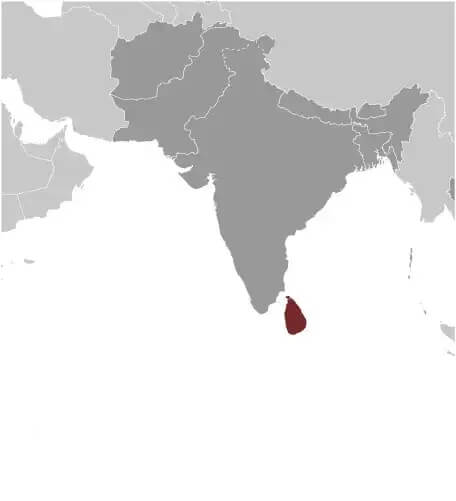
Sri Lanka is an island nation situated off the southeastern coast of India, characterized by its diverse landscapes that range from lush forests and rolling hills to pristine beaches. The total area of the country is 65,610 square kilometers, with land covering 64,630 square kilometers and water bodies accounting for 980 square kilometers. The island's geography is influenced by its tropical monsoon climate, which features two main monsoon seasons: the northeast monsoon from December to March and the southwest monsoon from June to October. This climatic diversity supports a rich array of natural resources, including limestone, graphite, mineral sands, gems, phosphates, clay, hydropower, and arable land, making Sri Lanka a country of significant ecological and economic potential.
People and Society
Population
Total: 21,982,608 (2024 estimated)
Ethnic groups
Sinhalese 74.9%, Sri Lankan Tamil 11.2%, Sri Lankan Moors 9.2%, Indian Tamil 4.2%, other 0.5% (2012 estimated)
Languages
Sinhala (official) 87%, Tamil (official) 28.5%, English 23.8% (2012 estimated)
Religions
Buddhist (official) 70.2%, Hindu 12.6%, Muslim 9.7%, Roman Catholic 6.1%, other Christian 1.3%, other 0.05% (2012 estimated)
Population growth rate
0.39% (2024 estimated)
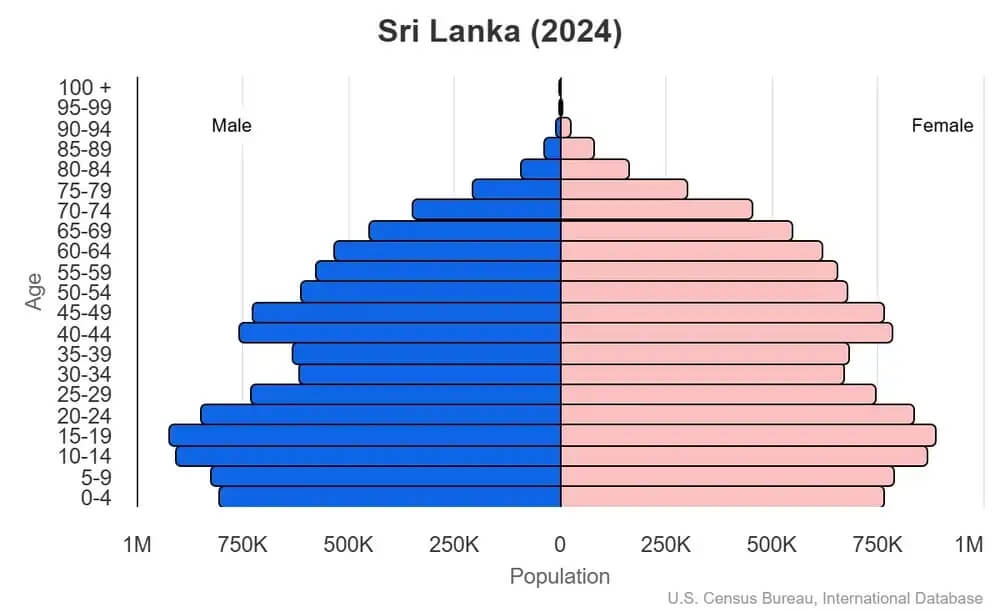
Sri Lanka's population is estimated at 21,982,608 in 2024, reflecting a diverse demographic landscape. The Sinhalese constitute the majority at 74.9%, followed by significant minorities including Sri Lankan Tamils at 11.2% and Sri Lankan Moors at 9.2%. The linguistic landscape is equally diverse, with Sinhala being the official language spoken by 87% of the population, while Tamil is also recognized officially, spoken by 28.5%. English serves as a vital secondary language, utilized by 23.8% of the population, particularly in urban areas and for business. The religious composition is predominantly Buddhist, accounting for 70.2% of the population, with Hinduism, Islam, and Christianity also represented. The population growth rate stands at 0.39%, indicating a gradual increase, which presents both opportunities and challenges for the nation in terms of resource management and social services.
Government
Government type
Presidential republic
Capital
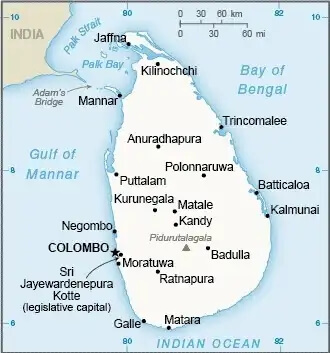
Name: Colombo (commercial capital); Sri Jayewardenepura Kotte (legislative capital)
Executive branch
Chief of state: President Anura Kumara DISSANAYAKE (since 23 September 2024)
Head of government: Prime Minister Harini AMARASURIYA (since 24 September 2024)
Diplomatic representation in the US
Chief of mission: Ambassador Mahinda SAMARASINGHE (since 13 January 2022)
Diplomatic representation from the US
Chief of mission: Ambassador Julie J. CHUNG (since 17 February 2022)
Sri Lanka operates as a presidential republic, where the President serves as both the head of state and the head of government. The capital city of Colombo functions as the commercial hub, while Sri Jayewardenepura Kotte serves as the legislative capital. The current President, Anura Kumara Dissanayake, has been in office since September 23, 2024, and leads the executive branch alongside Prime Minister Harini Amarasuriya, who took office on September 24, 2024. The country maintains diplomatic relations with various nations, including the United States, represented by Ambassador Mahinda Samarasinghe since January 13, 2022, and Ambassador Julie J. Chung from the US since February 17, 2022.
Economy
Economic overview
Economic contraction in 2022-23 marked by increased poverty and significant inflation; IMF two-year debt relief program following 2022 sovereign default; structural challenges from non-diversified economy and rigid labor laws; heavy dependence on tourism receipts and remittances
Real GDP (purchasing power parity)
$301.407 billion (2024 estimated)
$287.031 billion (2023 estimated)
$293.878 billion (2022 estimated)
Real GDP per capita
$13,800 (2024 estimated)
$13,000 (2023 estimated)
$13,200 (2022 estimated)
Exports
$17.327 billion (2023 estimated)
$16.169 billion (2022 estimated)
$14.974 billion (2021 estimated)
Exports - partners
USA 22%, India 7%, Germany 7%, UK 7%, Italy 5% (2023)
Exports - commodities
Garments, tea, precious stones, used rubber tires, rubber products (2023)
Imports
$18.823 billion (2023 estimated)
$19.244 billion (2022 estimated)
$21.526 billion (2021 estimated)
Imports - partners
India 21%, China 19%, UAE 10%, Singapore 5%, Malaysia 4% (2023)
Imports - commodities
Refined petroleum, fabric, crude petroleum, packaged medicine, cotton fabric (2023)
The economy of Sri Lanka has faced significant challenges in recent years, particularly during the economic contraction of 2022-23, which was characterized by rising poverty levels and substantial inflation. In response to a sovereign default in 2022, the International Monetary Fund (IMF) initiated a two-year debt relief program aimed at stabilizing the economy. Structural issues persist, including a non-diversified economic base and rigid labor laws that hinder growth. The country heavily relies on tourism receipts and remittances, which are critical for its economic stability. As of 2024, Sri Lanka's real GDP (purchasing power parity) is estimated at $301.407 billion, with a real GDP per capita of $13,800. The export sector, valued at $17.327 billion in 2023, is primarily driven by garments, tea, and precious stones, while imports, totaling $18.823 billion, are dominated by refined petroleum and fabric. The trade partnerships reveal a strong reliance on countries like the USA, India, and China, underscoring the interconnectedness of Sri Lanka's economy with global markets.
Human Development Index
The country's Human Development Index (HDI) is 0.776, ranking it 89th out of 193 countries tested. (more information)
World Happiness Report
The World Happiness Report ranked the country 132nd out of 158 countries tested with a score of 4.214. (more information)