World Book
Cambodia
World Book Index
52

With a score of 52, the country is ranked 121st out of 158 countries in the World Book ranking. (more information)
Introduction
Cambodia, a nation steeped in rich history and culture, is predominantly inhabited by the Khmer people, who proudly trace their lineage back to the illustrious Angkor Empire. This empire, which flourished from the 10th to the 13th centuries, left an indelible mark on Southeast Asia, influencing art, architecture, and governance. Following a tumultuous period during World War II, marked by Japanese occupation, Cambodia emerged as an independent nation in 1953, reclaiming its sovereignty from French colonial rule. Today, the country stands as a testament to resilience and cultural revival, navigating the complexities of modernity while honoring its storied past.
Neighboring countries
Laos - Thailand - Vietnam
Geography
Area
Total: 181,035 sq km
Land: 176,515 sq km
Water: 4,520 sq km
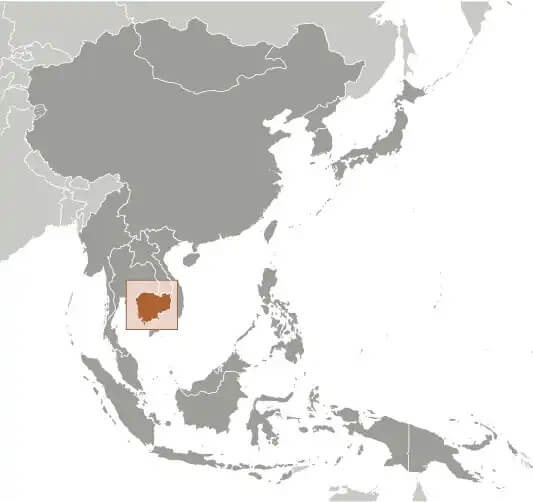
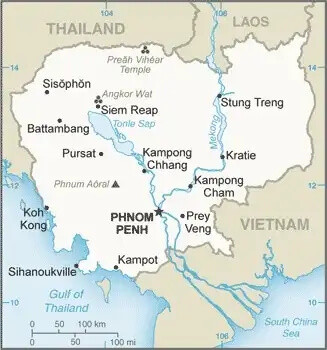
Cambodia is located in the heart of Southeast Asia, bordered by Thailand to the northwest, Laos to the north, and Vietnam to the east and south. The country's geography is characterized by a diverse landscape that includes the Mekong River, which flows through the nation, and the Tonle Sap Lake, a vital resource for fishing and agriculture. The climate is predominantly tropical, with a distinct monsoon season from May to November, followed by a dry season from December to April. This climatic variation supports a rich biodiversity and a variety of natural resources, including oil and gas, timber, and minerals, which are crucial for the country's economic development.
People and Society
Population
Total: 17,063,669 (2024 estimated)
Ethnic groups
Khmer 95.4%, Cham 2.4%, Chinese 1.5%, other 0.7% (2019-20 estimated)
Languages
Khmer (official) 95.8%, minority languages 2.9%, Chinese 0.6%, Vietnamese 0.5%, other 0.2% (2019 estimated)
Religions
Buddhist (official) 97.1%, Muslim 2%, Christian 0.3%, other 0.5% (2019 estimated)
Population growth rate
0.99% (2024 estimated)
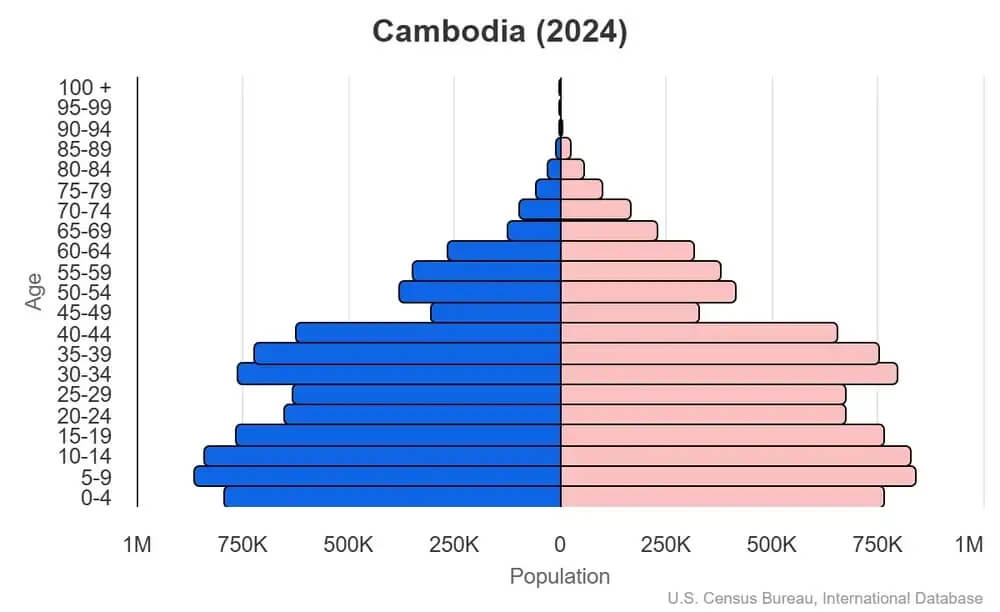
Cambodia's population reflects a rich tapestry of ethnic diversity, with the Khmer majority comprising 95.4% of the population. The Cham and Chinese communities, though smaller, contribute to the cultural mosaic of the nation. Khmer is the official language, spoken by the vast majority, while various minority languages also enrich the linguistic landscape. Buddhism is the predominant religion, deeply influencing the cultural and social norms of Cambodian society. The population growth rate of 0.99% indicates a steady increase, suggesting a youthful demographic that could play a pivotal role in the country's future development.
Government
Government type
Parliamentary constitutional monarchy
Capital
Name: Phnom Penh
Executive branch
Chief of state: King Norodom SIHAMONI (since 29 October 2004)
Head of government: Prime Minister HUN MANET (since 22 August 2023)
Diplomatic representation in the US
Chief of mission: Ambassador Koy KUONG (since 11 June 2025)
Diplomatic representation from the US
Chief of mission: Ambassador (vacant); Chargé d’Affaires Bridgette L. WALKER (since August 2024)
Cambodia operates as a parliamentary constitutional monarchy, where the King serves as the ceremonial head of state while the Prime Minister holds executive power. The capital city, Phnom Penh, is the political and economic heart of the nation. The current monarch, King Norodom SIHAMONI, has been in power since 2004, while Prime Minister HUN MANET has been leading the government since August 2023. This political structure allows for a blend of traditional monarchy and modern governance, reflecting the country's historical legacy and contemporary aspirations.
Economy
Economic overview
Cambodia is recognized as one of the fastest-growing economies in the region, driven primarily by tourism and clothing exports. The manufacturing and construction sectors have also seen substantial growth, contributing significantly to the national GDP. However, the economy faced challenges due to the COVID-19 pandemic, which led to declines in various sectors and the suspension of EU market preferential access. Despite these setbacks, Cambodia has made remarkable strides in reducing poverty, although rural areas continue to experience disproportionate levels of poverty compared to urban centers.
Real GDP (purchasing power parity)
$123.676 billion (2024 estimated)
$116.658 billion (2023 estimated)
$111.095 billion (2022 estimated)
Real GDP per capita
$7,000 (2024 estimated)
$6,700 (2023 estimated)
$6,500 (2022 estimated)
Exports
$31.712 billion (2024 estimated)
$27.753 billion (2023 estimated)
$25.497 billion (2022 estimated)
Exports - partners
USA 36%, Germany 6%, China 6%, Japan 6%, Thailand 5% (2023)
Exports - commodities
Garments, semiconductors, trunks and cases, footwear, gold (2023)
Imports
$34.329 billion (2024 estimated)
$29.421 billion (2023 estimated)
$34.759 billion (2022 estimated)
Imports - partners
China 39%, Thailand 20%, Vietnam 12%, Singapore 6%, Indonesia 3% (2023)
Imports - commodities
Refined petroleum, fabric, gold, plastic products, synthetic fabric (2023)
Human Development Index
The country's Human Development Index (HDI) is 0.606, ranking it 151st out of 193 countries tested. (more information)
World Happiness Report
The World Happiness Report ranked the country 120th out of 158 countries tested with a score of 4.47. (more information)