World Book
Thailand
World Book Index
71

With a score of 71, the country is ranked 57th out of 158 countries in the World Book ranking. (more information)
Introduction
Thailand, known for its rich cultural heritage and stunning landscapes, has a history that dates back to the establishment of a unified Thai kingdom in the mid-13th century. The country transitioned to a constitutional monarchy following a bloodless revolution in 1932, marking a significant shift in its governance. Since 2005, Thailand has faced a series of political challenges, including a military coup in 2006 and widespread street protests in 2008, 2009, 2010, 2014, and 2020, reflecting the dynamic and often tumultuous nature of its political landscape.
Neighboring countries
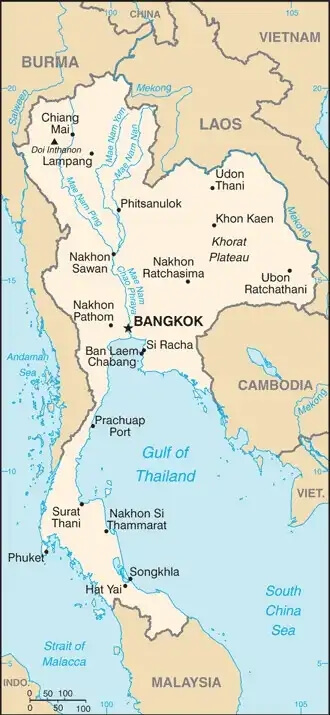
Burma - Cambodia - Laos - Malaysia
Geography
Area
Total: 513,120 sq km
Land: 510,890 sq km
Water: 2,230 sq km
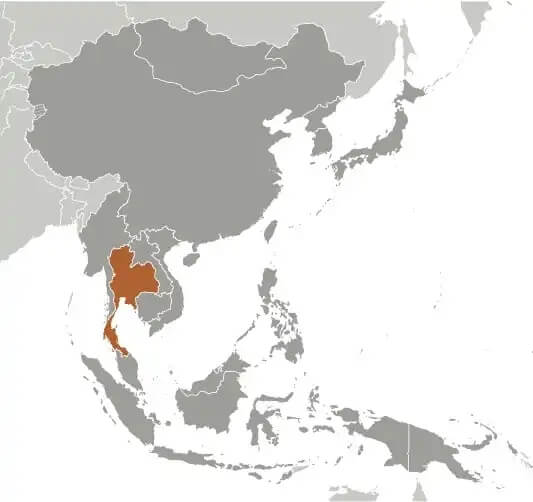
Thailand is located in the heart of Southeast Asia, bordered by several countries that contribute to its diverse cultural and geographical landscape. The country's climate is predominantly tropical, characterized by a rainy, warm, and cloudy southwest monsoon from mid-May to September, followed by a dry and cool northeast monsoon from November to mid-March. The southern isthmus remains hot and humid throughout the year. Thailand is endowed with a variety of natural resources, including tin, rubber, natural gas, tungsten, tantalum, timber, lead, fish, gypsum, lignite, fluorite, and arable land, which play a crucial role in its economy and development.
People and Society
Population
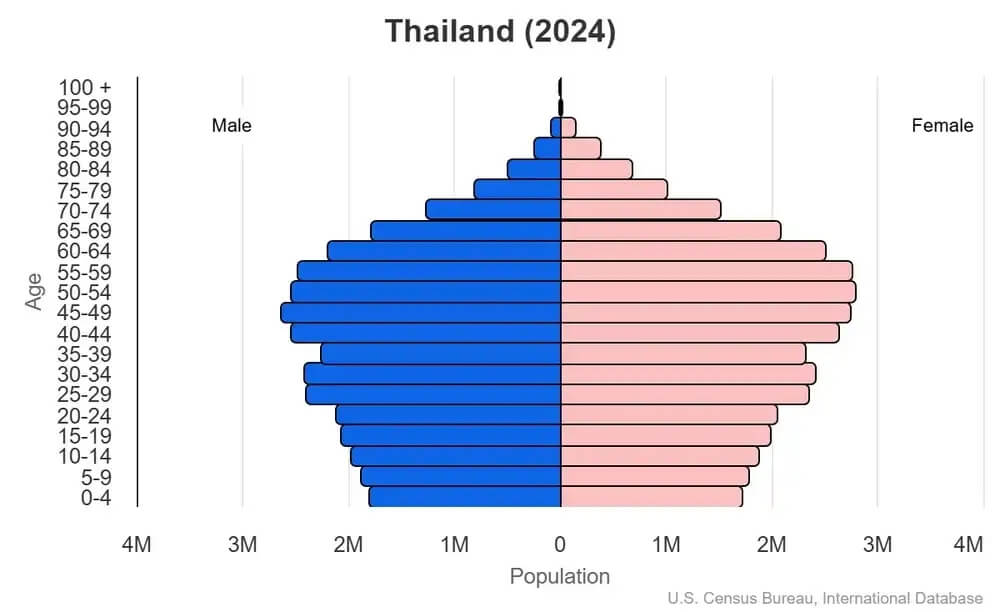
Total: 69,920,998 (2024 estimated)
Ethnic groups
Thai 97.5%, Burmese 1.3%, other 1.1%, unspecified <0.1% (2015 estimated)
Languages
Thai (official) only 90.7%, Thai and other languages 6.4%, only other languages 2.9% (includes Malay, Burmese); English is a secondary language among the elite (2010 estimated)
Religions
Buddhist 92.5%, Muslim 5.4%, Christian 1.2%, other 0.9% (includes animist, Confucian, Hindu, Jewish, Sikh, and Taoist) (2021 estimated)
Population growth rate
0.17% (2024 estimated)
Thailand's population is predominantly Thai, comprising 97.5% of the total demographic, with a small percentage of Burmese and other ethnic groups. The official language is Thai, spoken by the vast majority, while English serves as a secondary language primarily among the educated elite. The country is predominantly Buddhist, with 92.5% of the population adhering to this faith, followed by a significant Muslim minority. The population growth rate remains modest at 0.17%, indicating a stable demographic trend. This demographic composition reflects a rich tapestry of cultural influences, contributing to Thailand's unique identity and social dynamics.
Government
Government type
Constitutional monarchy
Capital
Name: Bangkok
Executive branch
Chief of state: King WACHIRALONGKON; also spelled Vajiralongkorn (since 1 December 2016)
Head of government: Prime Minister ANUTIN Charnvirakul (since 5 Sep 2025)
Diplomatic representation in the US
Chief of mission: Ambassador Dr. SURIYA Chindawongse (since 17 June 2024)
Diplomatic representation from the US
Chief of mission: Ambassador Robert F. GODEC (since 7 October 2022)
Thailand operates under a constitutional monarchy, where the King serves as the head of state while the Prime Minister is the head of government. The capital city, Bangkok, is the political and economic center of the country. The current monarch, King WACHIRALONGKON, has been in power since December 2016, while Prime Minister ANUTIN Charnvirakul has been leading the government since September 2025. Thailand maintains diplomatic relations with various countries, including the United States, where it is represented by Ambassador Dr. SURIYA Chindawongse.
Economy
Economic overview
Upper middle-income Southeast Asian economy; substantial infrastructure; major electronics, food, and automobile parts exporter; globally used currency; extremely low unemployment, even amid COVID-19; ongoing Thailand 4.0 economic development
Real GDP (purchasing power parity)
$1.558 trillion (2024 estimated)
$1.519 trillion (2023 estimated)
$1.489 trillion (2022 estimated)
Real GDP per capita
$21,700 (2024 estimated)
$21,200 (2023 estimated)
$20,800 (2022 estimated)
Exports
$369.191 billion (2024 estimated)
$337.45 billion (2023 estimated)
$324.111 billion (2022 estimated)
Exports - partners
USA 18%, China 13%, Japan 7%, Australia 4%, Singapore 4% (2023)
Exports - commodities
Machine parts, integrated circuits, trucks, cars, broadcasting equipment (2023)
Imports
$351.419 billion (2024 estimated)
$327.008 billion (2023 estimated)
$334.44 billion (2022 estimated)
Imports - partners
China 26%, Japan 11%, USA 7%, UAE 6%, Taiwan 5% (2023)
Imports - commodities
Crude petroleum, integrated circuits, natural gas, gold, vehicle parts/accessories (2023)
Thailand's economy is classified as an upper middle-income economy, characterized by substantial infrastructure and a diverse industrial base. The country is a significant exporter of electronics, food products, and automobile parts, contributing to its robust economic standing in the region. The real GDP, measured in purchasing power parity, is projected to reach $1.558 trillion in 2024, with a per capita GDP of $21,700. Exports are expected to total $369.191 billion, with the United States, China, and Japan being the primary trading partners. Conversely, imports are projected at $351.419 billion, with China being the largest source of imported goods. The economy has shown resilience, maintaining extremely low unemployment rates even during the challenges posed by the COVID-19 pandemic, and is currently undergoing the Thailand 4.0 economic development initiative aimed at enhancing innovation and technology in various sectors.
Human Development Index
The country's Human Development Index (HDI) is 0.798 , ranking it 76th out of 193 countries tested. (more information)
World Happiness Report
The World Happiness Report ranked the country 45th out of 158 countries tested with a score of 6.272. (more information)