World Book
Latvia
World Book Index
77

With a score of 77, the country is ranked 28th out of 158 countries in the World Book ranking. (more information)
Introduction
Latvia, a nation with a rich tapestry of history and culture, has evolved significantly since the medieval era when various eastern Baltic tribes coalesced to form its ethnic foundation. Over centuries, the region experienced a series of foreign dominations, including those by Germans, Poles, Swedes, and Russians, each leaving an indelible mark on its cultural landscape. The pivotal moment came in 1991 when Latvia regained its independence following the dissolution of the Soviet Union, marking a new chapter in its national identity and governance.
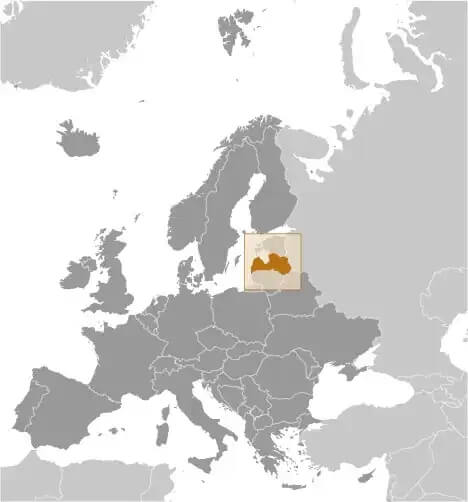
Neighboring countries
Belarus - Estonia - Lithuania - Russia
Geography
Area
Total: 64,589 sq km
Land: 62,249 sq km
Water: 2,340 sq km
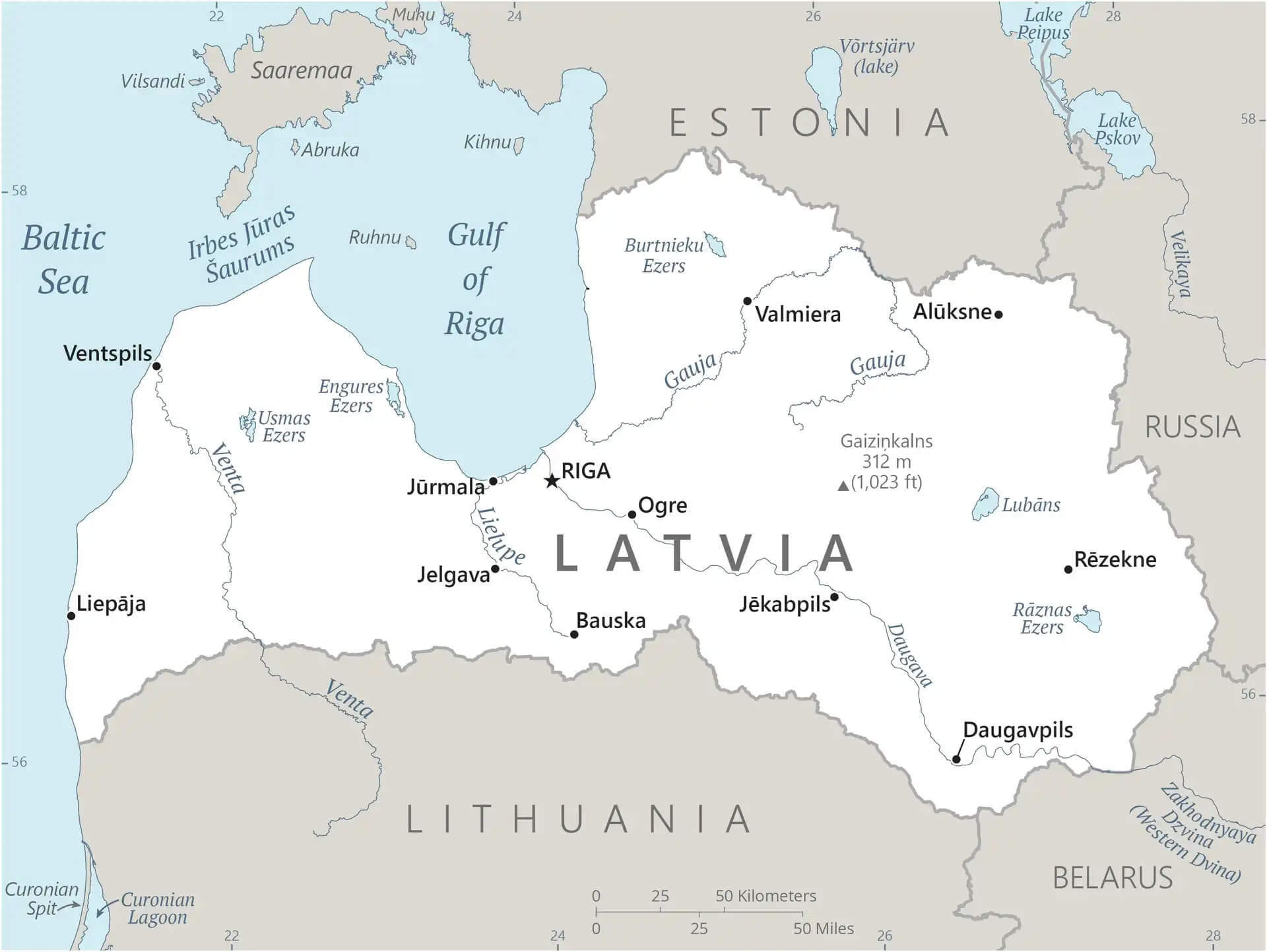
Latvia is characterized by its diverse geography, which includes a mix of flat plains, rolling hills, and a long coastline along the Baltic Sea. The country's climate is maritime, featuring wet conditions and moderate winters that influence both its natural ecosystems and agricultural practices. Latvia is endowed with a variety of natural resources, including peat, limestone, dolomite, amber, hydropower, timber, and arable land, which play a crucial role in its economy and environmental sustainability.
People and Society
Population
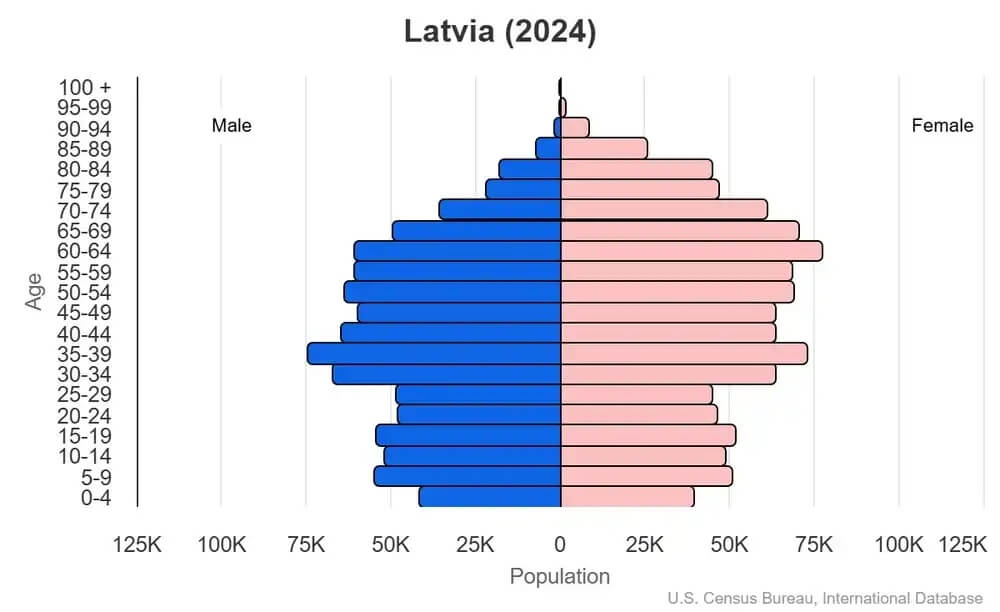
Total: 1,801,246 (2024 estimated)
Ethnic groups
Latvian 62.7%, Russian 24.5%, Belarusian 3.1%, Ukrainian 2.2%, Polish 2%, Lithuanian 1.1%, other 1.8%, unspecified 2.6% (2021 estimated)
Languages
Latvian (official) 56.3%, Russian 33.8%, other 0.6% (includes Polish, Ukrainian, and Belarusian), unspecified 9.4% (2011 estimated)
Religions
Lutheran 36.2%, Roman Catholic 19.5%, Orthodox 19.1%, other Christian 1.6%, other 0.1%, unspecified/none 23.5% (2017 estimated)
Population growth rate
-1.14% (2024 estimated)
Latvia's population reflects a complex demographic landscape, with a significant proportion of ethnic Latvians alongside notable Russian and Belarusian communities. The linguistic diversity is evident, with Latvian as the official language, while Russian holds a substantial presence. The religious composition is predominantly Lutheran, with a considerable number of Roman Catholics and Orthodox Christians. However, the country faces demographic challenges, including a declining population growth rate, which raises concerns about future workforce sustainability and social cohesion.
Government
Government type
Parliamentary republic
Capital
Name: Riga
Executive branch
Chief of state: President Edgars RINKEVICS (since 8 July 2023)
Head of government: Prime Minister Evika SILINA (since 15 September 2023)
Diplomatic representation in the US
Chief of mission: Ambassador Elita KUZMA (since 18 September 2024)
Diplomatic representation from the US
Chief of mission: Ambassador Christopher ROBINSON (since 21 February 2023)
Latvia operates as a parliamentary republic, where the government is characterized by a separation of powers among the executive, legislative, and judicial branches. The capital city, Riga, serves as the political and cultural heart of the nation. The current leadership, under President Edgars RINKEVICS and Prime Minister Evika SILINA, reflects a commitment to democratic governance and active participation in international diplomacy, particularly with the United States.
Economy
Economic overview
Latvia is classified as a high-income member of the EU and eurozone, currently navigating a weak recovery following a period of economic contraction. The economy is experiencing a slight increase in private consumption, although the trade environment remains uncertain. Key challenges include a shortage of skilled labor, limited access to capital markets, a large informal sector, and the need for transitions towards greener and more digital economies.
Real GDP (purchasing power parity)
$72.516 billion (2024 estimated)
$72.838 billion (2023 estimated)
$70.817 billion (2022 estimated)
Real GDP per capita
$38,900 (2024 estimated)
$38,800 (2023 estimated)
$37,700 (2022 estimated)
Exports
$28.117 billion (2024 estimated)
$28.294 billion (2023 estimated)
$29.364 billion (2022 estimated)
Exports - partners
Lithuania 19%, Estonia 6%, Russia 6%, Germany 6%, Sweden 5% (2023)
Exports - commodities
Wood, wheat, broadcasting equipment, packaged medicine, natural gas (2023)
Imports
$29.234 billion (2024 estimated)
$29.875 billion (2023 estimated)
$31.206 billion (2022 estimated)
Imports - partners
Lithuania 18%, Germany 11%, Poland 10%, Estonia 8%, Finland 5% (2023)
Imports - commodities
Refined petroleum, cars, packaged medicine, broadcasting equipment, natural gas (2023)
Human Development Index
The country's Human Development Index (HDI) is 0.889, ranking it 41st out of 193 countries tested. (more information)
World Happiness Report
The World Happiness Report ranked the country 30th out of 158 countries tested with a score of 6.523. (more information)